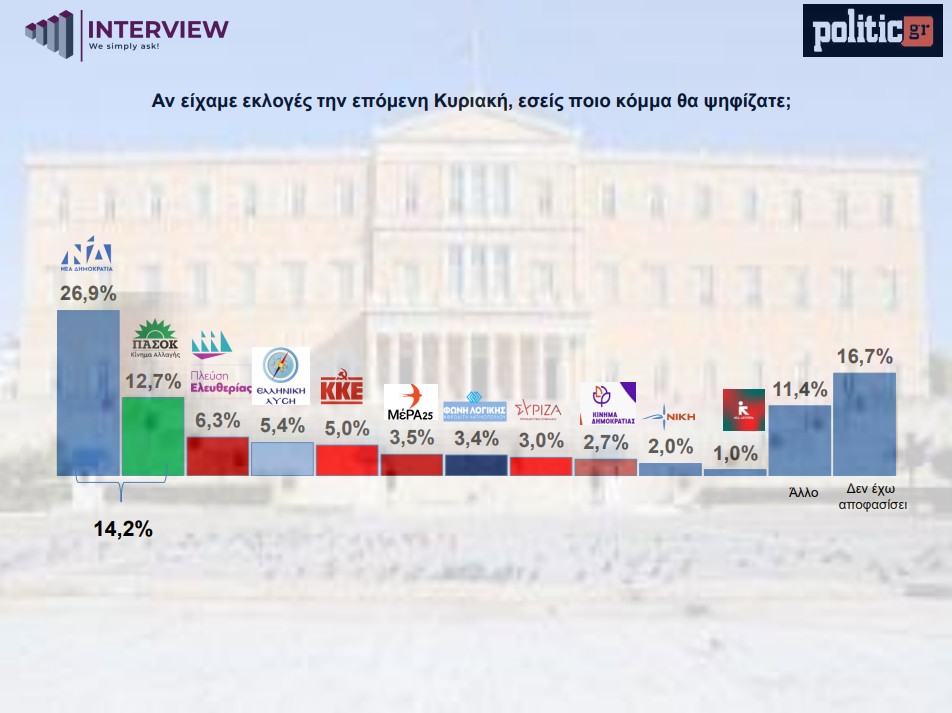
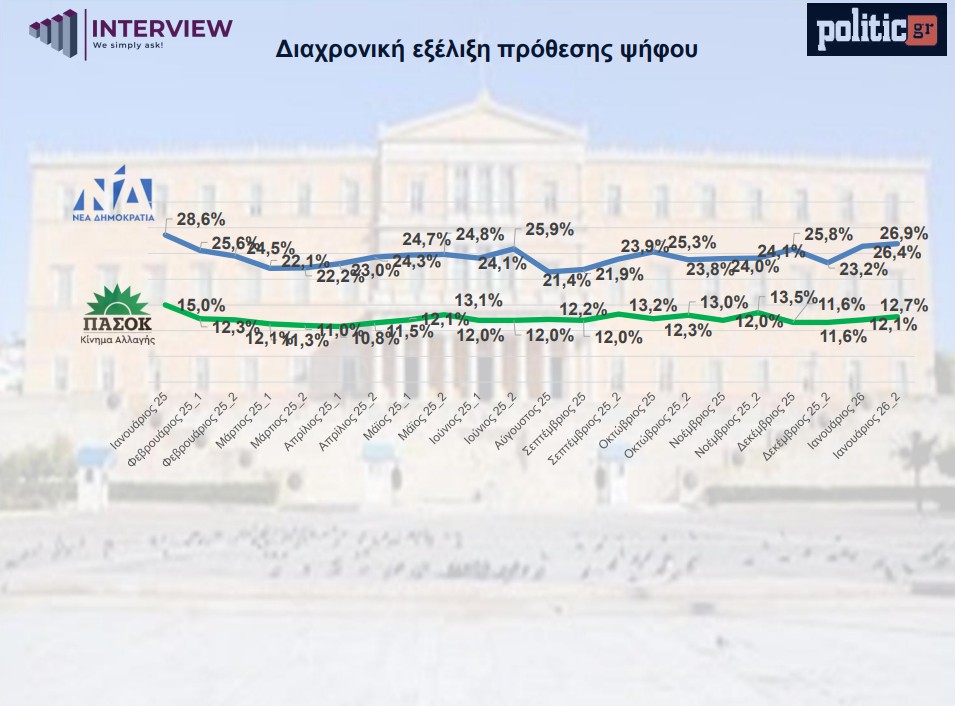
New Democracy remains firmly in first place with more than double PASOK’s percentage, according to an Interview poll for Politic.gr. The “blue” party gathers 26.9%, starting the year with strengthened percentages but without overturning the general picture. The undecided remain at high levels (16.7%), while PASOK maintains second place by strengthening its percentage to 12.7%.
In third place is Course of Freedom with 6.3%, followed by Greek Solution with 5.4% and KKE with 5.0%. MeRA25 gathers 3.5%, Voice of Reason 3.4% and SYRIZA 3.0%. Following are the Democracy Movement with 2.7%, NIKI with 2.0%, New Left with 1% while “other party” reaches 11.4%, a percentage indicative of distancing from existing political choices.
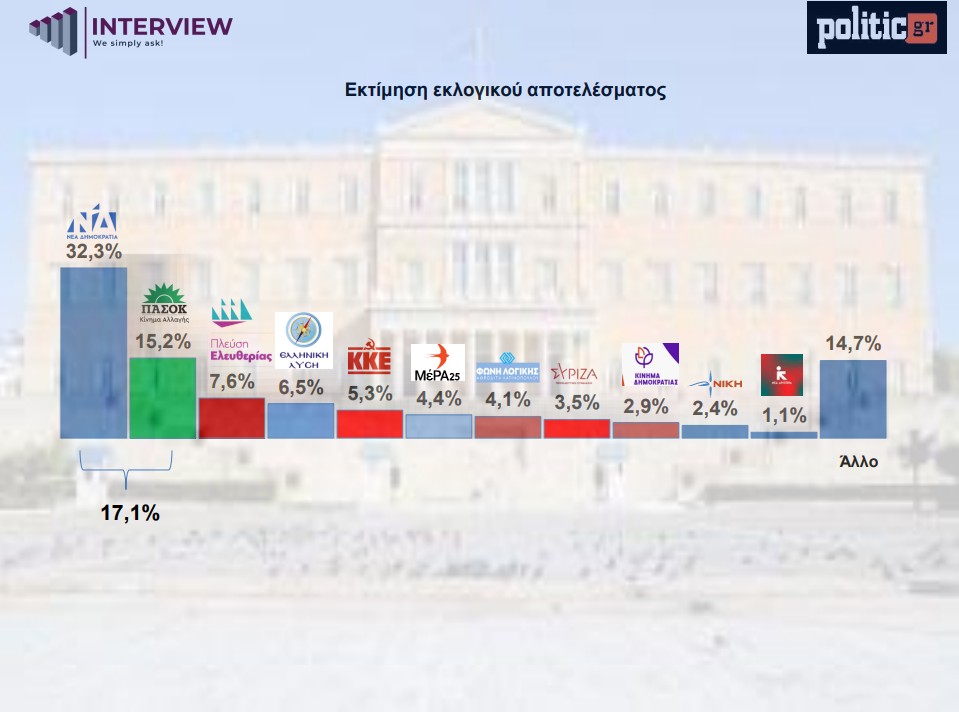
Regarding electoral result estimates, ND reaches 32.3%, PASOK 15.2% (difference 17.1%), Course of Freedom 7.6%, Greek Solution 6.5%, KKE 5.3%, MeRA25 4.4%, Voice of Reason 4.1%, SYRIZA 3.5%, Democracy Movement 2.9%, NIKI 2.4%, New Left 1.1%, while other party 14.7%.
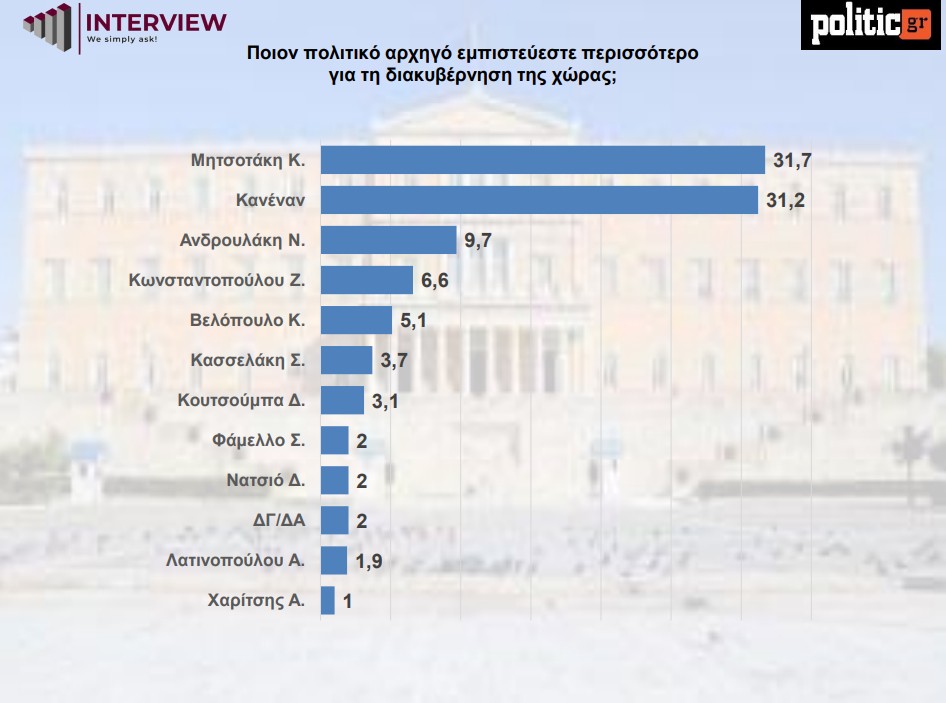
Regarding trust in governing the country, Kyriakos Mitsotakis is recorded first with 31.7%, with the choice “none” following very closely at 31.2%. Nikos Androulakis gathers 9.7%, followed by Zoe Konstantopoulou with 6.6% and Kyriakos Velopoulos with 5.1%. Moving at lower percentages are Stefanos Kasselakis with 3.7%, Dimitris Koutsoumbas with 3.1%, Socrates Famellos with 2%.
Interview poll: “Not ready yet for politics,” say 7 out of 10 about M. Karystianou
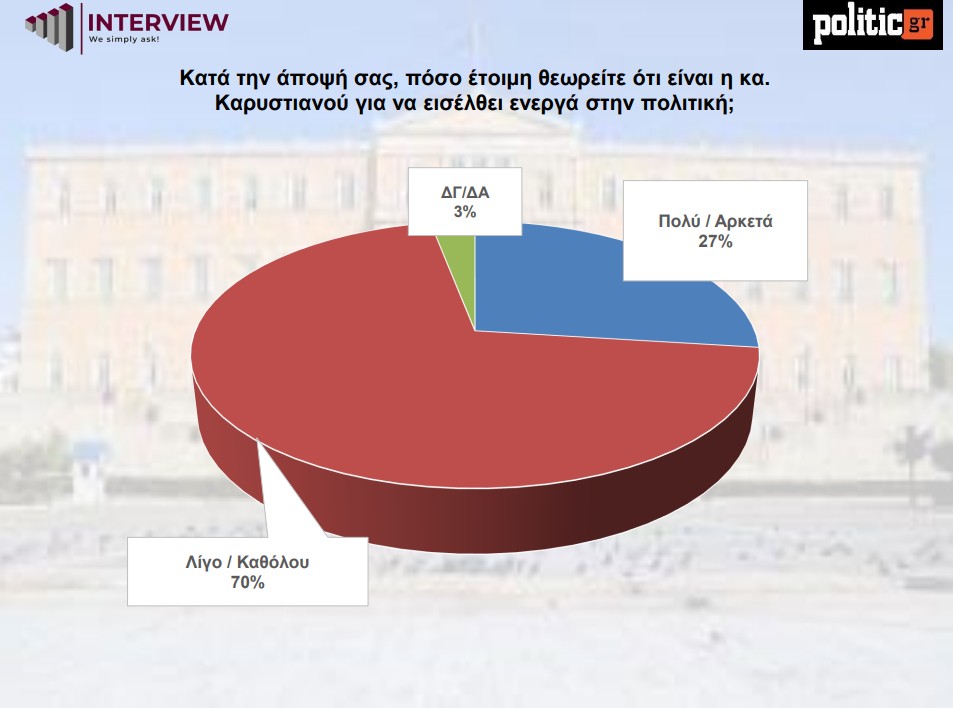
When asked whether Maria Karystianou is considered ready to actively enter politics, the majority of respondents appear reserved. 70% answer that they consider her “little or not at all ready,” while 27% judge her “very or quite ready.” A small percentage (3%) states they don’t know or don’t answer.
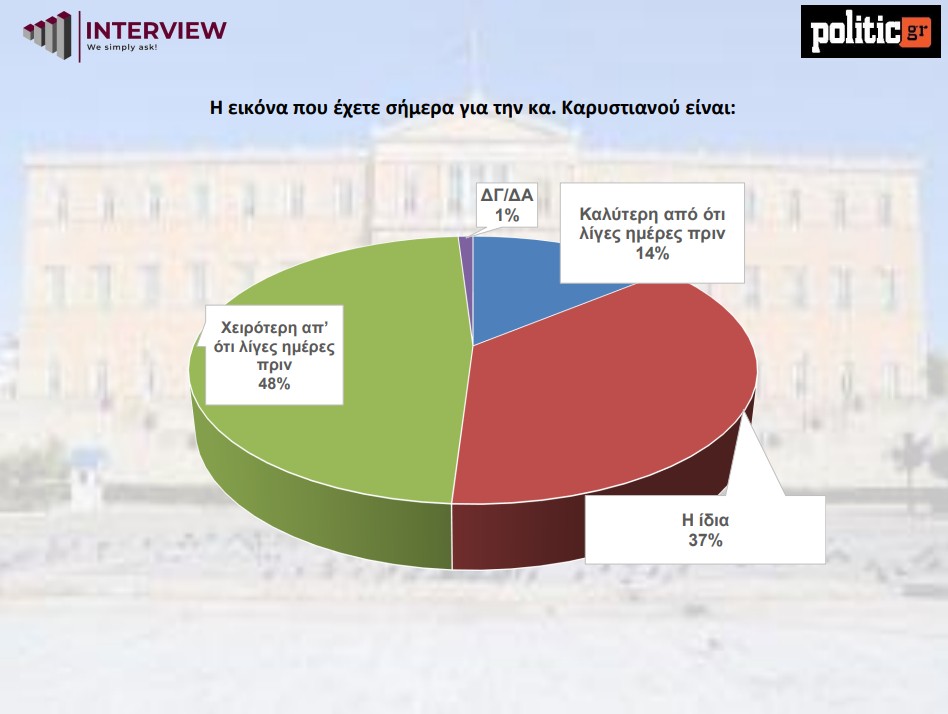
The next two questions are of particular interest, which were asked chronologically after Maria Karystianou’s interview, which provoked intense public discussion. According to the research results, M. Karystianou’s recent presence seems to have mainly affected the way citizens perceive her, leading to different assessments of her image, without however recording a corresponding effect on potential vote.
Specifically, 48% state that her image is worse compared to a few days ago, 37% that it remains the same, while 14% that it is better.
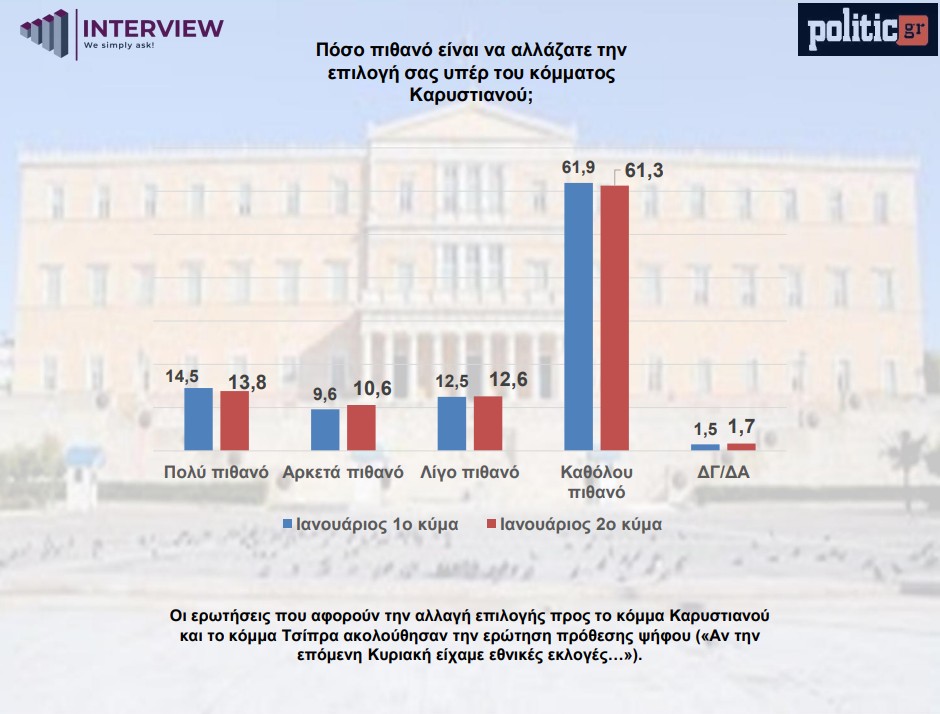
In contrast to image, potential vote remains stable. The percentage of those who state it is “very likely” to change their choice in favor of a potential Karystianou party is shaped at 14.5% in the first wave of research (before the interview) and 13.8% in the second. Overall, 37% of respondents state they are likely to change their choice in favor of a potential party of Maria Karystianou.
Interview poll: Karystianou superiority over Tsipras in hypothetical contest with Mitsotakis
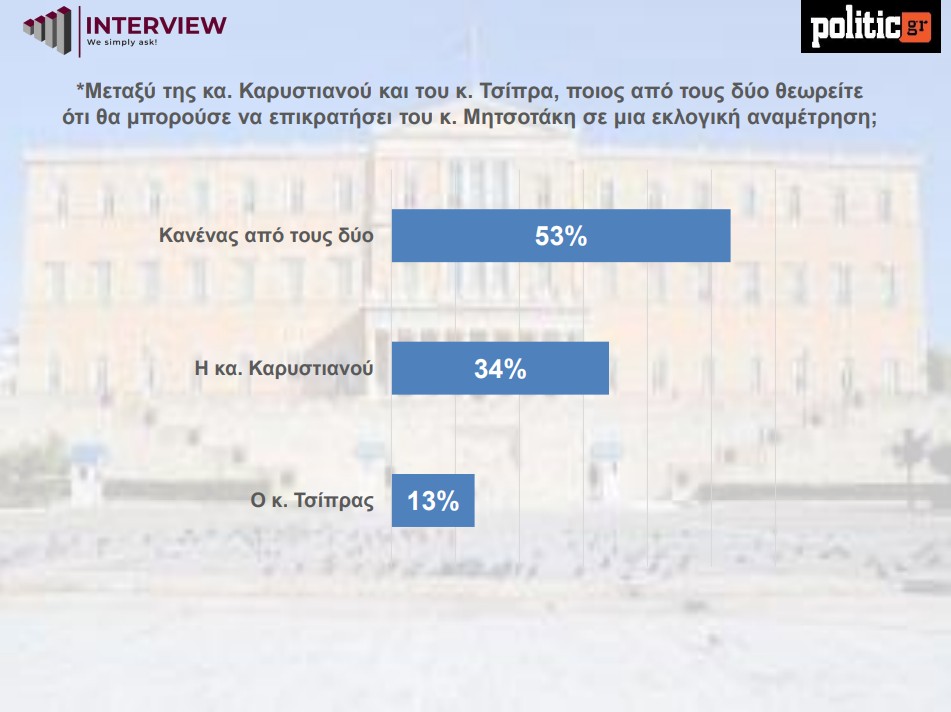
When asked which of the two, Maria Karystianou or Alexis Tsipras, could defeat Kyriakos Mitsotakis in an electoral contest, the majority of respondents (53%) answer that neither could achieve this. However, Maria Karystianou gathers 34%, more than double the percentage compared to the 13% attributed to Alexis Tsipras.
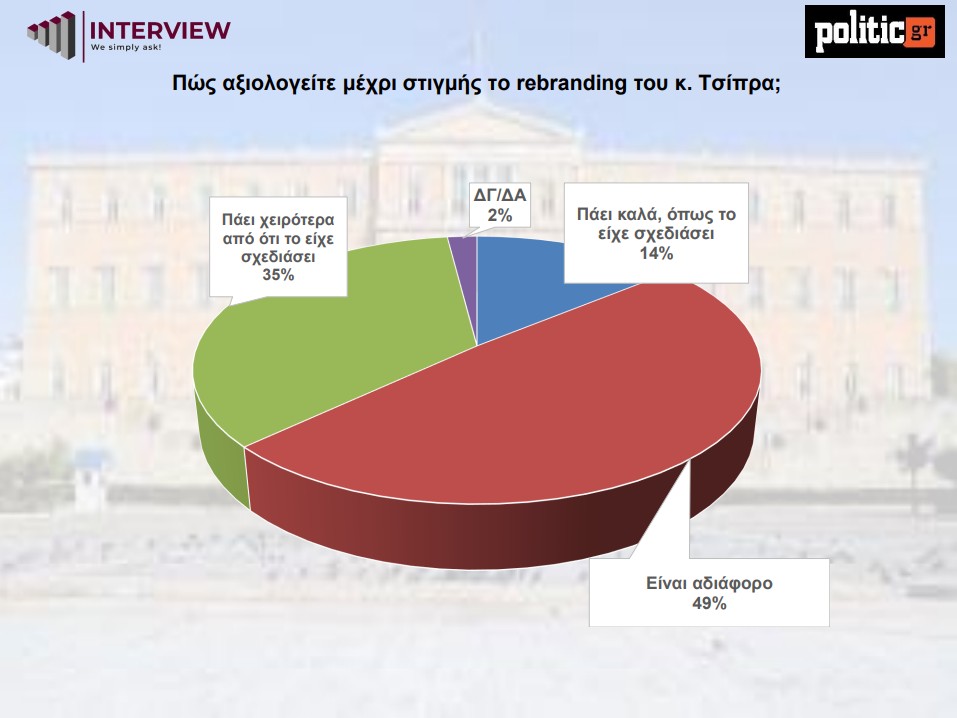
Interview poll: 49% indifferent, 35% negative about Tsipras rebranding
According to the research findings, Alexis Tsipras’s rebranding does not appear to create a strong imprint on the electorate so far. Almost half the respondents (49%) state they evaluate it as indifferent, while an additional 35% estimate it is developing worse than planned, with only 14% believing it “is going well.”
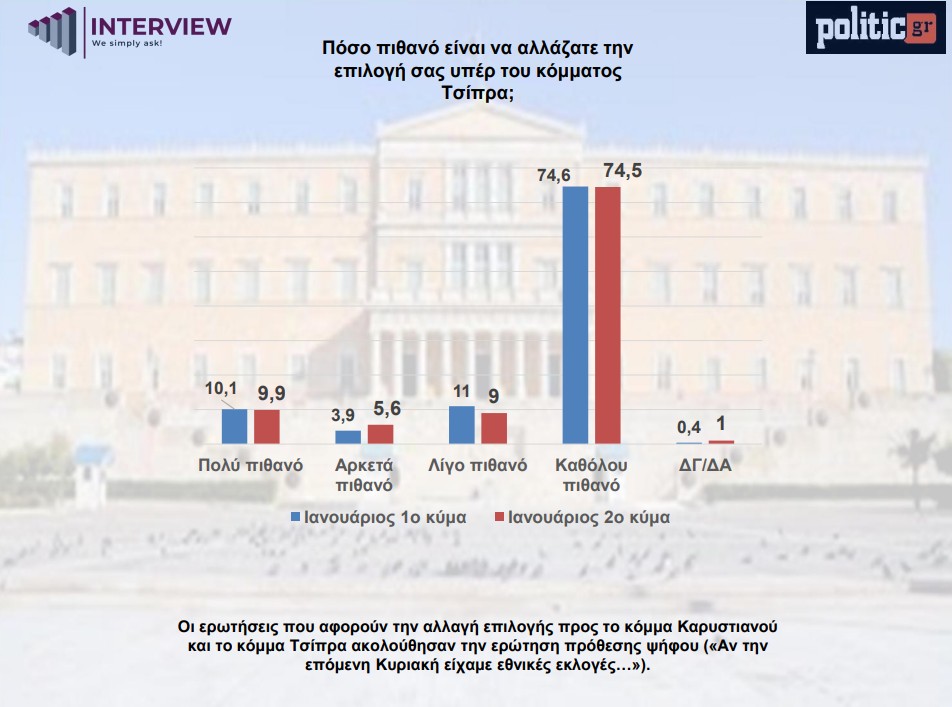
This image is also reflected in potential vote, as in the second wave of research 74.5% state they are not at all likely to change their choice in favor of a Tsipras party. Conversely, only 9.9% appear very likely to move electorally in favor of a Tsipras party. Overall, 24.5% of respondents state they are somewhat, quite or very likely to change their choice in favor of a Tsipras party.
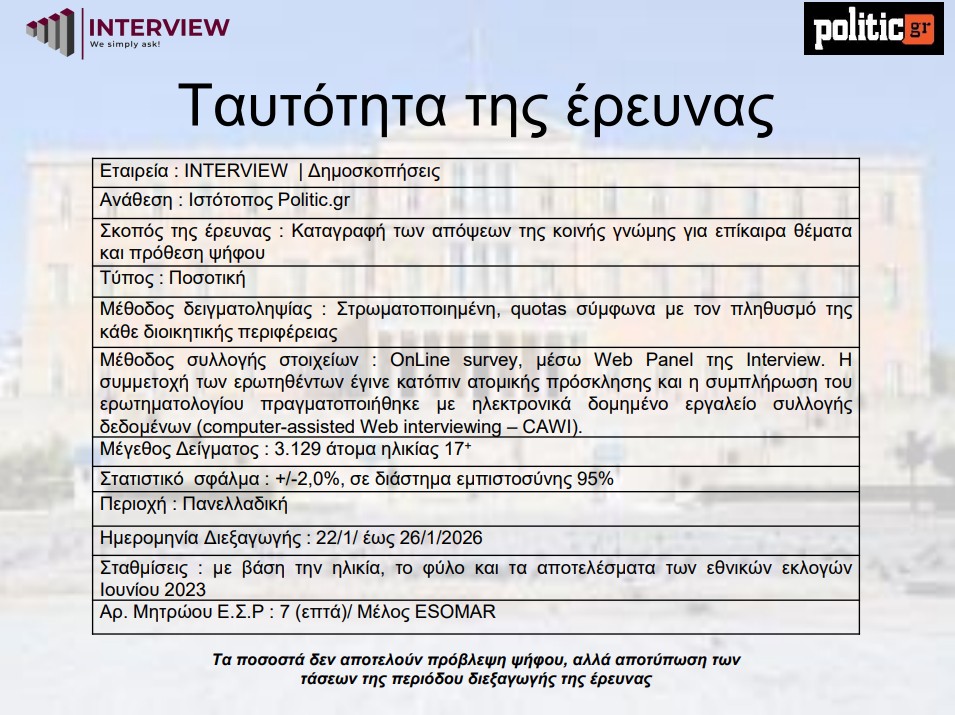
Interview poll: research methodology