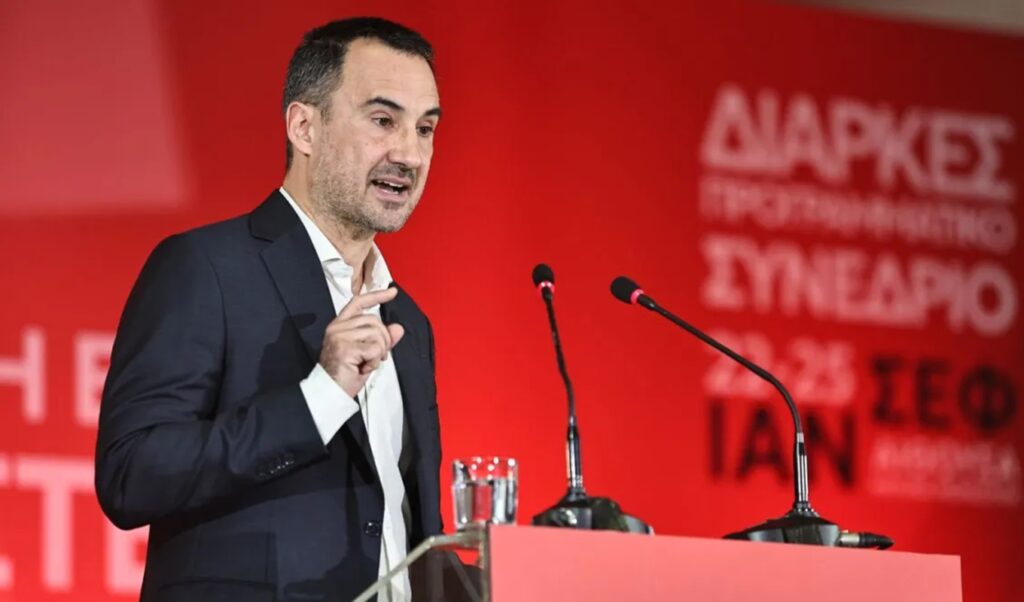
The leadership of the New Left party reached a fragile truce just before the end of their congress, as no one wanted to be blamed for splitting the party. Thus, both sides appeared to take steps back in order to reach a common decision.
However, the big loser in this story is the party president, Alexis Charitsis, who was forced to retreat from his main narrative about the popular front and dialogue for cooperation with Alexis Tsipras. In reality, Alexis Charitsis lost the opportunity to drive developments in his own party, even through a painful process, by accepting a text with positions that don’t represent him.
New Left: From division to compromise, Charitsis retreats on Popular Front
During the four days of the congress, it became clear that there were two distinct lines. One, expressed by Alexis Charitsis, calling for progressive cooperation even with Alexis Tsipras, and the other – the majority – which doesn’t discuss such a possibility, but only cooperation with more leftist parties, such as MeRA25.
Until yesterday morning, the prevailing impression was that the congress would end in division, as the officials who had sided with the party president seemed unwilling to back down. However, in a meeting that took place yesterday afternoon, after the first session of the Political Decision Committee, among the officials supporting Charitsis’s view, there was an opinion that they should take steps back, as the situation was deadlocked and the overwhelming majority was against cooperation with Alexis Tsipras. If they insisted, they risked being blamed for splitting the party.
Thus, in the second session that began in the afternoon, Alexis Charitsis’s associates appeared to abandon their position and seek words that would show that through the congress text, both Alexis Charitsis’s positions and those of the parliamentary group majority that shares his views are expressed. Officials from the Sakellaridis side and the Umbrella said, however, that Charitsis’s retreat has to do with the fact that there is still nothing concrete from Alexis Tsipras’s side and, therefore, a differentiation by these officials at this particular moment would fall into the void. They argued that, in reality, their comrades simply bought time.
Let us recall that in his presentation to the congress, Alexis Charitsis had mentioned, among other things, about the former prime minister, saying: “After Alexis Tsipras’s appearance in Athens, when everyone was talking about balconies and other such nonsense, we showed that the only way is that of political dialogue and substantial criticism. I listen to the argument, I enter into discussion, I clearly state my opinion. I don’t lower the flag of criticism, but I also don’t hide behind the flag to say ‘I won’t discuss’.” Indeed, in an interview he had given more explanations about the Popular Front, emphasizing that it is a proposal with a clear political sign: “We don’t speak generally and vaguely about gathering forces. We don’t see politics in terms of arithmetic. We speak about forces that can agree on a common program.”
On the contrary, in the congress decision – which he himself agreed with – it is stated that “the front we support is not an application of today’s failed centrist or center-left solutions. Nor does it entail the liquefaction of the Left or its transformation into a component of an abstract democratic camp. In this critical period, moreover, personality-based parties and person-centered strategies that have already proven unsuccessful in the past disorient the world of the Left and the world of labor and prevent giving a clear collective and unifying answer to today’s systemic problems.”
The references to personality-centered parties are a clear reference to Alexis Tsipras, without wanting to name him directly. Furthermore, the references to center-left parties concern the former prime minister’s narrative, as Alexis Tsipras’s narrative so far is broader, in order to also approach an audience that moves left of center.
Everyone wins
However, after the end of the congress, all sides claimed to be winners. From the side of the party secretary, Gavriil Sakellaridis, there was the assessment that within the decision there is recorded “clear demarcation from personality-based formations (Tsipras).” They also emphasized that center-left scenarios are not recorded, but only the need for reconstruction of the Reformist and Radical Left. They also pointed out that the autonomous course of the New Left is not questioned and the party is not transformed into a component of the Democratic Camp. “The term Popular Front does not exist,” they characteristically noted.
On the other hand, the Charitsis side declared itself extremely satisfied, as: “The congress, with an overwhelming majority, confirmed the founding act of the New Left: the logic of the Popular Front through a great alliance that includes forces of political ecology, the Left and left social democracy. The front’s goal is to overturn the balance of power and the Right in our country. The congress confirmed Alexis Charitsis’s criticism – reflected in his speech – of failed centrist solutions and the politics of the average. At the same time, that every unifying effort must respect the autonomy of individual spaces. The congress emphasizes that, in a fluid political landscape, the role of the New Left is to strengthen its political presence and action within society and to exhaust every possibility for unifying movements based on a radical program of immediate changes. It doesn’t close the door to dialogue, doesn’t choose withdrawal, doesn’t impose exclusions. It is a congress of programmatic agreement on the party’s next day and its commitment to the logic of political alliances.”