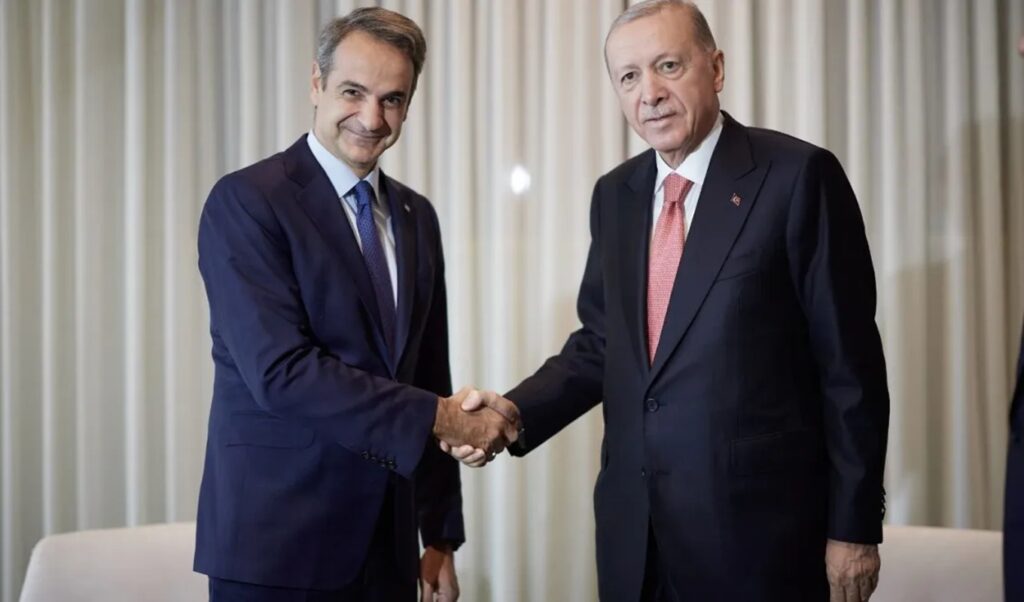
The final date for the High Council of Cooperation between Greece and Turkey is being sought by both sides within the first or second week of February. At the same time, Athens is seeking the best possible way to continue navigating the international environment amid a turbulent relationship between the European Union and the United States, which are gradually drifting apart rather than converging.
February Greece-Turkey High Council: International pressures, the European gamble and the role of the US
“Last week highlighted the challenges of the new world that is emerging, the importance of transatlantic relations, but much more the value of European strategic autonomy,” Kyriakos Mitsotakis characteristically wrote in his traditional Sunday Facebook post. “As we discussed at Thursday’s extraordinary European Council, Europe must be united, defend International Law and the sovereignty of its member states, as in the case of Denmark and Greenland. At the same time, we must maintain a framework of understanding and functional channels of cooperation with the United States, even in times of tension. While making our red lines clear. Greece, as a member of the European Union with a strategic relationship with the US, works for solutions that strengthen multilateralism, security and stability,” the Prime Minister also noted.
Within this new environment being shaped, Kyriakos Mitsotakis seeks to maintain and even expand the strategic relationship between the US and Greece: Our country has gained a pivotal position in American energy planning with the Vertical Corridor for natural gas transport from Alexandroupoli to Odessa, two American giants – Exxon Mobil and Chevron – are preparing for potential natural gas extraction in Greek seas, while the first fifth-generation F-35 fighter aircraft are expected at Andravida air base in 2028. He also seeks to strengthen our country’s position among the “frontline” states of the European Union, bringing back the proposal he submitted long ago for the need to strengthen European strategic autonomy, aligning on this issue with Emmanuel Macron. This means more resources for defense, support for domestic European defense industry and strengthening EU competitiveness within the international environment. “We support Europe’s strategic autonomy through stronger defense and greater competitiveness, we seek an active European role in Gaza and the Middle East and we undertake substantial initiatives in the European Union and the UN Security Council,” he noted in the same post.
“Fever” of meetings
The leaders of the 27 EU member states will have the opportunity to discuss again soon in person, specifically on February 12, at the informal EU Summit at Alden Biesen castle in Belgium, while the next day, on February 13, the Prime Minister plans to travel from Belgium to Germany to participate in one of the most important annual international security conferences, the Munich Security Conference. Before these, next Friday, January 30, Mr. Mitsotakis will travel to Zagreb for the informal summit of the European People’s Party leadership and EPP party leaders. Therefore, the first ten days of February is also the most ideal period for conducting the Greece-Turkey High Council of Cooperation, which is scheduled to take place in Ankara this time.
“Dialogue does not mean retreat, weakness, abandonment of national interest. Dialogue is the safety valve of calm, stability and good neighborliness,” Foreign Minister Giorgos Gerapetritis emphasized in his interview with the National Herald.
Last Tuesday, the Political Dialogue process between the two countries continued with a meeting in Athens between Deputy Foreign Minister Alexandra Papadopoulou and her Turkish counterpart, Mehmet Kemal Bozay. The meeting took place in a positive climate, with both sides confirming their common commitment to further expanding bilateral and international cooperation, as the related announcement notes. A day later, on Wednesday, January 21, also in Athens, the ninth round of Greek-Turkish talks of the so-called positive agenda took place between the other Deputy Foreign Minister, Haris Theoharis, and Mr. Bozay, with the subsequent announcement stating among other things that “the meetings within the framework of the Joint Action Plan also determine the framework for completing the relevant agreements, which may be signed during the next session of the High Council of Cooperation (HCC).”
Regarding the “Peace Council” for the Gaza Strip, in which Turkey participates and our country has been invited to participate, from the beginning both in Athens and generally in most European capitals there was concern about the fact that this initiative seems to undermine the role of the United Nations Organization. In any case, Greece wishes to be present in Middle East developments and is seeking the appropriate formula that will allow it to do so. As Kyriakos Mitsotakis said in an interview he gave to Euronews in Brussels, “if there is a way to cooperate with the US, but exclusively for Gaza and for a limited time period, Greece would certainly be very willing to take a leading role in seeking consensus towards this direction.”