The statements made by Maria Karystianos regarding the issue of abortions caused significant controversy and debate, with the first notable reaction coming from government spokesperson Pavlos Marinakis. During a press briefing, he addressed the matter stating that “the most terrible thing is that this was heard from a doctor. We will not go back to discussions that have been resolved.” Moreover, Karystianos’ statement was commented on by progressive opposition parties, which exercised sharp criticism of this position.
At the same time, dozens of social media users expressed their strong displeasure with this statement, taking a stand in favor of the right to abortion, while many reminded that this particular issue was resolved by state law in 1986.
The controversial statement by Karystianos
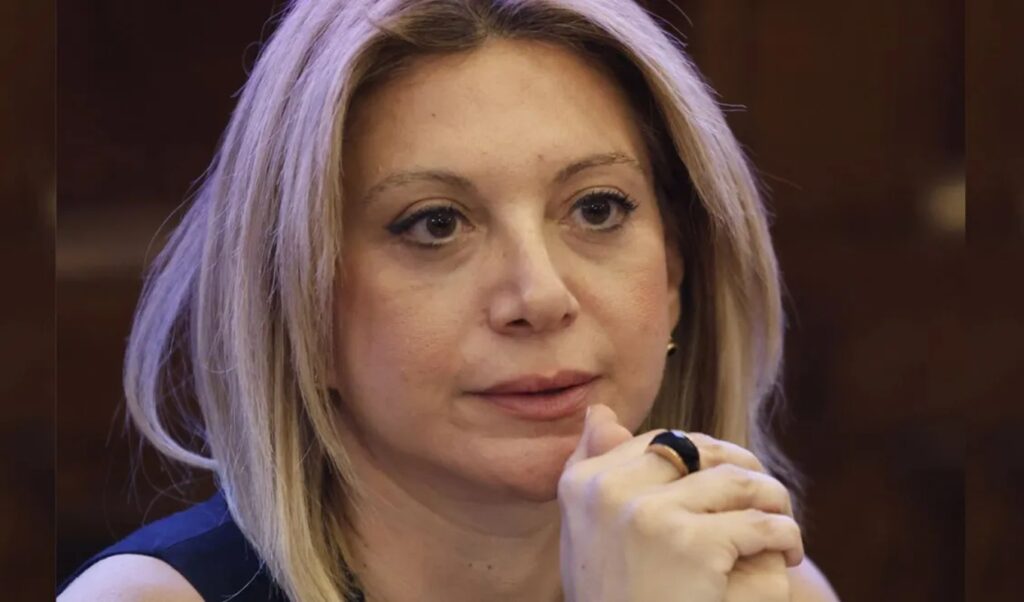
Ms. Karystianos, speaking on Open TV and asked to respond to the abortion issue, emphasized that it is a “matter of public consultation”. “I respect free will, it is very important and is constitutionally guaranteed. I believe it is a matter of public consultation. Let society decide what it would like to happen,” she said among other things. When the journalist asked her whether abortions are a matter of public consultation, she answered that “there is a particularity in the issue of abortions because it concerns women’s rights, her body is her own, that is the truth, but also the rights of the embryo. Now I am also a pediatrician. Therefore, due to my science I am torn about which rights should be higher, meaning I cannot prioritize the rights of the mother and the embryo”.
According to Maria Karystianos “a woman can decide, of course, decide about her body. The issue is that in the case of abortions there is also another moral issue, which for me is very important. It doesn’t matter what I believe or what you believe. That’s why you say in public consultation the majority will decide. Perhaps the majority will have a better opinion, view or in any case it is more democratic, because we are also talking about a life that is just being born. I tell you that my science has put me in a position to see things caring for the life that has just been created. I cannot separate these things. However, I want to fully understand the right of a woman to decide whether she wants childbearing or not. From the moment that starts from three months when a child’s heart beats it is considered a life that has been created. And after some weeks, babies, even those that come out by cesarean for various medical reasons, go see the neonatal care units, they survive. The babies are viable. I know this, about the moral issue. I want to tell you that issues which may concern how we want our society to function are for me an issue that can be solved with public consultation. Not this specific one, generally”.
What Ms. Karystianos said prompted the intervention of government spokesperson Pavlos Marinakis, who during the briefing stated that “the most terrible thing is that this was heard from a doctor. We will not go back to discussions that have been resolved. The river does not flow backwards. Every woman, every person is responsible for defining her body, period.”
PASOK: The abortion issue was definitively resolved under Andreas Papandreou
PASOK took a position on what Maria Karystianos stated about abortions. Specifically, the press office in its announcement states: “The abortion issue has been definitively resolved. The PASOK government of Andreas Papandreou with law 1609/1986 made real the right of every woman to decide herself with safety about her body. Access to safe abortion is an inalienable right”.
“Today it is time for more rights for women in the direction that the PASOK program has shown, and not for regression,” Charilaou Trikoupi also emphasizes.
SYRIZA: “Deeply political and dangerous” position on abortions, places it in obscurantist conception
The Equality and Rights Sector of SYRIZA PS issued an announcement regarding Maria Karystianos’ statement that abortions should be put to “public consultation”. The announcement characterizes her position as “deeply political and dangerous” and places it in an “obscurantist conception” that is historically connected with theocratic regimes and extreme conservative ideologies.
The announcement points out that in Greece, where abortion has been legal since 1986, and in Europe the overwhelming majority of states recognize the right to self-determination as fundamental and that this right was won through decades of feminist struggles against patriarchy, gender violence and religious fanaticism.
“Human rights are not negotiated and are not weighed with referendums and ‘consultations'”, emphasizes SYRIZA state MP Elena Akrita, on behalf of the Rights and Equality Sector. At the same time, it is noted that questioning the right to abortion places her ideologically in space connected with the Niki party.
New Left MP Efi Achtsioglou and party central committee secretary Gabriel Sakellaridis also took positions on this issue. “Ms. Karystianos stated this morning that abortions ‘are a matter of public consultation, let society decide what it would like to happen. There is a particularity in the issue, because it concerns women’s rights, but also those of the embryo’,” Ms. Achtsioglou wrote on social media.
“The statement is problematic for 4 reasons:
It questions the fundamental right of women to self-determination of their body. A right that has been won and legally established for decades.
The framework of illegality of abortions directly endangers the physical integrity of women, as happened in our country before their legalization and as continues to happen in other countries where abortions are illegal.
Public consultation can exist for many issues, but not for fundamental rights. Fundamental rights are not a matter of majority – minority.
There is no real and legal conflict between protecting fetal life and women’s bodily self-determination, within the framework of legal abortions, as their conditions are defined in European legal civilization, and for this reason no weighing is conceivable” she concluded.
For his part, Gabriel Sakellaridis emphasized that “defending justice, the rule of law and rights cannot be done à la carte. We cannot invoke certain aspects of them fragmentarily and silence or downgrade others that concern a large part of society”, characterizing Ms. Karystianos’ position on abortions as deeply problematic and extremely dangerous.
The 1986 law on abortions
In 1986 the right to abortion was established in our country (for the second time – the first was in 1978, in specific cases). Specifically, based on law 1609/1986, which was published in the Government Gazette on July 3 of that year, women gained the right to legally terminate unwanted pregnancy. The first time the right was established was for specific cases in 1978. However in 1986 it was legally provided by Andreas Papandreou’s government.
According to the law, abortion became legal “by choice” until the 12th week of pregnancy, without the need for medical or other indications. Also abortion was allowed at any moment of pregnancy without time limit if there was irreversible danger to the woman’s life or serious damage to her health.
According to article 2, paragraphs 4 and 5 of article 304 of the Penal Code were replaced as follows: “Artificial termination of pregnancy performed with the consent of the pregnant woman by an obstetrician-gynecologist with the participation of an anesthesiologist in an organized healthcare unit is not an unlawful act, if one of the following cases applies”. And the relevant cases followed. Abortion is performed with the pregnant woman’s consent, executed by an obstetrician-gynecologist with the participation of an anesthesiologist, in an organized healthcare unit. Finally, according to paragraph 5 of the penal code “if the pregnant woman is a minor, she must also have the consent of a parent or the person who has custody of her, in addition to her own”. The legislation was approved by parliament with a broad majority. The then official opposition of New Democracy voted against it.