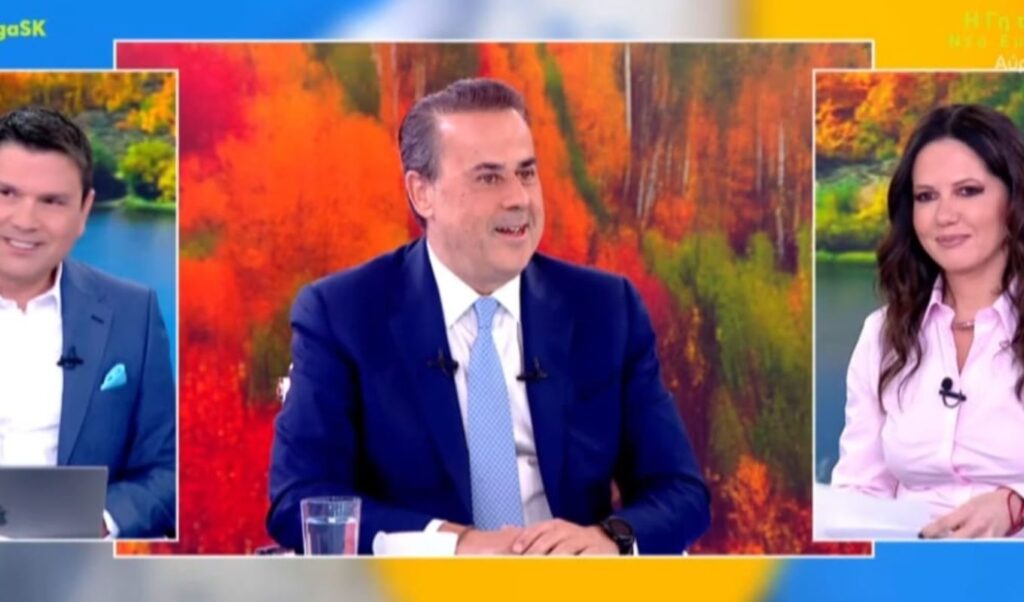
Minister of Environment and Energy Stavros Papastaurou referenced three major connectivity projects that are on a strategic trajectory for bilateral implementation when asked about his trip to Riyadh, speaking this morning on Mega TV’s “Mega Weekend” program with journalists Stella Gantona and Dinos Siomopoulos. Mr. Papastaurou described the projects: Greece-Saudi Arabia electrical interconnection (Saudi-Greek Interconnector), cooperation on green hydrogen issues, and the East Med Corridor (EMC).
Papastaurou: Saudi Arabia to become a second energy corridor, after the Vertical Corridor with American LNG
“Saudi Arabia is, as we all know, a global player in the energy sector. And their ambition is to continue playing this role by investing in renewable energy sources. Greece can function as a hub so that this electrical energy can be transferred from Saudi Arabia to Europe. That is, Saudi Arabia could constitute a second energy corridor, after the Vertical Corridor with American LNG,” he said characteristically.
“The initiatives we undertake and the agreements we make are always within the European framework in which we operate,” emphasized Minister of Environment and Energy Mr. Stavros Papastaurou, referring to both the design of the energy corridor with Saudi Arabia and the energy agreements with the US. Both the vertical corridor and the implementation of energy cooperation with Saudi Arabia, as he analyzed, are part of the Repower EU framework and the EU’s decision for complete independence from Russian natural gas. Moreover, green hydrogen is the subject of 2 of the 8 energy highways announced by European Commission President Ursula von der Leyen in her 2025 State of the Union address, namely the 8 basic strategic interconnections that will support the completion of the Energy Union.
The Minister also noted that the same applies to the IMO, the International Maritime Organization, emphasizing that for our country the maritime issue is of decisive importance: “And on the maritime issue, we will obviously cooperate first with our European partners, but at this moment there is a deadlock. The energy transition in shipping is at a deadlock in the IMO. So within the European framework we cooperate, so that a mutually acceptable, realistic solution is formulated first at the European level and then with the US and other interested countries within the next year.“
Regarding the contacts he had in Riyadh with the executive vice president of the Trump Organization, Eric Trump, Mr. Papastaurou emphasized that the company operates in the Middle East and has expressed interest in expanding to Europe: “I think that, since the Trump Organization is interested in expanding to Europe as well, for Greece it could not be otherwise. It should be one of the investment destinations they ought to examine.”
The path opens for the first seismic and geophysical surveys
Specifically regarding the contracts with the Chevron-HelleniqEnergy consortium, he mentioned that after recent approval from the Court of Audit and the upcoming submission to Parliament, the path opens so that within 2026 the first seismic and geophysical surveys will begin. When asked how these can help in daily life, Mr. Papastaurou emphasized: “If hydrocarbon exploration leads us to commercially exploitable deposits, then this means significantly more public resources for Greek men and women.”
Asked to comment on current political developments and new polling data, he mentioned that they reflect two things: first, that New Democracy remains the strongest and most resilient political force at this moment on the political scene, and second, that there is a fragmented landscape among those who oppose New Democracy.
About Karystianos
Regarding Ms. Karystianos, he said that everyone has the right to seek the vote of the Greek people: “Ms. Karystianos, with the positions she takes, chooses to move to the political field. She will be judged there: by the proposals, the program, the people, how she sees citizen problems.”
Finally, regarding energy costs, Mr. Papastaurou referred to our country’s position in the EU, as well as to the initiatives being promoted so that there is further de-escalation, describing the importance of the electrical interconnections being implemented: “The more we accelerate electrical interconnections, the more prices will fall. Greece, according to the European Commission’s quarterly reports for the second quarter of 2025 published 3 days ago, on January 15, is 19th in Europe in household electricity, below the average. So there are 18 EU countries more expensive than us, without this meaning we are complacent, however it constitutes a reference point.”