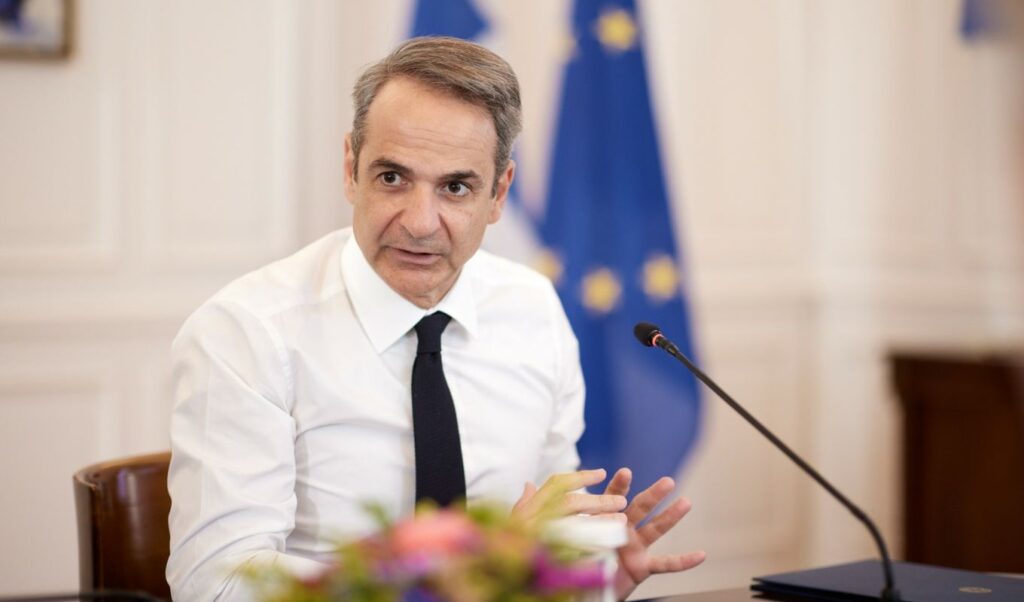
“Farmers know that the framework of interventions the government can make has practically already been announced. And this framework is clearly defined by the fiscal margins, which we have exhausted, social justice and European rules,” emphasized Prime Minister Kyriakos Mitsotakis, in his established weekly review. He added “tomorrow I will meet with the remaining farmers’ representatives who did not come to Tuesday’s meeting” and clarified that: “Our goal is not fragmentary solutions, but a fair, transparent and effective agricultural support system. A system that supports real producers, without wronging the rest of society, and that gives the primary sector prospects for better products and higher incomes.”
The Prime Minister began his review with the historic day of the first Belharra frigate’s integration into the Hellenic Navy, describing it as a historic milestone for National Defense and an important link – together with the other three that follow – in strengthening our country’s deterrent capability.
Full post by Kyriakos Mitsotakis
What a week this has been! One of those that reminds you that politics is not just about managing current affairs. It is, above all, responsibility. Responsibility to see a little further, to make decisions that build stability, security and direction for tomorrow. And this week had exactly that weight. Among everything that happened, there was something that belongs to continuity and not to circumstance.
I refer, of course, to the official integration of the first Belharra frigate into our Navy, a historic milestone for National Defense and an important link – together with the other three that follow – in strengthening our country’s deterrent capability, so that it is not challenged by anyone. Greece constitutes a pole of stability and reliability in the Eastern Mediterranean, seeks relations of good neighborliness and cooperation with the states of the region, but at the same time upgrades its Armed Forces both in terms of the means they have, and in terms of strengthening human resources. The moments I experienced on the bridge and deck of “Kimon” made me feel great joy and pride. And I believe this was felt by all Greek women and all Greeks. The first duty of every government, every political leadership, and mine as Prime Minister, is to hand over a homeland safer than when I received it. We took a very important step in this direction. I will wish from here that “Kimon” has a good voyage and we look forward to welcoming the other three ultra-modern Belharra frigates, which will be integrated into our Navy within the next 18 months.
Defense and economic security are interconnected concepts. One cannot exist without the other and, together with political stability, they constitute the sufficient and necessary condition for the prosperity and freedom of many. When a country can invest in its security without undermining its fiscal stability, this is a sign of seriousness. And this very seriousness was recognized by the markets in the recent issuance of Greece’s 10-year bond by the Public Debt Management Agency. Interest exceeded all expectations, with offers reaching 49.5 billion euros from 330 investors. Greece raised 4 billion euros with lower yields than last year, despite rising European interest rates. This is also the most convincing answer to those who question the value of investment grade: lower borrowing costs for the state, businesses and citizens, and more fiscal space for policies supporting the most vulnerable, young people and the periphery.
I now come to the agricultural issue, a topic that has been at the forefront for almost 50 days. From the first moment it was clear that the government chooses dialogue, but without easy promises and without moves that would undermine the overall effort for economic stability. Last Tuesday I had a substantive and honest discussion with farmers’ representatives, during which all views were heard and proposals were examined based on the real capabilities of the economy. Some of these were accepted, such as expanding the beneficiaries of low-cost electricity and providing fuel without special tax from now on, as well as without VAT on the discount they will have. Farmers know that the framework of interventions the government can make has practically already been announced. And this framework is clearly defined by the fiscal margins, which we have exhausted, social justice and European rules. Tomorrow I will meet with the remaining farmers’ representatives who did not come to Tuesday’s meeting. At the same time, especially for the issues of Greek livestock farming, which was severely tested by foot-and-mouth disease, a separate meeting with industry representatives will follow very soon.
Our goal is not fragmentary solutions, but a fair, transparent and effective agricultural support system. A system that supports real producers, without wronging the rest of society, and that gives the primary sector prospects for better products and higher incomes.
I continue to the other topics of today’s review and we go to unemployment, which I have to tell you is at historically low levels for our country. Without wanting to tire you, I present some data that was just published: our country recorded the largest increase in employment rate among all OECD countries in Q3 2025, compared to Q3 2024. In the 15-64 age group, the employment rate was 64.6%, rising 1.4 percentage points in one year which is the highest employment level ever recorded in the country. This progress must – and we want – to continue to concern more and more people. So the year begins with a new program from DYPA aimed at strengthening female employment, especially mothers of minor children. Companies are subsidized for hiring 10,000 unemployed women aged 18 and over, with priority to those with children up to 15 years old, for 5,000 new full-time jobs and 5,000 part-time positions. Another program that aims to facilitate return to work and practically support the balance of family and professional life.
Another issue from the field of labor concerns the implementation of the historic Social Agreement signed last November for the restoration of Collective Labor Agreements. By decision of the Minister of Labor, the collective agreement in the private insurance sector now extends to the entire sector, covering about 50,000 employees. This means that the terms of remuneration and work apply to all employees, regardless of whether they are members of the organizations that signed it. Whatever favorable provisions for salaries, benefits and leave now apply to everyone, without exceptions. With the Social Agreement, more Collective Agreements can be signed and extended, ensuring fair working conditions, protection, dignity, but also a stable and predictable framework that supports both the employee and the enterprise.
The same logic of action and results continues in healthcare, with the results from the reforms we are implementing having already begun to show. In 2025, there was a 29% decrease in the total number of patients on the Unified Surgery List, from 117,494 reduced to 83,457. An even more significant indicator, however, is the 52% decrease recorded in the total number of patients waiting more than 4 months in the same period, from almost 67,000 to almost 32,000, as well as the reduction of cases waiting before 2023, from 34,460 to 1,114. The contribution of free afternoon surgeries was decisive, with 11,342 free surgeries performed in 70 hospitals across the country. What contributed to these results? A combination of interventions we made, from increasing regular morning surgeries, establishing afternoon ones and vouchers in private clinics. With another important reform, the “bracelet,” we managed to reduce the average waiting time in emergency departments by over 65% for 2025. Have we solved everything? Certainly not, which is why we don’t stop our efforts. Let’s agree though that the NHS is changing, serving patients better and faster.
In the field of Justice, I had the opportunity to see up close how a reform changes daily life in practice. Together with a lawyer, I followed step-by-step the operation of the digital court file that was recently put into production. In just ten minutes, from his office computer, the filing of a lawsuit for a Land Registry case was completed, a process that until recently required at least two working days, travel and bureaucracy. Now, with digital filing, the hearing is automatically scheduled, so cases are scheduled in a few months instead of years. This is the change we pursue: less hassle, more speed and a Justice system entering a new era. Congratulations to those who worked to implement this project.
The Greek Parliament ratified the new agreement between the Greek State and the Italian railway group Ferrovie dello Stato and its subsidiary Hellenic Train, a particularly positive development for the Greek railway, with the signing of which the order for 23 brand new trains is activated, with investment from the Italian government and delivery horizon for the first trains within 18 months. This is the largest investment in land transport in the country, worth 308 million euros. Thus, for the first time since the Olympic Games period, Greece acquires new – not used – trains. With the arrival of the new trains and completion of works on the central Athens-Thessaloniki axis, the goal is for journey times to be reduced to under 3.5 hours.
I want to focus on a particularly important moment for the Greek State and the Muslim minority of Thrace: the recent swearing-in of the new Mufti of Didymoteicho, Emin Serif. For the first time, the modern institutional framework we established in 2022 for the operation of Muftis was applied in practice, ensuring a reliable and transparent process for selecting minority representatives. A process fully harmonized with the Constitution, the Treaty of Lausanne and European law. This is a substantial step that confirms that Greece is a country that respects diversity and invests in institutional order and peaceful coexistence of its citizens, regardless of religious belief. In a world tested by tensions and divisions, dialogue, understanding and trust in institutions remain the only stable path for progress and social cohesion.
I will close with something very optimistic. The major awareness campaign for organ donation that began last October added 30,000 new donors to the National Registry and led to increased transplants. With a small push, a great offering from human to human. Behind the numbers are hidden lives that were extended, families that hope, and a society that proves it can become more solidary. I remembered something Dionysis Savvopoulos had said: “The value of life is being able to surpass yourself. To share it with others, to create something beautiful.” With this I bid you farewell today. Good morning!