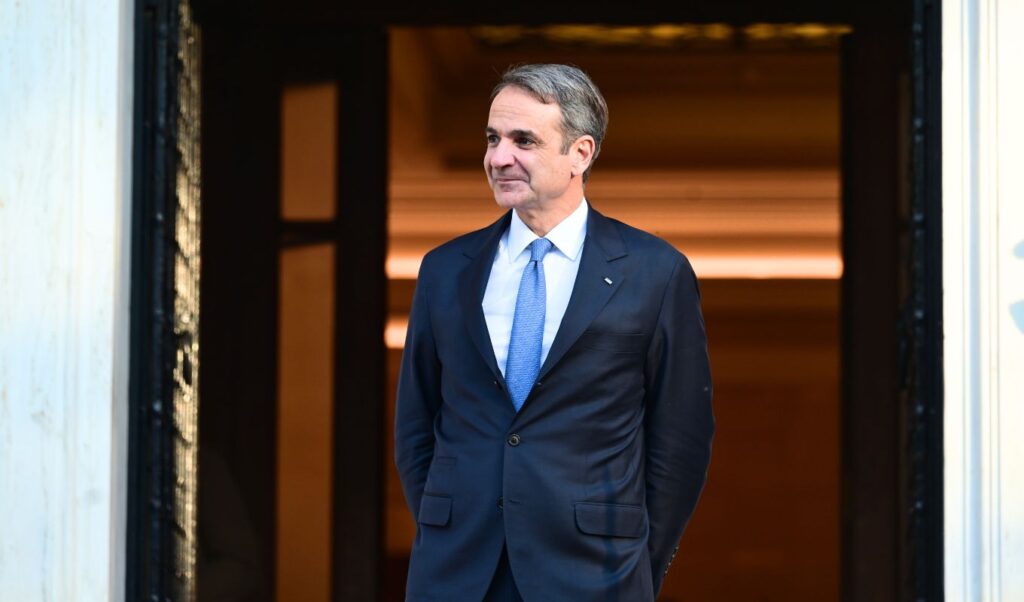
“In 2026 we continue with the same formula that has worked for 6.5 years: strengthening the economy through reforms and investments, without playing with public finances,” writes Prime Minister Kyriakos Mitsotakis in his Sunday review, the first for 2026, published on Sunday morning, January 11.
The prime minister refers to the fluid international environment, the conference of willing nations for Ukraine, the removal of perpetual students from university rolls, and the end of a multi-year occupation of common areas at the University of Athens student dormitories in Zografou. He also mentions renovations at “Agios Savvas” hospital and the Early Childhood Intervention Program, while making particular reference to the adjustment of water company tariffs, emphasizing that immediate action against water shortages is essential.
“2025 saw the largest percentage decrease in fatal traffic accidents ever recorded year-over-year in our country, at 21.5%,” the prime minister also notes, attributing this to the implementation of the new Traffic Code.
The prime minister’s full post in detail
We’re back! First review for 2026 and I wish for a year with health and more good news. If we confirmed anything from the first days of the new year, it’s that we live in a world changing at dizzying speed and in unpredictable ways. Certainties that shaped the post-war order are now openly questioned. In this new reality, stability is not a given. And the choice of responsibility can only be the most active, most reliable presence and constant defense of national interest in a world being tested.
The past week reminded us most emphatically that the international community cannot remain indifferent to illegal and authoritarian regimes that violate fundamental human rights. The only viable prospect for Venezuela is a smooth, democratic transition with respect for popular will and international rules. At the same time, as we clearly stated in the UN Security Council, the principles of the United Nations Charter and International Law must always be respected.
On our own continent, the past week brought the issue of European security back to the forefront, not as an abstract concept, but as a collective responsibility. At the Coalition of the Willing meeting in Paris for supporting Ukraine, I repeated our steadfast position: in favor of international law, in favor of just and sustainable peace, in favor of inviolable borders. We will not send troops to Ukraine. We will continue, however, to support it. We are open to examining our contribution in other ways, outside Ukraine, with emphasis on maritime surveillance issues. We are equally clear in our support of Greenland. Our commitment to International Law is our compass in this new, wild world. At the same time, however, we are not naive. We are realists. We know that defending national interest passes through strong alliances, but primarily through strengthening our deterrent capabilities. Let’s not forget that in a few days the “Kimon” docks at Salamis Naval Base, one of our many initiatives to ensure our security.
In 2026 we continue with the same formula that has worked for 6.5 years: strengthening the economy through reforms and investments, without playing with public finances. This way we managed, just last year, to support households and businesses with over 2 billion euros through new benefits and permanent tax reductions. And already from the beginning of the year, approximately 4 million taxpayers started seeing increases in their income due to the tax reform implemented by the Government (since 2019 there have been 83 total reductions in taxes and contributions), giving particular emphasis to the middle class, families with children, young people, uniformed personnel and our most vulnerable citizens like low-pension retirees, as well as the Greek regions.
We apply the same logic of responsibility and reform in Education, with the new year finding Public Universities with updated student registers, after completing the first phase of removing inactive students, 308,605 in total, who had enrolled even decades ago. The regime of “perpetual” students was unfair to Institutions and active students. Student status doesn’t last for life in any modern European university. Of course, the new framework isn’t inflexible: it provides exceptions and flexibility for working students, health reasons and serious family obligations, giving thousands of young people a real second chance to complete their studies, which they did. This planning is a prerequisite for upgrading study quality and daily academic functioning, as well as improving the qualitative criteria considered in evaluating Greek universities in international rankings.
I should mention the end of a multi-year occupation of common areas at the University of Athens student dormitories in Zografou. With cooperation from the Rectorate and administration of the Youth and Lifelong Learning Foundation, Greek Police removed the occupiers – people who had no connection to the University – and now the spaces, a gymnasium and 32 storage rooms, will be restored and returned for use by dormitory residents.
Moving to public health: From Thursday, “Agios Savvas,” the country’s largest oncology hospital, takes a big step forward: from 5 operating rooms, 11 now function, thanks to renovation of 9 rooms. This significant operational upgrade of the Hospital infrastructure was a demanding undertaking made possible, as the Health Minister noted, thanks to superhuman efforts by staff and determination of administrations. Thus, “Agios Savvas” is substantially strengthened to continue providing quality health services to patients for decades to come, with fewer waiting times. This is another emblematic investment in public health for building the new National Health System.
From tomorrow the Early Childhood Intervention Program begins, as procedures for provider training are completed. About 2,500 applications from parents and guardians have been approved, who will receive vouchers up to 800 euros monthly for specialized therapies like occupational therapy, speech therapy and other psychosocial support services for their children. It’s an intervention we know doesn’t solve everything, but does something very specific: helps early, reduces part of the cost and gives families more choices in a demanding daily routine. Support is provided beyond therapies already covered by EOPYY for children with neurodevelopmental problems and functional difficulties and their families. And this is one way to make daily life a little more manageable for these families.
I continue with an issue that concerns us all: water. The water company has designed a 2.5 billion euro program to armor Attica against water shortages, as the basin faces the biggest crisis of the last thirty years regarding water sufficiency. It’s a decade-long plan, with new infrastructure and upgrading existing ones, better reservoir management, stricter monitoring of the water supply network, as well as water reuse. To fund these vital projects, tariffs were readjusted, which however remain the cheapest in Europe. It’s a battle we must all fight together: the state with appropriate infrastructure and citizens with prudent water management and avoiding waste.
Coming to Justice, as here too the new year brings changes, with implementation of the new Civil Procedure Code. Among other things, it makes mandatory the scheduling of hearings for every case no later than 210 days from filing the lawsuit, meaning 7 months and up to 10 months for foreign residents. To compare with what happened until 31/12/2025, cases in regular justice had hearings scheduled 1,170 to 1,315 days from filing the lawsuit. We’re talking years of waiting. This ends now.
From Justice I move to everyone’s daily life, to road safety, as the stricter New Traffic Code and intensive police enforcement on roads are paying off. 2025 saw the largest percentage decrease in fatal traffic accidents ever recorded year-over-year in our country, at 21.5%. Based on official data from Greek Police, 522 people lost their lives on roads, a number lower even than the pandemic year, when traffic was drastically limited. In 2024 deaths had reached 665. We don’t celebrate numbers. We mention them for the lives saved. It’s indicative that during the holiday period thousands of breathalyzer tests were conducted, with proportionally very few positive results, showing that drivers are gradually changing behavior. Our effort for fewer accidents will continue, with interventions and rules already being implemented and with respect for human life.
On Wednesday, at the Development Minister’s meeting with representatives of farmers’ markets, agreement was confirmed for substantial strengthening of the institution, as a result of dialogue that lasted almost four months. The Development Ministry now has ready a legislative initiative that radically upgrades farmers’ market operations, reducing bureaucracy and practically facilitating entry of new producers and professionals. Basic interventions include complete digitization of licenses and converting them to indefinite duration, announcing all vacant positions, establishing electronic lottery and creating a modern Farmers’ Markets Digital Portal. In parallel, setting maximum daily fees is provided, simplifying procedures like position or market changes and improving the framework for transfer and substitution. Additionally, a 10% quota of seasonal positions for producers in each farmers’ market is institutionalized, as well as the possibility of creating producers’ farmers’ markets, with initiative from municipalities and operating bodies. In the same supportive direction, moves like abolishing the obligation for tax and insurance clearance for license renewal in December 2024 ensured uninterrupted work for thousands of people, preventing the risk of losing their jobs.
From the “small things” that make a difference: henceforth the circulation of required documents for passport issuance will be done electronically from application reception services to the Passport and Security Documents Directorate of Greek Police Headquarters. In practice this means less bureaucracy, faster and safer citizen service, reduced bureaucracy and enhanced security of the process. The new application was designed and implemented without any burden on the state budget, with absolute guarantee of personal data protection.
I close with extremely positive news for the sports world. The placement in public sector positions of 111 distinguished champions – both typical and persons with disabilities – with appointment rights has been completed, pending even since 2014 and covering the entire period from then until the first half of 2025. Their restoration signals the normalization of a very important institutional privilege for their outstanding international distinctions, which in some cases our champions waited up to 11 years for. It became reality, then, with respect for the contribution of athletes who honored our country and our sports.
That’s it for our first review of the year. I hope I didn’t tire you! See you, of course, next Sunday. Good morning!