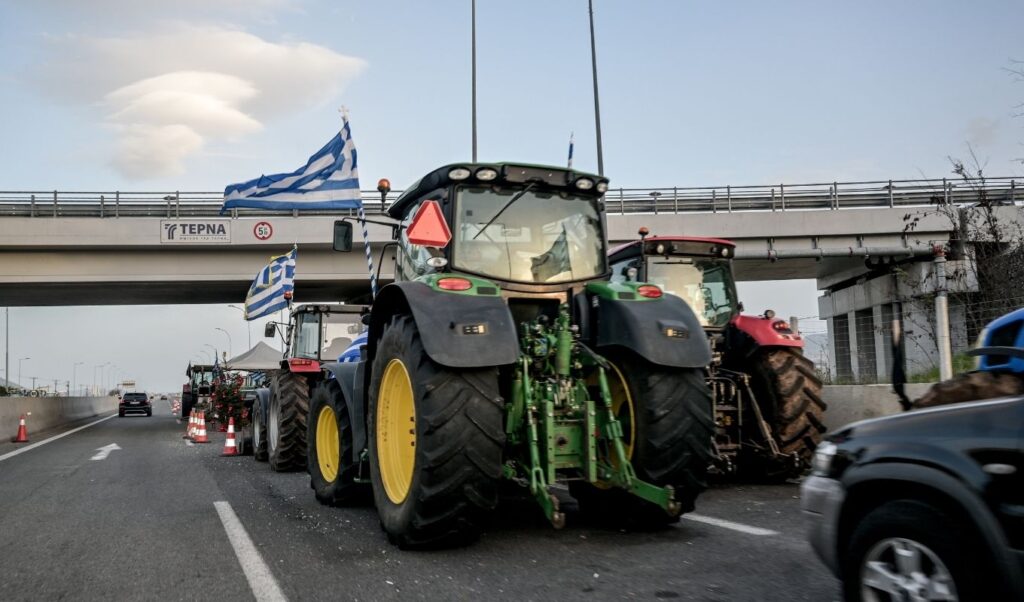
The time for announcements regarding farmers has arrived, and four ministers will today at noon detail the “package” of measures with which they hope to reach a “peace” agreement with the agricultural community and de-escalate the mobilizations. Deputy Prime Minister Kostis Hatzidakis, Minister of Rural Development and Food Kostas Tsiaras, Minister of Digital Governance Dimitris Papastergiou, and the Deputy Finance Minister will present at a press conference at the Ministry of Rural Development the completion of payments totaling €3.8 billion to farmers during 2025. They will explain that 20 of the 27 demands formulated by farmers through their conferences have either been implemented or are under consideration for implementation. Seven of these cannot be resolved either because they conflict with basic European rules and the operation of the CAP (Common Agricultural Policy) or because they are fiscally unfeasible.
The measures the government will announce for farmers
Primarily, however, the ministers are expected to focus in today’s press conference on four key announcements that satisfy farmers’ corresponding demands either wholly or partially:
• Extension of the “Gaia” program that ensures low electricity prices at 9.2 cents/kWh for farmers, following an agreement with DEI (Public Power Corporation) for an even more favorable tariff, which according to sources will be “locked in” at approximately 8.5 cents.
• Return of the Special Consumption Tax on agricultural fuel at the pump, through a special application prepared in cooperation between the Ministry of Finance and AADE, in order to address any delays and injustices without creating loopholes for unfair practices.
• Changes to ELGA regulations to expand the scope of compensation for natural disasters and provide 100% compensation.
• Support worth €160 million for livestock farmers and cotton and wheat growers. Specifically, from unused resources reaching this amount, €80 million will be given to livestock farmers as additional amounts from basic support and ecological schemes, and another €80 million will be given additionally to cotton and wheat producers.
What penalties farmers will face if blockades continue
In parallel, Mr. Papastergiou will present the plan for traceability of agricultural and livestock products and thus addressing the phenomenon of so-called “Hellenization” of imported products. The door for dialogue will remain open for farmers’ representatives, as will be emphasized again today. At the same time, however, the government is expected to send the message once again that there is no room for additional measures, just as there is no room for further tolerance of road closures. “Too much time has passed, the government cannot remain with crossed arms and play traffic cop in a blocked country,” Kostis Hatzidakis characteristically stated in his latest intervention, essentially announcing sanctions against those who obstruct traffic. “There is a legal framework that can simply be applied. We don’t want to reach that point, but now the limits have been exhausted and we may even be at ‘five past the deadline.’ It’s clear what we mean,” noted Mr. Marinakis. The sanctions are expected to be both administrative and financial, in the form of fines.