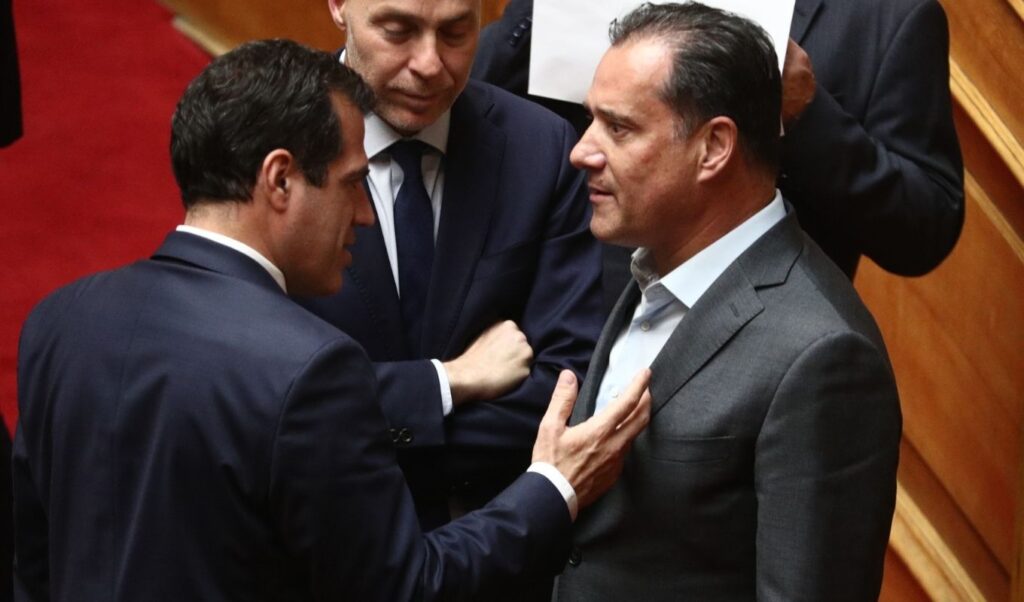
Sharp criticism against Amnesty International and the International Court of Justice at The Hague was leveled by Migration and Asylum Minister Thanos Plevris and Health Minister Adonis Georgiadis, describing these organizations as bodies that operate with “anti-Western” and “left-dominated” logic.
The public statement came after a post by Adonis Georgiadis on platform X, where he characterized both Amnesty International and The Hague Court as “irrelevant left-dominated schemes,” arguing that they should not influence the decisions of sovereign states.

Plevris: “They impose ideologically charged decisions”
Thanos Plevris, in his own intervention, agreed with this specific criticism, arguing that the jurisprudence of international and European courts has been shaped in recent years under the influence of a “long-standing left-wing ideological hegemony.” As he noted, many decisions are not based on international conventions themselves, but on how they are interpreted, resulting—according to him—in the adoption of a pro-migration and often anti-European approach.
Specifically regarding migration, the minister emphasized that international bodies oppose policies such as deportations, the creation of hosting centers outside the European Union, the establishment of safe third countries, and strict border control, although—as he noted—these are choices supported by democratically elected governments.
Ο @AdonisGeorgiadi ανοίγει με το γνωστό του ξεκάθαρο τρόπο μια μεγάλη κουβέντα που πρέπει να κάνουμε με ειλικρίνεια. Η νομολογία πολλών ευρωπαϊκών και διεθνών δικαστηρίων και οι αποφάσεις διεθνών και ευρωπαϊκών οργάνων έχουν επηρεαστεί από μια πολυετή ηγεμονία της αριστερής… https://t.co/kizl0K7EPs
— Θάνος Πλεύρης (@thanosplevris) December 28, 2025
“Criticism confirms the need for stricter measures”
Mr. Plevris stated that the negative criticism received by legislative initiatives he supported, such as asylum suspension, criminalization of illegal stay, and acceleration of deportations, not only does not concern him, but functions, in his view, as confirmation of the correctness of these choices and the need for even stricter deterrent measures.
Additionally, he extended his comments to international political issues, mentioning that international bodies have maintained a similar stance toward Israel, showing—as he argued—greater sensitivity toward perpetrators of terrorist acts rather than victims.
The minister concluded by saying that, although decisions by international organizations are evaluated within the framework of European Union principles, public criticism is legitimate and necessary, as he noted—”no body is above criticism.”