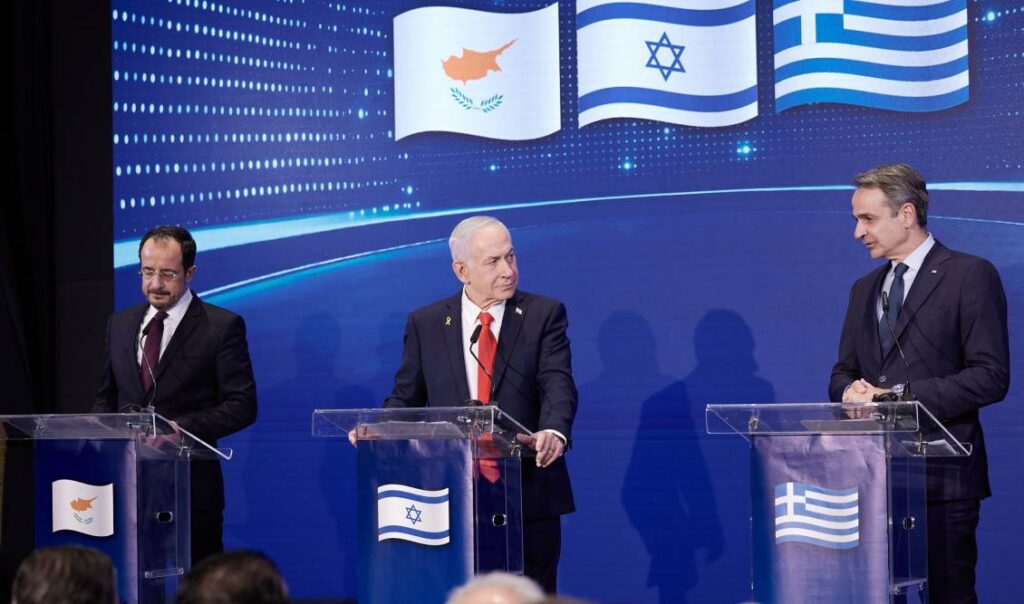
The trilateral cooperation between Greece-Cyprus-Israel is reaching a new level, with energy at the center and Turkey’s threat in the background. It was no coincidence that yesterday’s Trilateral Summit agreed to strengthen cooperation “in security, defense and military fields,” nor was the subsequent turn in Benjamin Netanyahu’s speech accidental: “To all those who fantasize about establishing their empire and dominance in our land, I say forget it, it will not happen,” emphasized the Israeli Prime Minister. “Israel, Greece and Cyprus are real democracies that have suffered slavery and deprivation,” he added, sending an indirect but clear message to Ankara. Kyriakos Mitsotakis even revealed that by 2026, the Coast Guards of the three countries “will conduct a joint exercise focused on combating marine pollution.”
Messages from the Greece-Cyprus-Israel trilateral summit
The three countries are placing particular emphasis on the 3+1 framework, with the participation and active support of the US, something that was evident in the statements by Mitsotakis, Christodoulides and Netanyahu. The India-Middle East-Europe Corridor (IMEC) plays a pivotal role in this upgraded cooperation, as it is a massive trade and economic route that all three countries wish to join.
Part of this planning is the northern maritime section connecting the port of Haifa in Israel with major European ports, one of which is Piraeus. This entire planning had essentially been frozen over the past two years due to the war in Gaza Strip, however the recent peace agreement – brokered by the US – is revitalizing Israel’s interest in IMEC.
“We will promote IMEC,” declared Benjamin Netanyahu. “This is an idea that has been articulated in the past, but we believe it’s time to implement it.” He described the project as a combination of maritime routes, energy pipelines and connectivity through cables, linking Asia with Europe through Israel, Cyprus and Greece.
Within this effort, Netanyahu mentioned that the leaders are also promoting the Great Sea Interconnector project, which will enable energy cooperation between the three countries, Europe and the Arabian Peninsula and, ultimately, connection with Asia. “We discussed in practical terms how the project will proceed and we intend to advance it,” he concluded, breathing new life into the much-discussed underwater electrical interconnection project between the three countries, which had seemed frozen in recent months.
“We confirm our determination to advance joint energy projects, including natural gas development, electrical interconnections and renewable energy initiatives, as a stable foundation for cooperation in the region, based on international law, including maritime law, and respect for the right of all states to exercise their rights in their respective Exclusive Economic Zones (EEZ) and Continental Shelf,” states the joint declaration signed yesterday in Jerusalem by the three leaders.
“Greece is emerging as a key energy hub in Southeast Europe. We constitute a gateway for liquefied natural gas, something that could be very important for both Cyprus and Israel. We are becoming net exporters of electricity. And, of course, ensuring the advancement of important interconnection projects linking our three countries remains a key priority for our three countries,” stated Kyriakos Mitsotakis during the joint statements following the Trilateral Summit. Regarding the ambitious IMEC project, he noted “the need to move from the vague idea that exists today to concrete deliverables – project-oriented deliverables – that will prove the great value of this strategic corridor connecting India, the Middle East, Israel, Cyprus and continental Europe.”
It’s worth noting that earlier, Mitsotakis met with Palestinian Authority President Mahmoud Abbas in Ramallah and expressed Greece’s support for the Palestinian Authority as the sole legitimate representative of the Palestinian people. The Prime Minister emphasized that Greece is ready to contribute to Gaza’s reconstruction and establishment of security conditions, while stressing the importance of Palestinian participation in implementing the peace plan. He mentioned that Greece consistently contributes aid to Gaza residents, always prioritizing civilian protection, and has arranged for the treatment of children rescued from the war in Greek hospitals.