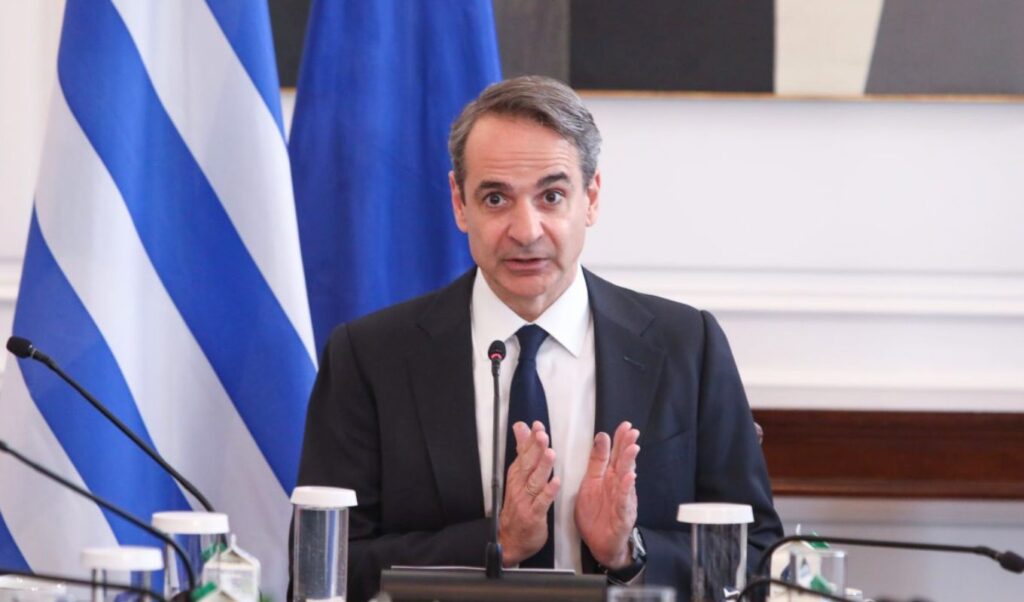
“We are open to dialogue, but not to the unreasonable,” emphasized Prime Minister Kyriakos Mitsotakis, in his customary and final weekly review of the year, referring to the farmers and their mobilizations across Greece. “From the list of 27 farmer demands, 16 have already been satisfied or are being addressed positively, 4 are under consideration or discussion to find a solution, and only 7 cannot be resolved either because they conflict with basic European rules and CAP operations or because they are fiscally unfeasible,” the Prime Minister explained.
“Persistence in sterile dialogue refusal benefits no one and demonstrates a non-constructive stance. The economic impact from the blockades on the rest of society is already evident. Demanding rights must always be done with respect for society as a whole. If the farmers maintaining blockades refuse to listen to the government, let them listen to hoteliers, restaurateurs, and regional chambers of commerce. To their friends and relatives who want to travel and visit them for the holidays. But let them also think about our country, its international trade, and the economic activity negatively affected by their mobilizations, certainly without any positive impact on their demands. With this compass of dialogue and defense of social unity and progress, the government will proceed. We do not belong to the school of politics that says ‘let’s give even what we DON’T have,’ as we unfortunately heard the PASOK leader say. Nor could we ever consent to measures that place us outside the European framework, especially when we’re talking about EU agricultural subsidies. An important opportunity is our proposal for a high-level cross-party committee aimed at modernizing the primary sector,” he stated.
In detail, the Prime Minister reviewed the week, highlighting the government’s most significant projects and measures, focusing on citizen support, development, justice reforms, social welfare, and security enhancement.
Specifically, he states: “Somewhere between budget speeches and first thoughts about the holidays, this week passed, with current affairs remaining dense and demanding.
I’ll start, as you’d expect, with the 2026 Budget. The parliamentary discussion once again illuminated our government policy’s basic priority: supporting citizens’ real disposable income. This is reflected in both salary increases and further tax burden reductions totaling €2.9 billion. Budget implementation began in practice with January pension prepayments starting this Friday, incorporating scheduled increases.
I also presented six complementary housing interventions, a persistent problem we won’t stop ‘besieging’ with every feasible method. We’re launching a generous home renovation program worth €400 million, covering up to 90% of expenses (up to €36,000) with high income criteria, increased for each child. We’re returning two months’ rent to public employees and officials renting homes outside Athens and Thessaloniki, while imposing restrictions on short-term rentals in Thessaloniki. Additionally, local upgrade plans for municipal and state buildings in mountainous and island areas will proceed with Regional and Municipal implementation, providing additional incentives for private affordable housing investments and facilitating rapid conversion of existing properties from non-residential to residential use. Housing is an issue transcending national borders. That’s why the European Commission is developing a European strategy within the next Multiannual Financial Framework – something I emphasized in my recent European Council intervention. We’ll naturally claim every additional resource that can strengthen national housing policy.
Concluding budget matters, I should mention the Swiss franc loan regulation, another legacy issue keeping approximately 50,000 borrowers ‘hostage.’ In coordination with the Finance Ministry, we’re submitting provisions converting these citizens’ obligations to euros with fixed, low interest rates, providing ‘haircuts’ based on borrowers’ assets, while allowing repayment extensions up to five years. Borrowers are thus relieved, and exchange rate risk essentially disappears since capital will be converted to euros. Though complex, we reached the best possible solution soon to be submitted to Parliament for approval and implementation.
However, this week also brought a historic moment for our Navy – receiving the first of four Belharra frigates, the frigate “Kimon.” A moment of pride for our country, especially for Armed Forces that entered a new era since 2019. The Greek fleet acquires a modern, digital vessel substantially enhancing deterrent power in the Aegean and beyond. After completing necessary weapons system integration procedures, frigate “Kimon” is expected to sail into Greek waters in mid-January 2026. Choosing Belharra frigates represents a strategic choice during complex geopolitical circumstances and signals a new operational philosophy: investing in quality, technology, and people called to keep the country safe. Because ultimately, strength isn’t measured only in ships and systems, but in the readiness and confidence of those serving them.
Moving to the dramatic upgrade of the ERGANI Information System, a valuable tool serving workers and businesses. ERGANI II’s new digital architecture brings document elimination and significant procedure simplification, transforming it from an event recording system – like announcements – into a live registry accurately reflecting employment and employment relationship changes at every moment. For workers, this means greater protection and transparency. For businesses, less bureaucracy. For the labor market, a more modern and reliable operational framework. ERGANI II will operate experimentally for the next two months, allowing all businesses and entities to adapt to the new environment, and will enter productive operation from February 16, 2026.
Remaining in employment, the spectacular overtime increase due to better recording after digital card implementation worked doubly in workers’ favor. First, they’re paid for extra working hours, and second, it provided significant fiscal relief for the insurance system, as 2026 is expected to bring additional insurance fund revenues of €1 billion! A result connected both to economic improvement and minimum wage increases and more effective labor market controls.
Continuing with the National Cybersecurity Strategy 2026-2030. This is a cohesive, long-term roadmap our country acquired for addressing continuously increasing cyber threats of our digital age. The Strategy was formulated through public consultation with all key stakeholders’ participation. As National Cybersecurity Authority Director Michalis Bletsas said, it’s a realistic, applicable framework supporting the state, businesses, and citizens in safely, resiliently, and responsibly utilizing technology in a rapidly and unpredictably changing environment. The Strategy builds upon the institutional framework already strengthened in recent years, transposing European directives and establishing two laws providing clearer rules, more obligations, and stronger oversight and coordination mechanisms in the critical cybersecurity sector.
Wednesday saw Parliament approve “Pharos” legislation – the artificial intelligence factory I’ve already discussed. Essentially, through cooperation between the Superfund and Digital Governance Ministry, we’re creating an entity bringing research and entrepreneurship to the same physical and digital space, using top-tier Daedalus infrastructure, our National supercomputer. Startups, research centers, and universities will access artificial intelligence computing power to turn ideas into reality. Another step moving innovation from theory to everyday life.
Another significant development for research is the Development Ministry’s decision to create Greece’s first Semiconductor Competence Center (Hellenic Chips Competence Centre – HCCC), with €3.63 million funding, a strategically important project for the country’s industrial and technological upgrade. The Hellenic Semiconductor Competence Center represents a broad national partnership, coordinated by the Hellenic Emerging Technologies Industry Association (HETiA) with fifteen university and research institution cooperation. It will serve as a research, innovation, and training hub, supporting Greek industry through technology transfer, high-power infrastructure access, and developing human resource training programs.
In road safety, the first seven “smart” cameras were installed on central Athens metropolitan arteries to improve safety, monitoring, and better traffic management. According to Regional planning, 11 more will be added in January, 33 in February, and after March through June, 85 cameras monthly will be installed, totaling 388. All at high-risk locations, creating a comprehensive safety network for drivers and pedestrians across Attica’s central road network. Reducing traffic accidents is an urgent necessity; fines alone clearly aren’t enough, but – as Nikos Hardalias correctly said – we need to establish a new responsibility culture on our roads. Cameras will operate 24/7, capable of recording photos and videos even under low lighting conditions, while ensuring personal data protection by recording only vehicle rear sections, preventing passenger identification.
As I mentioned in the previous review, 24-hour operation of Thessaloniki Metro and six basic bus lines began yesterday pilot-wise and will repeat next Saturday, December 27. Holidays bring more traffic, more movements, and more people out at night. Athens experience showed us that during Saturday night hours – objectively the most ‘dangerous’ for accidents – continuous public transport operation isn’t simply convenience. It’s a way for everyone to return home safer, reducing accidents and protecting human lives.
Regarding agricultural mobilizations, I maintain we’re open to dialogue, but not to the unreasonable. From the 27 farmer demands list, 16 have already been satisfied or are being addressed positively, 4 are under consideration or discussion to find solutions, and only 7 cannot be resolved either because they conflict with basic European rules and CAP operations or are fiscally unfeasible. Persistence in sterile dialogue refusal therefore benefits no one and demonstrates a non-constructive stance. Economic impacts from blockades on the rest of society are already evident. Rights demands must always be made with respect for society as a whole. If blockade farmers refuse to listen to the government, let them listen to hoteliers, restaurateurs, regional chambers of commerce. To friends and relatives wanting to travel and visit them for holidays. But let them also consider our homeland, its international trade, and economic activity negatively affected by their mobilizations, certainly without any positive impact on their demands. With this compass of dialogue and defense of social unity and progress, the government will proceed. We don’t belong to the political school saying ‘let’s give even what we DON’T have,’ as we unfortunately heard the PASOK leader say. Nor could we ever consent to measures placing us outside the European framework, especially when discussing EU agricultural subsidies. Our proposal for a high-level cross-party committee aimed at primary sector modernization is also an important opportunity.
I’ll close with the very significant development concerning the National Archaeological Museum’s expansion and upgrade – the world’s most important and richest ancient Greek art repository, with at least 17,000 exhibits. All preliminary studies for the entire building block and museum complex were unanimously approved by the Culture Ministry’s highest advisory bodies, a globally unique undertaking. Studies were conducted by top architectural firms Chipperfield-Tombazis, sponsored by Spyros and Dorothy Latsis in memory of John and Erietta Latsis. The expansion goal is simple and substantial: opening the museum more to the city, creating new public green space, and showcasing collections as they deserve, for visitors from Greece and worldwide.
I realize this is the year’s final review! Looking back, weeks seem to have passed quickly. With standout events, quieter others, but all together created this year’s journey. Our established review tradition will continue with the new year. Wishing you Merry Christmas and wonderful time with your loved ones. Though truthfully, you’ll see my posts during the holidays too. Good morning!”