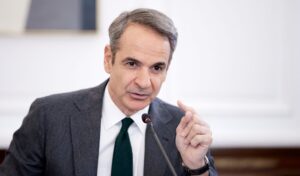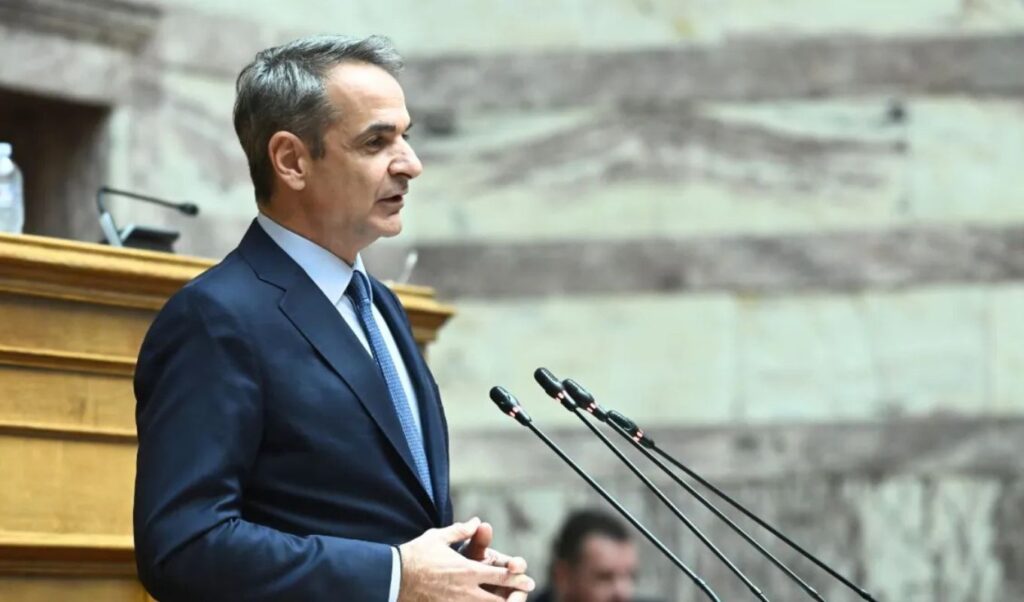
The government is awaiting the response from farmers to the open invitation for dialogue with Prime Minister Kyriakos Mitsotakis, appearing ready to satisfy a series of their basic demands. From the Parliament floor tonight, Kyriakos Mitsotakis will make a special reference to the ongoing farmer situation during his speech within the framework of the Budget discussion, while leaving the negotiation component to the relevant ministry.
He will, according to sources, insist on his position for restructuring primary production, focusing on reforming OPEKEPE and transferring it to AADE, which he considers a pivotal point for modernizing the entire subsidy system. As he is expected to emphasize, transferring OPEKEPE to AADE will be the first step for the state to seriously pursue reform of the primary sector. “The proposal for dialogue was extended from the first moment. In reality, dialogue never stopped. More important than the sincere willingness for dialogue is the government’s policy, which transforms demands into action when there is money, when there are possibilities,” government spokesperson Pavlos Marinakis said Monday evening on ERTnews.
The 5 interventions the government is considering for farmers
Based on statements made by Agriculture and Food Minister Kostas Tsiaras, the government is willing to consider interventions in five areas:
– In production costs, through regulations that directly reduce burdens and strengthen producer liquidity.
– In energy, by ensuring stable and lower prices for agricultural electricity.
– In fuels, specifically regarding agricultural diesel at the pump.
– In ELGA, with immediate changes to regulations so compensation covers 100% of insured damage.
– In strengthening the most pressured sectors, such as livestock farming and specific crops. The new support will come from utilizing unused amounts from CAP basic support. These amounts result from OPEKEPE’s restructuring and targeted cross-checks by AADE.
Mitsotakis to farmers: Dialogue doesn’t happen with ultimatums, solutions emerge only through discussion
Kyriakos Mitsotakis is expected to address this issue again today afternoon, highlighting both the actions the government has already taken in recent years to strengthen the primary sector and those currently being implemented.
“Dialogue doesn’t happen with ultimatums. And solutions emerge only through discussion. Whoever rejects these principles of logic and Democracy assumes great responsibility toward the rest of society,” is the position expressed by the Prime Minister after the Nikaia blockade’s decision not to come to the discussion table at Maximos Mansion.
Kyriakos Mitsotakis also expressed his categorical opposition to farmers’ demand not to integrate OPEKEPE into AADE, a process already in full development. “Non-negotiable, however, remains my position on OPEKEPE’s restructuring through its integration into AADE. This is because it constitutes the catalyst that will comprehensively modernize the primary sector in the country,” Mr. Mitsotakis emphasized, who today from the Parliament floor is expected to call once more for farmers to open the roads.
Regarding the list of thirty demands formulated by farmer representatives, the government, through government spokesperson Pavlos Marinakis, classifies them into three categories: Demands that are logical and can be put into dialogue without derailing public finances. Demands considered absolutely maximalist and consequently extremely difficult to satisfy without derailing the budget. And demands that cannot be satisfied due to European Union rules on state aid, etc.
“Greece paid very dearly for the logic of outbidding, the logic of costless promises that turned into very costly benefits in previous years. The Kyriakos Mitsotakis government is not in this logic,” Mr. Marinakis stated, essentially setting the limit within which any agreed benefits can ultimately move.
Society in its majority supports farmer blockades
Meanwhile, the GPO Barometer for Parapolitika 90.1 regarding farmer mobilizations shows that a very significant percentage of 85.1% considers the demands of the agricultural community fair. Perhaps more significant, however, is the 64.8% that justifies the form of mobilizations, including the closure of national roads. As Antonis Papargyris comments, “at this stage, agricultural demands appear to have the tolerance of the rest of Greek society, which combined with everything being revealed around the OPEKEPE scandal recognizes the justice of the mobilizations and positions itself favorably toward the agricultural community’s demands.”