The first major incidents in the farmers’ mobilizations, after 8 consecutive days, as well as the increasing participation in roadblocks are testing the government’s strategy, which however remains firm in the position it has stated recently: Yes to dialogue, but with farmers who will come in a coordinated manner to the discussion, will have specific representation that will express the entire agricultural community – and not isolated roadblocks or regions – and ultimately will formulate specific demands.
The extension of low electricity prices is under consideration by the government leadership, which leaves open the possibility of redefining the quantities of agricultural fuel per crop and extending the “Gaia” program, which ensures low electricity prices at 9.2 cents/kWh. They emphasize that the advance payment of basic support and four other programs have already been disbursed and that new payments will begin immediately, starting with Measure 23.
“Society judges what it sees, we always have the door open for dialogue,” emphasized a government official speaking to parapolitika.gr, who noted that the Greek Police did their job and located and arrested the violators behind the violent incidents in Crete. He underlined that legal farmers at the end of the year, when payments are completed, will receive more money and that this is a basic message from the government.
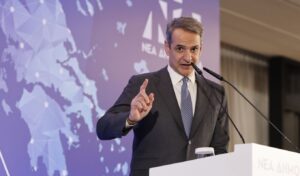
Kyriakos Mitsotakis on Monday acknowledged that the change being made with the transition of OPEKEPE to AADE – which he characterized as a necessary reform – has political cost for the government, and that there are delays in payments. He also called on farmers “to consider that sometimes the most extreme mobilizations may turn large segments of society against farmers, who may have legitimate demands,” as messages have already reached Maximos Mansion from hotels and other businesses in the periphery that are seeing the first damages recorded from roadblocks and the problems they cause in transportation and transfers.
Mr. Mitsotakis emphasized (speaking to Nikos Hatzinikolaou at the “Health Above All” conference) that the government is open to good-faith dialogue. “What do we ask? That there be serious representation of farmers, that we know who we are talking with, and also that they come with specific demands. Because at this moment there is a general ambiguity, which does not serve our effort to sit together to plan the next steps that need to be taken for the productive sector,” he said, setting the framework for dialogue.
He also set the limit of dialogue, which is what the Commission allows and what it doesn’t based on European rules, while leaving a barb for the Karamanlis government in 2009 and the so-called Hatzigakis package, of the then Minister of Agricultural Development: “Let’s see within the framework of European restrictions what we will do. But we are not going to make the mistake we made in other times again, to promise and give farmers money that we could not subsequently justify and Europe asks us to return with interest. Therefore, whatever is done must also take into account the European dimension”.
Indicative of the government’s plans for farmer support measures are what Minister of Agricultural Development Kostas Tsiaras said yesterday speaking to Action24. Speaking about cheap agricultural electricity, he emphasized that “the Prime Minister himself last week asked all of us to find a way with DEI so that the cheap tariff, that is 9.2 cents per kilowatt hour, can be extended, because the original plan was for 2+8 years, that is two years we would have a locked price of 9.2 cents per kilowatt hour and the next 8 there would be essentially a combination in the final price, which would be 33% stable and from there on could be combined with any cheap DEI tariff. This is what the Prime Minister asked us, to find a way, and I think the specific issue has been raised by the Deputy Prime Minister to DEI in order to extend the low locked price per kilowatt hour for agricultural electricity.” As the Minister of Agricultural Development said, it is open to extend cheap agricultural electricity.
He then mentioned that “for the first time we have legislative regulation for 100% return of the Special Consumption Tax in our homeland. This means that without calculating as a ceiling the amount that will be allocated, all invoices submitted through this specific procedure will receive the return of the Special Consumption Tax.” The second problem “concerns the fact that the determination of the amount of fuel needed per crop was made in 2015 and we are in dialogue with farmer representatives so that in the coming period – it is not an easy exercise nor does it require little time – we can redefine the quantities of fuel needed for each crop. To this you must add that a few days ago the Prime Minister decided and announced an additional 50% return of the Special Consumption Tax”.