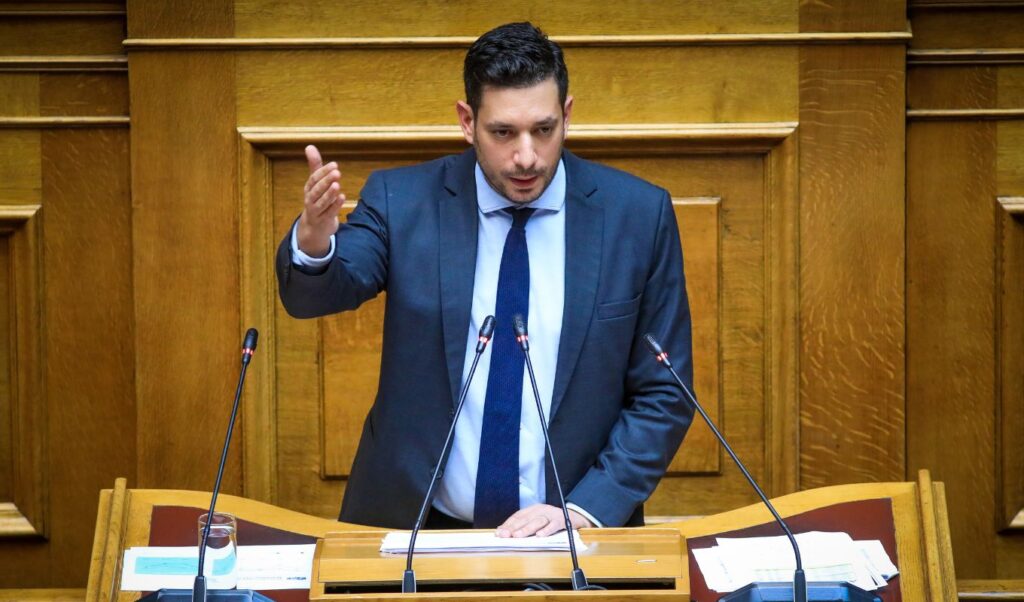
The reasons behind the traffic chaos plaguing Athens streets were addressed by Deputy Transport Minister Konstantinos Kyranakis speaking in Parliament during a current question session by PASOK. According to the Deputy Transport Minister, the factors contributing to traffic congestion are the year-round tourism season – with 600,000 to 700,000 tourists arriving monthly in the country – as well as freight transport.
As Mr. Kyranakis admitted, “trucks burden Kifissos, Attiki Odos and the major arteries. Imagine what will happen at Elliniko, having a supply chain during peak hours in this new city being created. It’s impossible, we must do something serious and interventional. I can’t do something alone, that’s why we are in consultation with the competent ministries, with the Development Ministry.”
Kyranakis: Truck traffic ban
In this context, Mr. Kyranakis insisted on the proposal he made in recent days regarding banning truck traffic during morning hours when traffic congestion occurs, adding that consultation is ongoing with truck drivers’ unions to adapt the supply chain so that trucks don’t burden the main arteries from 7 to 10 AM, when most Athenians go to work.
At the same time, he emphasized significant projects that will lead to road axis decongestion as well as the Elefsina-Thebes rail connection (Thriasio-Sfinga), informing the House that in the first quarter of ’26, an official request will be submitted to fund this specific study. He also mentioned that the Ministry of Infrastructure and Transport is examining a medium-term proposal related to changing the logistics operation mode around the urban fabric. He also spoke about increasing suburban routes that will contribute to decentralization, as well as relocating businesses outside the center, next to railway hubs.
However, what was surprising was that Mr. Kyranakis admitted that opposition proposals regarding adopting flexible working hours and car trip sharing are heading in the right direction. He referenced a recent survey on traffic congestion in 29 major European cities, highlighting that our country is in the middle, ranking 15th.
On the other hand, he commented that with the triptych “more drivers, new vehicles, clean bus lanes,” better service will be offered to citizens in 2026. In this context, the Deputy Transport Minister announced new hirings, while arguing that opposition leader Nikos Androulakis’s claims about losing Recovery Fund resources are untrue, given that all new buses circulating were purchased with European money.
“300 hirings at OSY”
Additionally, he informed the House about announcing 300 hirings at OSY, driver salary increases from 2026, while taking shots at PASOK, commenting that “thinking in small-party terms,” it didn’t vote for the bill related to installing cameras on bus lanes. Regarding metro extension to Glyfada, he noted that the project study begins in early ’26 and emphasized the urgent need for implementation, considering that traffic gridlock will be created in the area due to Elliniko.
“The planning is agreed with local government and shows a branch. It leaves from Elliniko, ending at the terminal station at Agios Konstantinos. The upper branch reaches Upper Glyfada, at Gounari and ends at Vouliagmeni. It’s a very important project, whatever government there is must continue it,” he characteristically stated.
Additionally, Mr. Kyranakis referred to the electric railway operation. “Things are very difficult with the electric railway, citizens are right,” Konstantinos Kyranakis meaningfully admitted. He also mentioned new trains expected to be added and the “Clean Line” program, informing that crews are cleaning graffiti and dirt. Finally, regarding Metro routes, he argued that it now operates with 52 trains, compared to 40 during ’15-’19, while setting a goal to add 4 more trains to Line 3 by 2026.