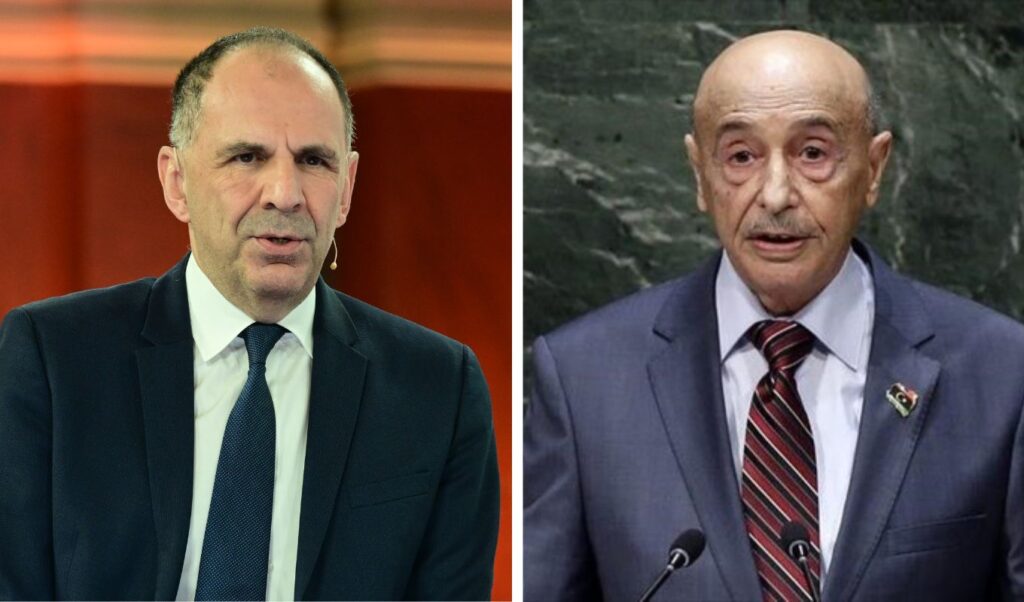
Relations between Greece and Libya are expected to be put on the table in today’s meeting between Foreign Minister Giorgos Gerapetritis and the President of Libya’s House of Representatives Aqila Saleh, who is visiting our country for the third time.
The exchange of visits and contacts with officials from both sides of the North African country, at the highest level, which began in the summer, smoothed out the crisis in Greek-Libyan relations that had been caused by the signing of the Turkish-Libyan memorandum in 2019. It should be recalled that the visits of Foreign Minister Giorgos Gerapetritis to Libya and talks with the two heads of government prevented the ratification of the illegal Turkey–Libya agreement, just before the competent parliamentary committee was formed to rule on the legality of the Turkish-Libyan memorandum.
Gerapetritis-Saleh meeting: Window of opportunity to cancel Turkish-Libyan memorandum, Chevron & ExxonMobil “push” Greece-Libya EEZ agreement
Political scientist and international relations expert Theodoros Tsikas, speaking to parapolitika.gr, points out that Libya’s Parliamentary President never changed his stance toward the Turkish-Libyan memorandum, unlike Marshal Khalifa Haftar whom Ankara approached. According to Mr. Tsikas, Libya’s parliamentary president“despite being based in Eastern Libya, has not followed Haftar’s moves (at least for now) and appears to maintain the same position. Therefore, some points of convergence can be found, because we know there is pressure now from Turkey toward Libya’s Parliament to ratify the Turkish-Libyan memorandum. So I imagine the minimum the Greek government can ask for is that the ratification of the Turkish-Libyan memorandum not proceed“.
According to diplomatic sources, Giorgos Gerapetritis is expected to reiterate to Mr. Saleh that Greece rejects the Turkish-Libyan memorandum as illegal and invalid, and as Foreign Ministry spokesperson Lana Zochios had stated, this position is also the European Union’s stance.
In divided Libya, any agreement is considered difficult to implement without the participation of the internationally recognized government in Tripoli. Technical committees between Greece and Libya were established with Abdul Hamid Dabaiba’s government to explore the issue of maritime zone delimitation and the Exclusive Economic Zone (EEZ). However, despite the agreement, they have not yet convened (except for the inaugural session).
However, the maritime zone delimitation processes between Greece and Libya appear to be accelerating due to the presence of major American energy companies Chevron and ExxonMobil south of Crete. Mr. Tsikas points out that“these companies, because they are going to operate south of Crete, are very likely to request intervention from the American government to mediate between Greece and Libya, the Tripoli government, so there can be a settlement on the maritime zones issue. Because exploitation in a non-delimited continental shelf is not allowed, it is prohibited by International Law. And since Greece and Libya have not delimited continental shelf and Exclusive Economic Zone, there will be a legal issue. And I don’t think American companies want to complicate things further“.
The US President’s advisor on African affairs, Massad Boulos, according to international relations expert Theodoros Tsikas, has contacted the Greek government in an effort to find a solution, either for complete maritime zone delimitation, partial delimitation, or at least some informal understanding between the Greek and Libyan governments to reach an agreement.
The neighboring country’s intentions regarding EEZ delimitation, as the Greek side ardently desires, are expected to become apparent during today’s meeting between the Foreign Minister and Libya’s House of Representatives President.