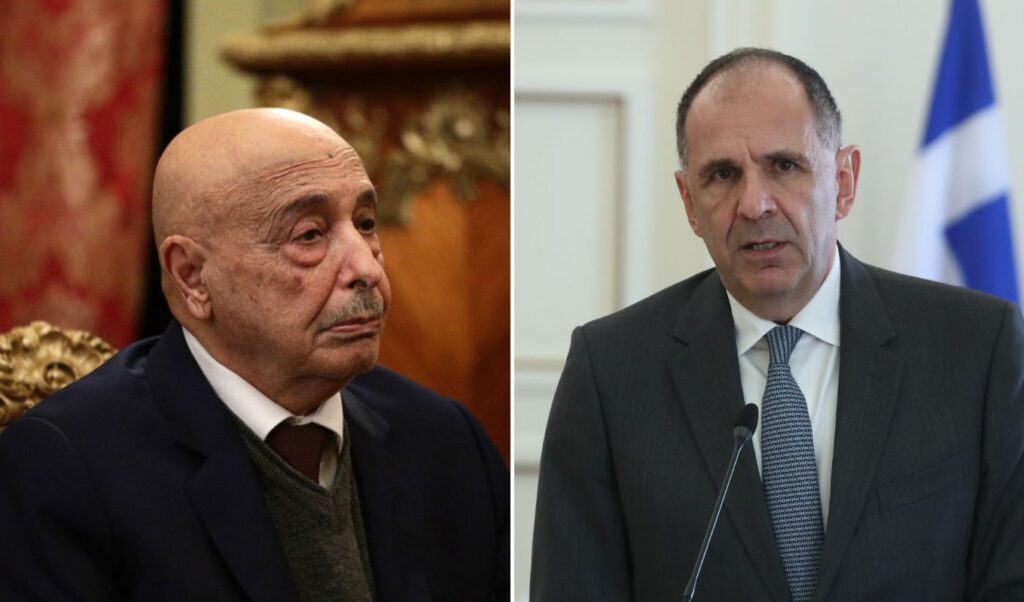
For the second time, the President of Libya’s House of Representatives will visit Greece. Akila Saleh will arrive in our country on Friday, December 5, to meet with Foreign Minister George Gerapetritis. The main subject of the meeting is expected to be the Memorandum of Agreement signed by Turkey with the Tripoli government of Libya, known as the “Turkey-Libya memorandum.”
Greece’s request is the practical cancellation of this agreement that was signed in 2019 and was approved by the Turkish National Assembly, but not by Libya’s House of Representatives, where it was voted down.
During that period, Khalifa Haftar’s government, based in Eastern Libya, rejected the Turkey-Libya memorandum as an “illegal agreement that violates International Law and does not respect the legitimate rights of other Eastern Mediterranean countries,” as stated in their announcements. However, today the relations between Eastern Libya’s government and Turkey have normalized, with Khalifa Haftar concluding economic and defense agreements with the Turkish President, consequently changing his stance and appearing ready to ratify the agreement.
However, the President of the House of Representatives, Akila Saleh, appears to maintain a different position. On December 12, 2019, when he had visited Athens again, just days after the signing of the Turkey-Libya memorandum, he rejected the agreement as illegal. Beyond this, he had also sent a relevant letter to the UN Secretary-General requesting its rejection. His stance has not changed to this day, and the House of Representatives has not yielded to Ankara’s pressures. The memorandum has not been ratified, something that would offer Turkey the right to conduct research in maritime zones northeast of Libya, contrary to International Law and the Law of the Sea.
The spokesperson of the Greek Foreign Ministry, Lana Zochios, reiterated once again during the regular briefing of diplomatic correspondents on Tuesday that Greece’s position that the Turkey-Libya memorandum is null and illegal is also the position of the European Union.
Regarding the work of technical committees established by Greece and Libya to discuss the issue of EEZ delimitation between the two countries, Ms. Zochios mentioned that the second session to be held in Tripoli, Libya, has not yet been scheduled, characterizing the issues to be resolved as “complex and complicated.”
In contrast, a Greek business mission led by Deputy Foreign Minister Harris Theocharis is scheduled to travel to Benghazi in January 2026. Greek companies are set to engage in the country’s reconstruction projects.
Additionally, within the framework of efforts to establish a unified government in this African country torn by civil unrest, Foreign Minister George Gerapetritis had a telephone conversation on November 19 with the UN Secretary-General’s Special Representative to Libya, Hana Tetch. Mr. Gerapetritis reiterated Greece’s support for the UN mission’s roadmap, aimed at advancing the political process in the country to find a solution and end the conflicts.