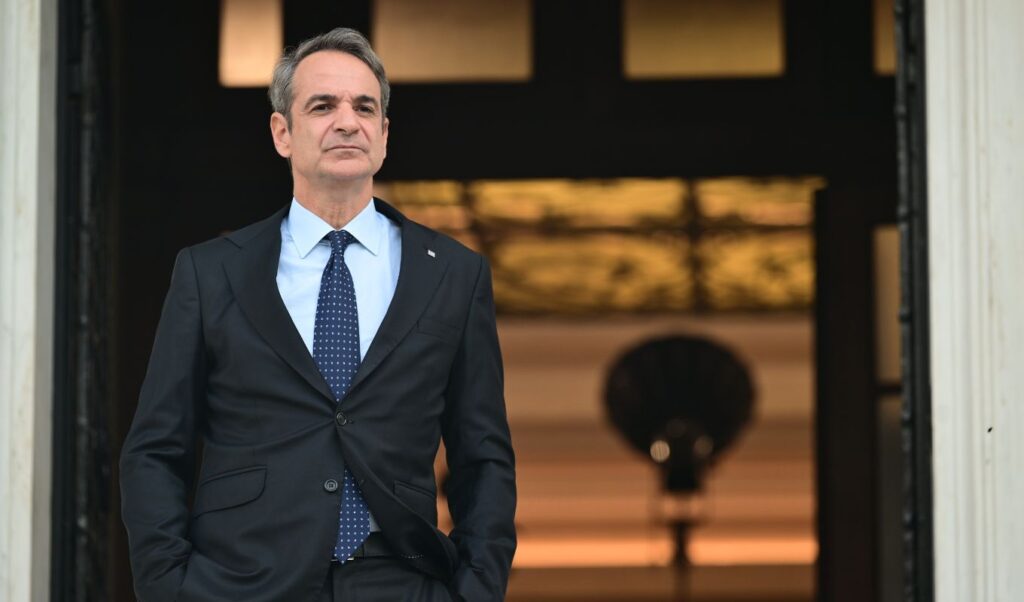
“The Greek crisis belongs to the past and Greece is steadily achieving remarkable recovery,” is the message that Kyriakos Mitsotakis will send today to investors, bankers and fund managers in London, at the same time that the UK’s main topic of discussion is the additional 26 billion pounds in taxes provided by the state budget for 2026 to cover large gaps.
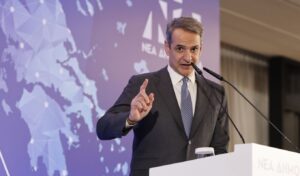
The Prime Minister is already in the British capital, where he will soon participate and speak at the fourth investment conference “Morgan Stanley and Athens Stock Exchange Greek Investment Conference,” organized by Morgan Stanley and the Athens Stock Exchange. At 10:15 (local time) he will have a public discussion with Clare Woodman, Managing Director of Morgan Stanley & Co. International and Head of Europe, Middle East, Africa, Latin America and Canada. Also, on the sidelines of the conference, he will meet with major investors.
Later, he will travel to Oxford, where he will have a fireside chat at the Blavatnik School of Government at Oxford University, a school that has evolved into one of the world’s leading centers for education and research in public policy. The discussion will be with Ngaire Woods, Professor of Global Economic Governance and Dean of the School, who is considered to provide high-level interdisciplinary training in governance, international relations, economic policy and leadership, and serves as a reference point in connecting theory and practice of governance.
This period, despite the globally unstable environment due to the two-year war in the Middle East, the ongoing war in Ukraine and other factors, is considered by Maximos Mansion to provide significant opportunities for foreign businesses and capital to come to Greece, and this is the main goal of the Prime Minister’s travels. Political stability in the country, where an autonomous government has been ruling for almost seven consecutive years, is one of the key elements of the Prime Minister’s political “narrative” to his foreign interlocutors – whether those he saw days ago in Singapore, those he will meet in England, or elsewhere.
The second element of the international environment that he highlights according to sources in discussions the Prime Minister has, is the political and fiscal situation in Europe’s major economies, such as England, France and Germany, with serious parliamentary disputes and intra-governmental crises regarding the preparation of national budgets, at the same time that these countries’ economies are trapped in weak growth. He contrasts the situation in our country, with stable growth in recent years, well above the European average, with parallel continuous annual primary budget surpluses.
As Mr. Mitsotakis mentioned in a digression of his speech at the recent cabinet meeting, “at a time when most governments in Europe – the Finance Minister knows this well from his international contacts – are forced to vote for austerity budgets – you saw what happened in the United Kingdom which is currently facing a ‘hole’ exceeding 20 billion pounds – we can not only achieve our fiscal targets, but also return the dividend of growth back to citizens, as a ‘bulwark’ against the increased cost of living.”
The third part which, according to the same sources, the Prime Minister focuses on in closed discussions like the one he will have this morning with investors, bankers and businesspeople, is the capabilities and opportunities presented by the Greek economy. “Many of them think we only have tourism and shipping, but he explains that we export pharmaceuticals, agri-food goods, high-tech products and others, he analyzes developments in energy, logistics, startups,” a Prime Minister’s associate tells “P”. “He creates confidence and the way he communicates all this,” argues his associate.
Specifically in London, this morning, Kyriakos Mitsotakis, according to government sources, will have the opportunity to present the continued progress of the Greek economy and Greece’s attractiveness as an investment destination. This progress is reflected, as he will emphasize, in the growth rate of the Greek economy that consistently exceeds the European average, the significant reduction in unemployment, the increase in investments (including foreign direct investments), the continuous reduction of public debt, the good performance of the Greek financial sector where significant foreign investments are recorded (UniCredit and Euronext), the emerging startup ecosystem, and Greece’s progress in digitization and the integration of Artificial Intelligence in economic activity, education and public administration. The Prime Minister will also refer to Greece’s transformation into an energy and broader economic hub in the Southeast Europe region, as well as the strengthening of our country’s geopolitical importance in the broader region.