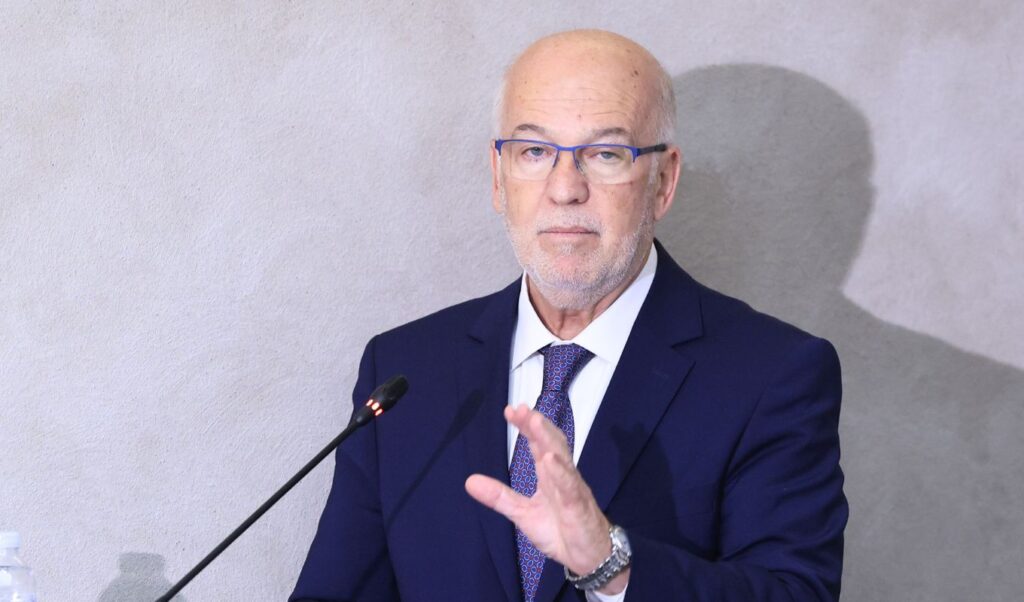
Justice Minister Giorgos Floridis presented a complete restructuring of the country’s forensic medical services, emphasizing that the system had been in a state of “complete dissolution” for decades. “The situation was extremely poor, and this was unfortunately confirmed by court decisions, which ruled that forensic doctors in serious cases had not done their job properly,” he stressed.
According to the minister, forensic medical services had operated for 115 years without unified administrative structure, without supervision, and without common examination protocols, creating serious discrepancies and doubts in reports submitted to judicial authorities. “We are not talking about reorganization, because you reorganize something that is already organized. Here we are talking about organizing from scratch,” he emphasized.
Floridis on forensic services: What changes with law 5172/2025
The new law established a General Directorate of Forensic Medical Services within the Ministry of Justice, along with regional directorates and departments, aiming for clear hierarchy, supervision and guidance. Additionally, a mandatory unified standard for drafting forensic reports was established, ensuring each examination includes specific data and avoiding ambiguities that previously created problems in criminal proceedings.
A significant innovation is the establishment of a three-member re-evaluation committee, which will examine cases of controversial reports that previously could not be assessed in a direct and acceptable manner by the Justice system. “We heard countless criticisms that the committee has questionable purposes. However, it is a crucial tool for the service to fulfill its mission,” Mr. Floridis noted.
Digital transformation with artificial intelligence
In collaboration with the University of Piraeus, forensic medical services are transitioning fully to a digital environment. Dean of the School of Information and Communication Technologies and director of the Computational Biomedical Laboratory, Ilias Maglogiannis, presented the new information system, which utilizes artificial intelligence and will serve as a unified database nationwide.
The system will enhance speed in report issuance, ensure transparency, provide automated data recording, and enable interoperability with other public services involved in criminal proceedings.
The programmatic agreement cost amounts to €751,635 including VAT, while including an obligation to install information systems worth €100,000. According to the minister, the produced work constitutes a “uniquely valuable digital product, possibly a global prototype,” which can subsequently be utilized more broadly by the University.
Systemic problems faced for decades
The ministry’s service secretary, Viky Giavri, presented photographic material depicting the state of abandonment of many forensic centers, as well as renovation and modernization projects that have been completed or are in progress.
Among the problems that characterized the system for years:
– Absence of operational planning
– Lack of evaluation and control
– Years-long delays in issuing forensic reports – in one case lasting 5 years
– Understaffing and shortages of mortuary attendants and specialized personnel
– Inadequate medical equipment and substandard mortuaries
– Controversial forensic reports in high-profile cases
– Mandatory autopsies even for deaths within hospitals
– Unidentified bodies in refrigerated chambers for extended periods
– Where and when new services will operate
The restructuring includes significant changes to the operational map of forensic units:
– From July 1, 2026: Merger of Athens and Piraeus mortuaries into a new, modern facility serving all of Attica.
– From January 1, 2026: Operation of daily forensic medical services in Kavala for Kavala and Drama prefectures.
– From early 2026: Operation of forensic services in Polygyros (twice weekly in winter, daily in summer) for Chalkidiki prefecture.
– Nea Moudania: Medical office for clinical cases.
Already operational since November 1, 2025: Service in Chalkida twice weekly for Evia and Boeotia.
Additionally, on December 18, 2025, with sponsorship from Heal Academy, the first training cycle for forensic doctors begins, focusing on child abuse and psychological support for citizens.