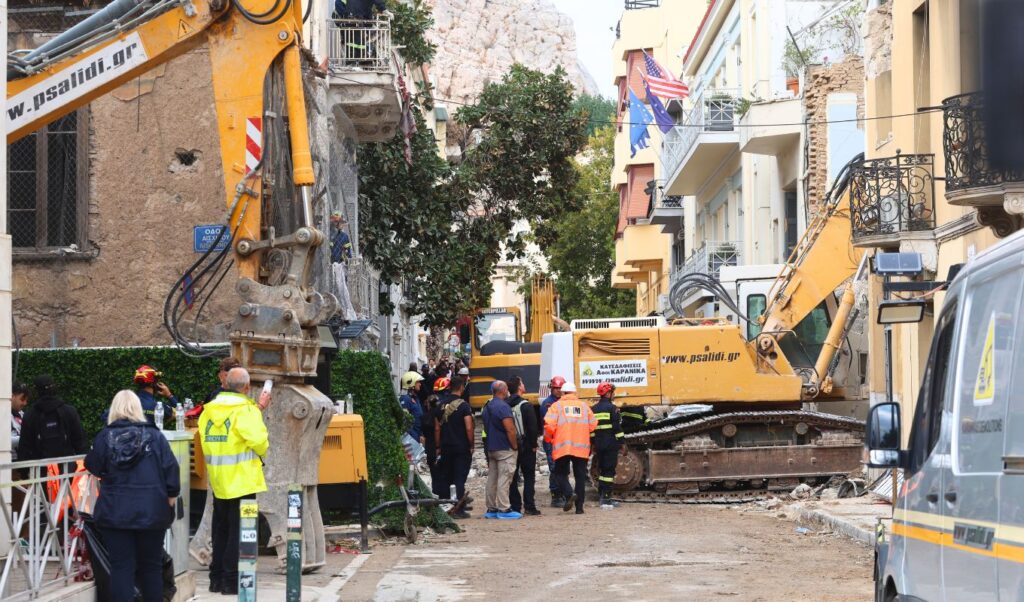
Authorities are investigating the cause of the powerful deadly explosion that occurred early Friday morning (26/09) in Plaka, Athens. After completing the search operation for six missing persons — who were tragically recovered dead — investigators continue to comb through the rubble of the collapsed apartment building on Lysikratous Street, while concerns also mount over structural damage to surrounding buildings.
Plaka tragedy: Investigation into the cause of the explosion continues
By order of Minister Evangelos Tournas, fire service units and personnel from the 1st EMAK (Special Disaster Response Unit) will remain on site for as long as necessary to assist with ongoing operations. The head and a team from the Arson Crimes Investigation Directorate (DAEE) will also remain at the scene, continuing their preliminary investigation to determine the cause and circumstances of the incident.
As explained by Fire Service and Athens Municipality officials, debris from the building is being transferred to a dedicated facility where it is being meticulously examined by teams from the Athens Arson Crimes Investigation Directorate, in an effort to uncover traces that will reveal the cause of the deadly blast. Meanwhile, the first structural inspection by the Urban Planning Authority of the neighbouring buildings is expected to take place on Monday.
Vathrakoyannis: No gas odour complaints were reported before the explosion
During an emergency briefing, Fire Service Chief of Strategic Planning and Communications, Chief Fire Officer Vasilis Vathrakoyannis, stated that “because a gas smell was reported, staff from the enaon EDA company were requested and attended the scene — a company that has since issued a relevant statement,” adding that “prior to the explosion, no complaints regarding a gas odour in the area had been reported to the Fire Service.”
He explained that the operation is being carried out in accordance with the standard protocol followed after a building collapse caused by an earthquake, without interruption throughout the night and with the presence of the Hellenic Police.
Regarding the investigation into the cause of the explosion and fire, Mr. Vathrakoyannis noted that from the very first moment, a team from the Arson Crimes Investigation Directorate — consisting of 10 specialised officers — was deployed to the site of the explosion and fire at the building in question.
He stated that as part of the ex officio preliminary investigation, DAEE officers are documenting the scene, collecting and evaluating every piece of evidence that may contribute to establishing the circumstances of the incident. He added that the sequence of the explosion, fire, and building collapse is being examined in order to determine the root cause.
“The preliminary investigative actions are being carried out under the guidance of the competent Athens Court of First Instance Prosecutor’s Office and in cooperation with the relevant services of the Hellenic Police,” he noted. He also emphasised that throughout the operation, geophones are being used to detect sounds, alongside cameras to locate individuals, with the support of search and rescue dogs.
Currently deployed at the scene are 30 firefighters with 6 vehicles, including two specialised rescue vehicles from the 1st EMAK, as well as 3 search and rescue dogs.
Athens Mayor Doukas points to major gas leak as likely cause
Athens Mayor Haris Doukas, who was again present at the scene, stated that according to initial assessments, the powerful explosion may have been caused by a gas leak. “Unfortunately, the worst-case scenario has been confirmed. We have six bodies. We said from the beginning that this was an extremely difficult situation. You can see for yourselves that things will continue to be difficult going forward, because we are talking about two neighbouring buildings that are also now unusable. The process needs to move quickly for those as well — they are dangerous. The building across the street also has serious cracks, and we will need to assess how dangerous the situation is there too. Experts will continue to be here over the coming days, along with the Municipality’s crews and the specialised equipment we have. People have worked over 30 hours without stopping for a single minute,” Haris Doukas stressed.
“And they will continue with great care to find whatever else may be there. Every finding now is extremely important. We also need to see how we can quickly move forward with the other two buildings so that this street can return to normality as soon as possible. Until then, the greater part of the road will remain closed. The Municipality’s specialised crews will be present, along with Municipal Police, Hellenic Police, and we are always coordinating with the Fire Service.”
“There are expert investigators collecting data. I should mention that, in cooperation with and under the guidance of the experts, the debris is being taken to a dedicated storage facility, where the Fire Service and the relevant authorities will carry out all necessary checks. The initial indications point to gas, and it must have been an extremely large — let’s put it this way — concentration, because the blast that occurred is unprecedented. This was not a very small leak; we are talking about an extensive leak and one of enormous force,” he added.
Regarding the natural gas leak specifically, the Mayor said: “I don’t have that information myself. Nothing official has come through to us. Representatives from the gas company are here on site. They will need to inform us whether such an issue existed or not.” “The initial assessment is… The building that collapsed has collapsed. The neighbouring ones are, I believe, already disused — the Urban Planning Authority, which has already carried out a first inspection and will report back in detail on Monday, did not consider them to be in a critical state previously. Now they are in a state of disuse, and the building across the street has sustained very serious damage. The Urban Planning Authority has attended and carried out an initial inspection. What is critical now is for the EMAK teams to complete their work here, so that we have all the data and the experts can answer with absolute certainty what the cause of this tragedy was,” he said regarding the condition of the adjacent buildings.
Lekkas: The scene in Plaka reminded me of Beirut
The President of the Earthquake Planning and Protection Organisation (OASP), Efthymis Lekkas, also visited the site in Plaka and said that the scenes he witnessed reminded him of the explosion that had taken place in Beirut, adding that “the building was old and made of masonry — bricks — which are particularly vulnerable in this kind of event, as they have no structural cohesion whatsoever.”
He also commended EMAK for its exemplary rescue operation, while on the subject of the explosion he noted that the matter remains under investigation, with the natural gas leak scenario being one of several possibilities currently being examined.