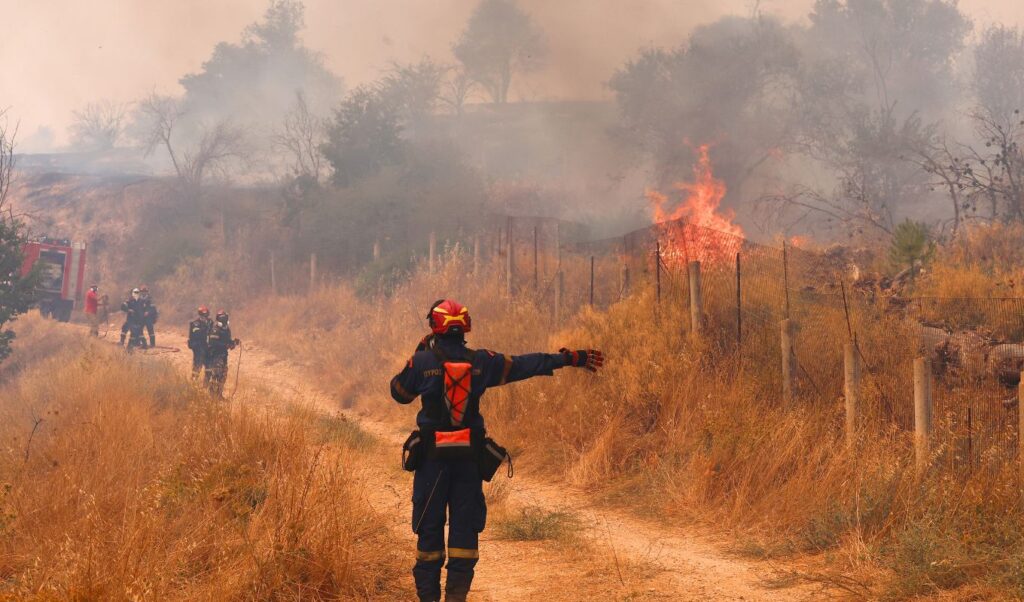
With unrelenting intensity, the battle continues against the massive wildfire that has been burning since last Friday across the Attica-Boeotia region, with the Greek Fire Service having deployed one of the largest firefighting operations in recent years — on land, in the air, and at sea.
Attica-Boeotia wildfire: Massive ground and aerial forces battle the flames
From the early morning hours of Monday, 23 firefighting aircraft and 11 helicopters were thrown into the battle, three of which are being used exclusively for operational coordination. At the same time, hundreds of firefighters, volunteers, water tankers, and heavy machinery are working to contain the fire fronts, while the specialized “DEUCALION” team is providing support to ground forces.
Meanwhile, heavy machinery from the Construction and Natural Disaster Management Command, working in coordination with the Forestry Service, continues to cut firebreaks in an effort to halt the fire’s advance.
How the shield is being built on land, in the air, and at sea
The operation, however, extends well beyond the land. In the coastal zone, two vessels and a Fire Service speedboat are on standby, alongside Coast Guard ships and private watercraft, patrolling the waters off Psatha, Nea Peramos, and Pachi Megaros — ready to intervene immediately should a new evacuation of residents become necessary.
The Hellenic Police and the National Emergency Medical Service (EKAV) remain on full alert, while buses from the Fire Service and the Armed Forces have been deployed in the area to facilitate the potential transport of residents. All forces are being coordinated from the mobile operations center “OLYMPOS,” with ESKEDIК receiving a continuous feed from drones equipped with thermal and optical cameras.
24 emergency alert messages sent
The danger level remains extremely high, as the area is classified at Category 4 on the wildfire risk forecast map. Today alone, five new emergency alerts were issued via the 112 system for the precautionary evacuation of residents from areas including Kandyli, Psatha, Alepohori, and the Megara Industrial Zone.
In total, since the outbreak of the major wildfire, 24 emergency alert messages have been sent — 19 had already been issued up to August 2nd, with an additional five dispatched today. In the preceding days, sea evacuations were also carried out, with 254 people rescued from Agios Vasileios on July 31st and a further 12 individuals safely transported from Porto Germeno on August 1st. These numbers reflect the sheer scale of an operation that remains fully underway.
Despite the unprecedented mobilization and the massive operational footprint deployed across land, air, and sea, the battle is far from over. Constantly shifting winds, severely reduced visibility caused by dense smoke, rugged and difficult terrain, and a range of unpredictable operational factors are continuously testing the effectiveness of the firefighting “shield.” The result is an ever-evolving series of new challenges for firefighting forces, with the battle against the raging inferno remaining fierce and being fought simultaneously across all fronts.