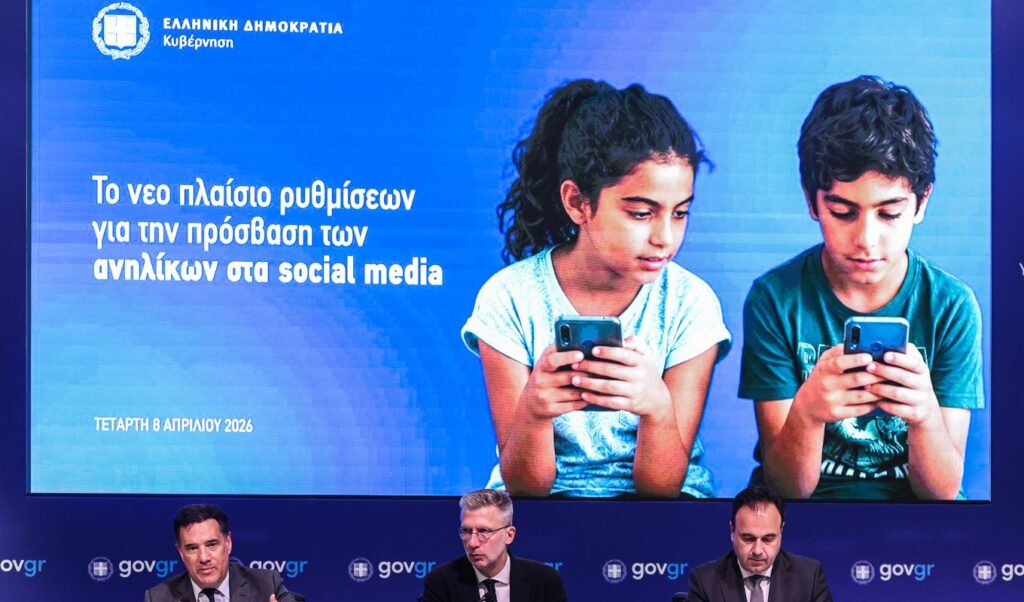
From January 1, 2027, Greece will implement a pioneering measure to protect minors in the digital world. Children under 15 will no longer be able to access social media platforms, according to the new regulatory framework announced by the competent ministries. The regulation is accompanied by KidsWallet, the first state age verification mechanism in the European Union, and aims to combat digital addiction that threatens young people’s mental health.
The Greek initiative on the international stage
The Greek Prime Minister raised the issue of protecting minors from internet addiction at the UN General Assembly in September 2024. This initiative is part of a broader international movement, as countries like Australia, France and Spain adopt similar measures. The Greek government promotes a series of actions both at national and European level, with the central focus on strengthening parental control and protecting children’s psychosocial development.
Which platforms does the ban cover
The measure applies to all social networking services where users create profiles and interact with each other. Platforms such as Facebook, Instagram and TikTok are included in the ban. According to the Digital Services Act (DSA), the companies themselves bear the responsibility for installing reliable age verification systems. Implementation will be gradual and will include a re-verification process for existing minor accounts.
The role of regulatory authorities and sanctions
EETT, ESR and the Data Protection Authority will supervise platform compliance with the new framework. Companies that do not comply face strict sanctions. Fines can reach up to 6% of their global turnover, while daily fines are also provided until full compliance. Additionally, in cases of personal data breaches, GDPR sanctions apply, while restrictions on platform operations may be imposed.
The impact of social media on children’s mental health
Experts warn that excessive exposure to social media and mobile phones seriously affects the psychosocial development of minors. Scientific studies record increased levels of anxiety, depression and social isolation among young people. Researchers have observed that platform use activates the same reward circuits in the brain that are activated by addictive substances. Digital addiction is now treated as a serious public health issue requiring immediate intervention.
Concerning data from OECD research
According to OECD research, 17% of children aged 11 to 15 have fallen victim to cyberbullying. Even more concerning is the fact that 23% of 15-year-old adolescents feel intense insecurity when they don’t have access to their mobile phone. This data underscores the need for a systematic approach to the problem and strengthening protection mechanisms for minors online.
KidsWallet and strengthening parental responsibility
The new regulation does not constitute a form of digital policing, but a tool for empowering the parental role. Parents are called to install KidsWallet and supervise its proper use by their children. The system functions as a communication bridge between parents and children, promoting dialogue about boundaries and responsible use of technology. Parental consent and supervision are fundamental pillars of the new framework.
The European framework and the Digital Services Act
The Digital Services Act sets clear obligations for protecting minors online. It prohibits targeted advertising to children and requires platforms to take measures to ensure their privacy. The European Commission is developing unified age verification systems, which will connect with the EU Digital Identity Wallet by the end of 2026. This comprehensive approach aims to create a safer digital environment for children across Europe.
The Greek proposal for a unified European limit
In a letter to the President of the European Commission, the Greek Prime Minister requests the establishment of a unified European digital age limit of 15 years. The proposal includes mandatory use of common verification mechanisms in all member states and acceleration of the sanctions enforcement process for platforms that violate the rules. The Greek initiative aims to create a uniform protection framework throughout the European Union.
Implementation timeline for the new framework
The measure implementation process follows a specific timeline. European consultation is planned for the second quarter of 2026, while law voting is expected in the third quarter of the same year. Companies will have a compliance period until the end of 2026 to adapt their systems. Full implementation of the social media ban for minors under 15 officially begins on January 1, 2027, marking a new era in digital protection of children in Greece and Europe.