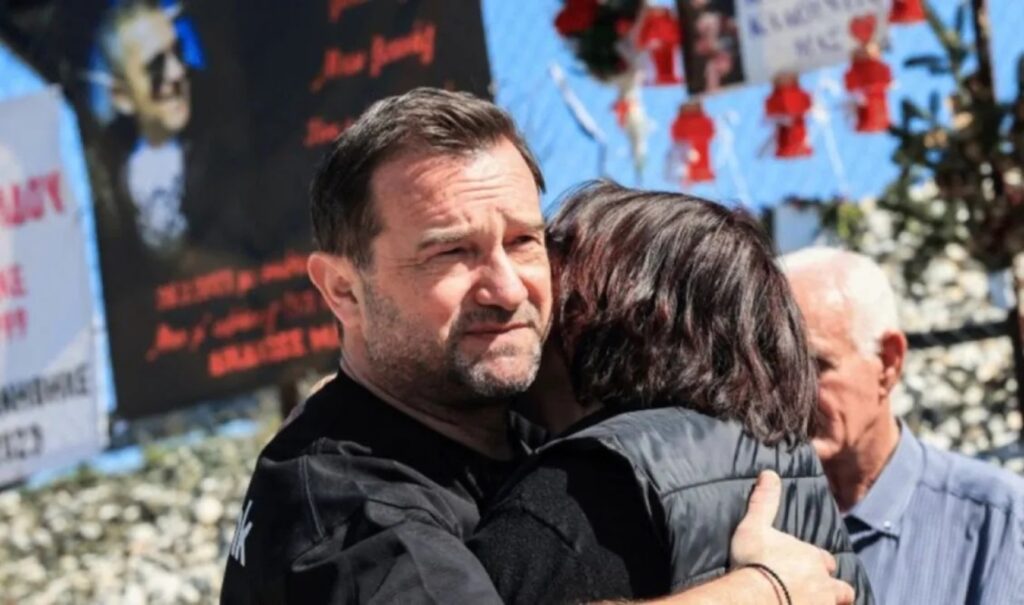
Nikos Plakias, who lost his twin daughters and niece in the Tempe tragedy, spoke about that night and gave words that remain, because it’s not simply a narrative of events, but a raw depiction of how a parent freezes, how they wait, how they try to grasp onto any information to avoid collapsing, and how anger comes later when they realize that justice is not a matter of days. Speaking to OPEN, he described how when he heard about the train derailment, he didn’t even do the obvious thing of immediately calling his children – as he said, he froze and waited for developments. Initially he was reassured by the first reports that there were no deaths or injuries, but then only one question began to eat at him: whether his children were alive during the collision or after, and if they needed anything, if they called out “dad or mom.” This thought, as he describes it, was the first and most torturous burden, even before the “why” and “how” set in.
Tempe: The first night, the police station and the feeling they were “lost”
Mr. Plakias describes in his OPEN interview how he remembers that when he learned something had happened, he didn’t even tell his family, he waited, watched developments and then told his wife that something had happened because he couldn’t find the children. So they took the car and went to the Tempe Police Station. From the beginning, as he says, he felt that the three girls were lost. He saw the list of passengers who would be transported by buses, their names weren’t on it, and then they were directed to go to the hospitals where the injured were being taken. He describes a waiting scene that leaves no room for comfort. In the waiting room, a doctor came down and said that in the ICU there was a girl being treated, 1.75 meters tall, blonde, with blue eyes. As he says, three families from the center jumped up, and when the one from the center saw the photo, he hugged his family. Then, as he narrates, he understood it wasn’t his child. At that moment, the agony is no longer theoretical, it becomes a confrontation with reality, with who hope “takes” and who it leaves behind.
Tempe: The house, the room and anger for justice
Mr. Plakias talks about the first period where, as he notes, he and most relatives had their minds on the event and not on the causes. He remembers that at 40 days, when they went to hold the memorial service, everyone was together, with all those who discovered along the way that they had a share of responsibility. But the weight didn’t stay only outside, it came home and became daily life. He describes how he waited for the door to open and his child to come in, and says the worst thing was when he passed by the room, he didn’t dare turn to look, he wouldn’t go in. In the house there is only one photograph of the girls, in their room, as he emphasizes, no photos on the walls, no “their best moments” spread throughout the house. On the judicial front, his tone is clear and angry. He mentions that a train collision was initially treated like a simple traffic accident, and that even the families initially didn’t press much, as he says, few focused on the legal aspect. He points out that the first briefing was incomplete, and that the cover-up wasn’t even in the case file. In his conclusion, all those responsible must pay, from the station master to the minister, because, as he emphasizes, the relatives cannot point to just one responsible person – the case is not “one person” but a chain.
Three years later, he says there is no justice, expressing dissatisfaction that no one is in prison, while noting that the trial is expected to last many years. And he closes with a phrase that carries his entire burden, that the rage, hatred, and anger have not passed, and that “we didn’t make the girls into Iphigenias” to give the country a better railway system.