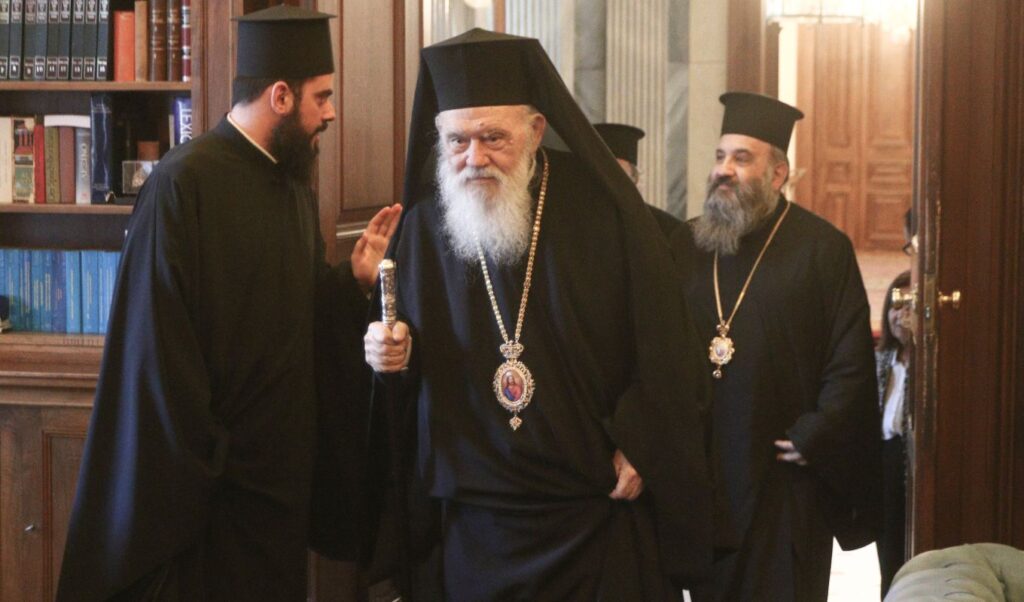
In an in-depth interview with the newspaper “TA NEA,” Archbishop of Athens and All Greece Ieronymos addresses critical issues concerning the Church. Just days after marking 18 years since his election and enthronement, His Beatitude reflects on the future of the Greek Church, new bishops, and the question of his succession. “I want to live, but I can also live without being an active Archbishop,” he characteristically states, leaving open discussion about the future.
“Many years have passed, the end comes for everyone. I must think about it too. That’s why I have two dreams and ambitions: To leave a Church that has as few and as small problems as possible, with bishops who love the country” and “with the issue of ecclesiastical property resolved, which has tormented Church-State relations for two centuries.”
Although the upcoming constitutional revision apparently does not concern Church-State relations, His Beatitude feels the need to say that the separation of State and Church involves “dangerous things” and admits that he now views the issue from a revised perspective.
In a climate of generalized international concern about immigration and more, he speaks of a national issue that now requires great attention because it constitutes an “approaching danger.” He also expresses intense concern about the future of Mount Sinai Monastery and declares clear pessimism about developments. He extensively discusses the Church’s philanthropic work, particularly in student housing, supporting young couples, and elderly care. He evaluates Prime Minister Kyriakos Mitsotakis’ response very positively and refers to Alexis Tsipras, George Papandreou, Antonis Samaras, and Kostas Karamanlis.
Dominant is his nostalgia for the past and concern for tomorrow in the homeland, youth, and Diaspora, to which he sends a resounding message. In a confessional tone, the Primate of the Greek Church does not avoid referring even to his personal end and succession, characteristically noting: “Many years have passed, the end comes for everyone. I must think about it too.”
Archbishop Ieronymos: “Only God knows”
Following are selected excerpts from the interview with Archbishop of Athens and All Greece Ieronymos:
Church and State: “Separation involves dangerous things”
His positions on Church-State relations are particularly interesting. Responding to whether things would be easier with complete Church independence from the State, the Archbishop notes:
“I too have had these thoughts and think them many times, but these are dangerous things for our Nation. The State, among other things, doesn’t have the same measure of judgment every time. And if we take specifically the property issue, from 1917 onwards, it interfered, tolerated, and committed plundering. It destroyed everything. Anyone in good faith can see and know this. The Church consumed and consumes itself for our People and Homeland. That’s how it acted, acts, and will act. And something more personal. I cannot and will never forget that Alexis Tsipras became the first Greek Prime Minister who publicly acknowledged the State’s debt to the Church. I’m preparing something. But since discussions are happening and it seems something will change, I say let me make a stop and let someone else continue…”
Concerns about Saint Catherine’s Monastery of Sinai
Asked how he assesses the situation at Saint Catherine’s Monastery of Sinai and the complications created in recent months, His Beatitude expresses intense concern.
“I think the problem remains. And it’s a very big problem. First, we should identify a major cause of the problem within the Monastery space itself. If the Monastery strictly followed its principles and what Monasticism says and advocates, and what Sinai Monastery represents, it wouldn’t be threatened from anywhere. Therefore, we must find within ourselves the reason and situation we need to heal. This is the most difficult part. Great damage has been done… I don’t know if you’re aware, but a large group of monks hasn’t gone to the Monastery. They’re here. What are they doing here, while down there are 6-7-10 people? What can they manage to do when 5,000 people pass through the Monastery daily? Then there will no longer be ownership. These are unfortunately things brought by new times…” he states.
The “two dreams” for the Church
Archbishop Ieronymos clearly describes his dreams for the future of the Greek Church. He simultaneously emphasizes the need for seriousness and consistency in educating the people, stressing that he desires bishops “who love the country, tradition, and want seriousness and consistency.”
“We must think about this too. I’m not saying now, we’re not saying tomorrow. We’ll see. I would like to make a confession myself. I owe it. Many years have passed, the end comes for everyone. I must think about it too. That’s why I have two dreams, ambitions: To leave a Church that has as few and as small problems as possible and with bishops who love the country, tradition, and want seriousness and consistency in educating our people, without extremes, and secondly, to leave ecclesiastical property free from usurpers – and it’s known who they are – and a Church in direct cooperation and excellent collaboration on many issues, especially social, welfare, and economic ones with the State, so there can be more light for everyone,” he emphasizes.
The next day for the Greek Church
The Archbishop appears optimistic about the new generation of hierarchs: “We have many good bishops and the latest batch produced even better ones.”
At the same time, His Beatitude gives a clear criterion for his succession.
“Only God knows. The person doesn’t interest me. This one or that one. From the following generation or the younger generation or my peers, as you journalists write. Neither from this ‘triad’ nor that ‘triad,’ nor from the new ‘quartet.’ What concerns me is that my successor loves people, cares for the weakest. Has deep kindness within him,” he emphasizes.
The human reference to blessed Archbishop Christodoulos
Particularly human is his reference to blessed Archbishop Christodoulos.
“We both made our mistakes in our personal relationship. We were united by love for the Homeland and Church. We were friends when we were younger. We remained friends, despite third parties who wanted us opposed… In the end I said goodbye to him and he said goodbye to me, like in the old days, when we were students. One forgave the other. Manly and priestly,” he characteristically states.
The “heroic” mother and lessons from childhood years
Perhaps the most moving part of his interview is the retrospection on his difficult, impoverished childhood years. With his father, Anastasios, forced to hide due to the troubled political situations of the era, his mother, Dimitra, became the absolute pillar of the household.
The Archbishop calls her a “heroine” and his essential protector. He nostalgically remembers Saturday afternoons when his mother, after finishing the week’s exhausting work, would take them for walks to an old village chapel. There, showing them folk frescoes from the Ottoman period, she taught them life’s true values: She showed them the miller who cheats on the scales or the person who is lazy on Sunday, building their moral character.
Closing this deeply human retrospection, the Primate of the Greek Church confesses what every person feels, regardless of their position: “I miss my mother very much after so many years.”
The message for the Diaspora
Asked to say a word about the Diaspora, His Beatitude states among other things: “It’s a Greece, beside Greece. That misses Greece. That fights for Greece, wherever and however it can. We owe one thing to our compatriots abroad: One. The ‘export,’ by every means and every modern medium, of our Culture and History, our Ancient Literature, the Literature of our Holy Fathers, constantly for the new generations of expatriates, whom I dream of speaking Greek, their language, of the place where they live.”