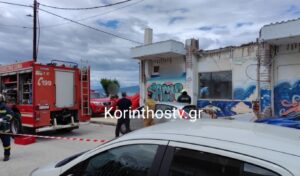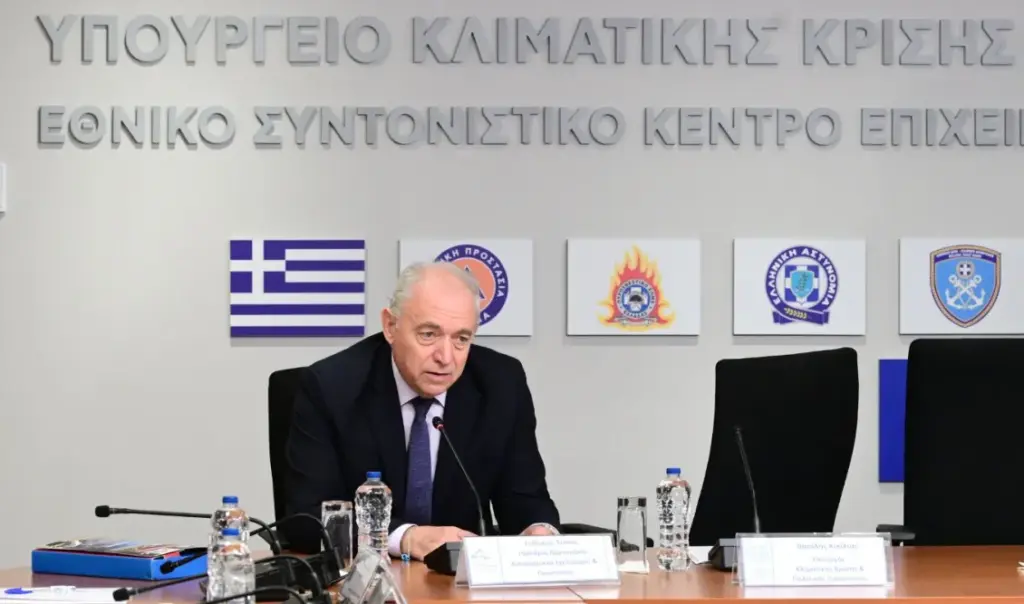
The reason why there have been frequent and intense erosive phenomena and landslides recently, such as what happened in the now-isolated Mazaraki in Ilia, was explained by Professor of Natural Disasters and president of OASP, Efthymios Lekkas. Specifically, speaking on ERT News Radio 105.8 today, Wednesday (18/02), Mr. Lekkas stated: “Landslides in the general sense of the term, because they include collapses, cave-ins, rotational landslides, debris flows, soil flows, mudflows and other phenomena, are phenomena that essentially shaped the planet’s surface along with earthquakes, erosion, sediment deposits, etc.”
“That is, all these phenomena are closely intertwined with the planet’s evolution. So, from this perspective, these phenomena occurred and will continue to occur. Now, however, we must examine the cause, because this year we have approximately 40% to 60% more phenomena than last year, phenomena that were essentially triggered by intense rainfall. That’s where the whole process lies. The causes existed and the causes are the geological structure, the nature of the rocks,” he characteristically noted.
Efthymios Lekkas: Many areas are high risk
When asked about this, Efthymios Lekkas noted that they could have been predicted, but when phenomena are widespread, it is very difficult to take action everywhere. Regarding whether similar events could occur in the future, he stated “certainly, because it’s not just the phenomena that have manifested. There are also phenomena that are essentially ready to manifest. That is, conditions are very ripe for these phenomena to occur, new phenomena.” Indeed, the professor noted that many areas are high risk. “There are extensive areas and we know these areas, which are susceptible to landslides. We can’t do many things because despite the fact that they are identified areas, large areas, we cannot intervene at specific points. (…)
When we are certain or with very high probability that a landslide will occur, we do it and it has been done many times in the past, but most times we are not certain that a landslide will happen. And you understand that if at this moment, for example, we have 100 villages in Greece that are at risk from landslides, you understand we cannot evacuate 100 villages. It’s an issue we face many times not only with landslides, but last year around this time, with the volcanic eruption in Santorini or major earthquakes or floods, that is, the entire Thessalian plain is a flood plain. We cannot evacuate the entire Thessalian plain. We must have solid scientific and technical data and say here definitely a flood phenomenon will occur one day, two days to carry out evacuation. (…)
Efthymios Lekkas: Red zone areas have previously experienced landslide phenomena
These areas that are in the red zone are areas that have previously experienced landslide phenomena and disasters. Special measures have been taken for these areas. Beyond that, however, we cannot cause tremendous social disruption over assumptions, even if these assumptions are based on some scientific evidence, to evacuate at the slightest provocation or in any case without significant reason, areas,” Mr. Lekkas added.
Regarding the landslide on the Ionia Highway, Mr. Lekkas mentioned: “There is another situation there, where human intervention also comes into play. That is, the cause is also anthropogenic, in what sense, in the sense that we are dealing with a technical project, which yes took the required measures during its construction, but ultimately we are dealing with a process that is due to the fact that studies were not adequately conducted or in any case we had problems with the studies.
There the issue is completely different. But there were also other areas where we are dealing with a natural phenomenon, which in any case to some degree includes human intervention.”