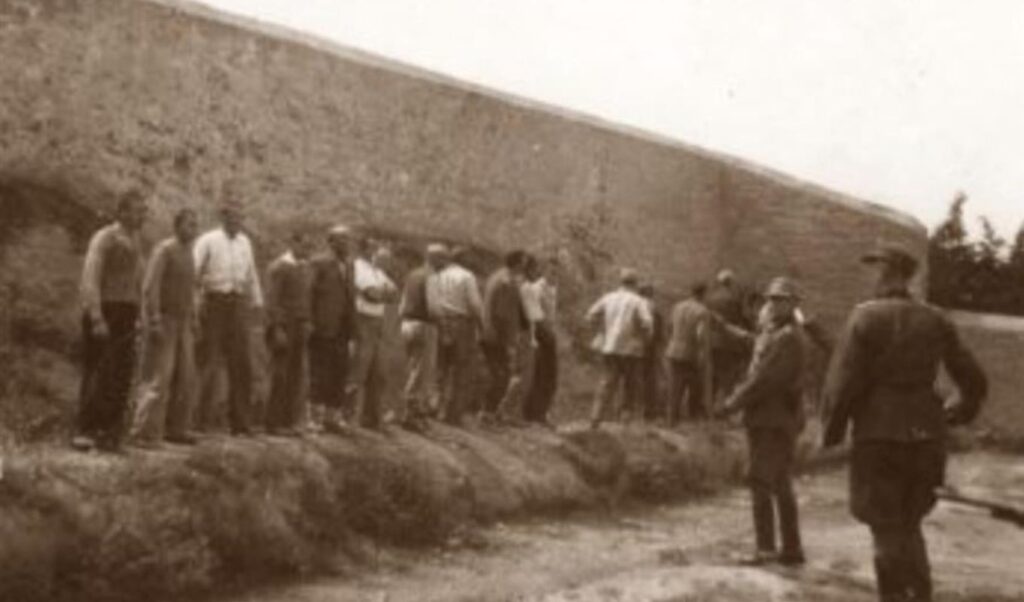
Rare photographs shed light on the final moments of the 200 resistance fighters at the Shooting Range who were executed by the occupation forces on May Day 1944 in Kaisariani, causing profound emotion throughout Greece. The photographic documents, which according to initial reports appear to be attributed to German Second Lieutenant Herman Hoyer, capture with chilling detail the greatness of spirit of the fighters as they were led to the firing squad, provoking waves of emotion across the entire country. The photographs became known through the Belgian company “Crain’s Militaria,” which had put them up for auction on eBay, however the company decided to withdraw them, declaring itself shocked by the damage caused to the Kaisariani monument and remaining open to dialogue with Greek authorities. The Greek Communist Party, based on the Central Committee archive, has already proceeded to identify two individuals depicted in the material: 30-year-old Thrasyvoulοs Kalafatakis and Dimitris Papadopoulos. Meanwhile, the Ministry of Culture and the Greek Parliament are taking action to acquire the collection, so that it can be preserved as national heritage.
Vangelis Gkiougkis: “The triumph of memory and history”
The president of the Association of Imprisoned Exiled Resistance Fighters 1967-1974 (SFEA), Vangelis Gkiougkis, spoke to Orange Press Agency about the significance of the finding, noting that “indeed, it is a rare document for the history and collective memory of our homeland. It is clearly visible in the faces of these fighters who are going for execution, with what pride, patience and endurance they go to the firing squad.” He emphasized the moral stature of those about to die, stressing that “if we consider that these were executed without any conviction, without any criminal charge, but only because the occupation forces, the axis forces, the fascist forces decided so, we understand the greatness of spirit of these fighters, who essentially go to the firing squad with a smile.” Mr. Gkiougkis explained the connection of his own generation with those heroes saying that “we as an association of imprisoned and exiled resistance fighters, of a later resistance against the junta, look with admiration, with respect and with an effort to maintain and have the triumph of memory and history. These photographs must definitely pass to the State, to the museums, so that we can show the younger generations and the generations to come how we face death.” He even referred with a personal tone to the brother of Manolis Glezos: “I know from the first moment that Nikos Glezos was one of the two hundred. He was then a student, nineteen, twenty years old and in his honor Manolis named his son Nikos Glezos as well.”
Ilias Papadopoulos: “They went to conquer death”
Ilias Papadopoulos, member of the Panhellenic Union of National Resistance Fighters (PEAEA) Kaisariani, described the shocking moments of the execution noting that “the photographs certify nothing other than the righteousness of spirit that these people had, who went to teach us this superiority they believed in for another world.” As he explained, the 200 stood “without blindfolds, upright, ready to meet death. Despite the request made by Soukatzidis for all two hundred to be executed together, the guard officer refused and so the execution was carried out in groups of twenty.” Mr. Papadopoulos conveyed the image of absolute sacrifice and comradeship: “When twenty people had already been executed, the next group of twenty would come and load their comrades on their shoulders to transport them to the trucks waiting in the yard behind. We are waiting for these photographs to be authenticated, they belong to the people of Kaisariani, to the Museum of EAM National Resistance and to the Communist Party of Greece.”
Mary Evangelopoulou: “Tremendous inner strength that only faith in high ideals gives”
Mary Evangelopoulou focused on the inner serenity emanating from the faces of the executed, observing that “we see them walking in these photographs, as if they are going to some work, that is, not as if they are going to the firing squad. And this means tremendous inner strength that these people had, which only faith in high ideals gives.” She reminded, as she says, the historical truth that “the two hundred patriots were communists, they were prisoners of the regime that Metaxas handed over to the Germans. We must tell these things to our grandchildren too, because these are difficult times we live in with all this militarization.”
The vandalism and the response of memory
The emotion over the new documents came in tragic contrast to the vandalism that occurred on Sunday at the Kaisariani monument. Mrs. Evangelopoulou commented bitterly: “What can I tell you? It’s no coincidence that at the time when these shocking photographs were found, at the same moment this terrible, unacceptable thing happens. So many years later do we still have Germanophiles, do we have pro-Nazis in Greece? Logically they must be young people too, because to climb over the fence? Someone my age cannot climb.” Vangelis Gkiougkis added that “this attempt to destroy monuments and the vandalism at the Kaisariani memorial site shows exactly that fascist elements have neither sacred nor holy. They respect neither history, nor memory, nor our homeland.” Despite the attack, the Municipal Authority of Kaisariani made clear that historical memory does not fade and that it will proceed immediately to restore the damage, against those who try to prevent honoring the heroes.