The owner of the “Violanta” biscuit factory in Trikala remains under temporary custody at the Police Directorate and is expected to officially testify on Tuesday morning. The businessman was arrested yesterday afternoon by officers from the Arson Crimes Investigation Unit (DAEE), following a surprise operation at the factory. This development came after the Prosecutor’s Office decided to upgrade the charges related to the explosion that claimed the lives of five women three weeks ago.
Read: Trikala: The moment of arrest of the “Violanta” factory owner after charge upgrade (Video)
Specifically, the charges of arson and explosion were upgraded from a misdemeanor due to negligence to a felony with possible intent, leading to the immediate issuance of an arrest warrant by the Trikala Investigator.
“Violanta”: The causes of the tragedy and DAEE revelations
The supplementary case file compiled by DAEE officers was based on a series of testimonies from experts and employees, who confirmed that the propane odor had been strong since June. Despite warnings and a visit from a private technician, the problem was not resolved due to financial disagreement with the ownership.
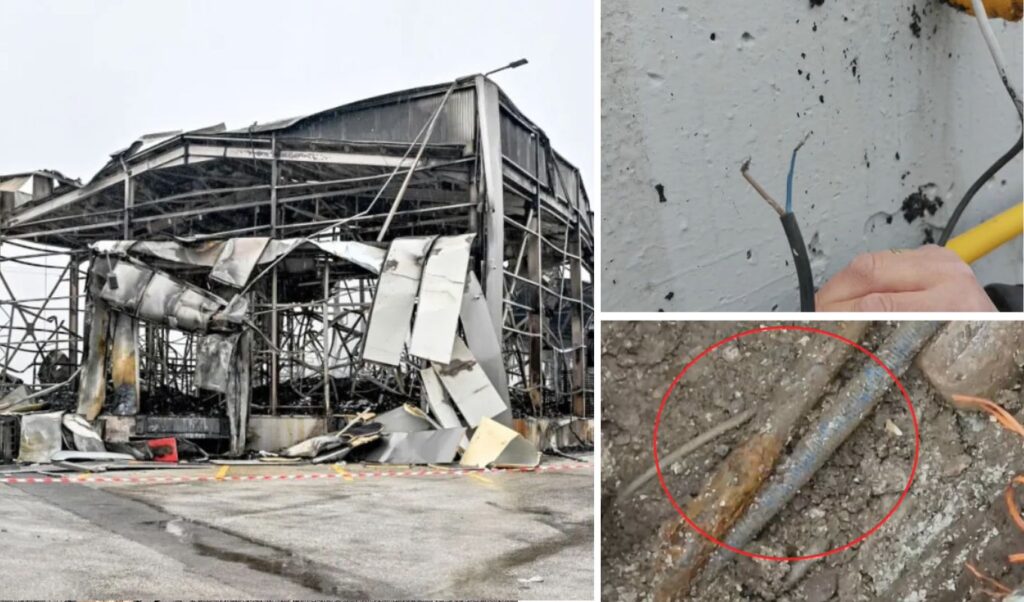
According to ERTnews sources, the investigation revealed that a corroded pipe in the basement, which had been installed in violation of regulations directly on the ground, suffered damage from fertilizers from neighboring fields. The resulting propane leak turned the basement into a “bomb,” which was triggered by a spark from the water pump. The explosion’s force was terrifying, estimated at 185 kilograms of dynamite equivalent, resulting in the immediate dismemberment of the five victims.
Study falsifications and inadequate safety measures
The DAEE investigation now extends to the responsibilities of engineers who signed the studies, as serious inaccuracies were found in topographical diagrams. According to sources, the company allegedly concealed from the Fire Department and Regional Authority the existence of two above-ground tanks, which had been placed at a distance smaller than the required 7.5 meters from the property boundaries. Meanwhile, photographs that came to light reveal fake safety systems, such as detectors that were not connected to the electrical network but had cables painted on the wall to give the impression of operation, as well as pipes that had been joined with simple fittings instead of approved methods. The area remains sealed to avoid evidence tampering, while the investigation is in full progress.


Violanta explosion becomes “case study” for industrial safety
The investigative authority’s decision to upgrade the charges for the deadly explosion at the “Violanta” factory in Trikala is based on specific evidence and proof that emerged from testimonies, according to retired Brigadier General and Chemistry Professor Michalis Chalaris, who spoke on the “Weekend from 5” program on ERTnews.
Mr. Chalaris emphasized that the preliminary investigation is proceeding with the required speed and accuracy. He also highlighted that the report from the five appointed expert witnesses is awaited with particular interest, as they will provide the definitive scientific answer about the explosion’s causes, beyond initial assessments.
Regulatory oversight mechanisms full of holes
Serious questions arise about the effectiveness of regulatory oversight mechanisms, as the facility violations apparently went undetected. Mr. Chalaris noted that while necessary control structures exist, deficiencies are often observed, such as conducting inspections “on paper” rather than substantive facility checks. The lack of meaningful supervision allows industrial units to operate based solely on the judgment of each owner, who may not prioritize safety.
This particular case is characterized by the professor as a “case study” that is expected to highlight the need for radical changes in the safety regulatory framework for industrial installations in Greece.
Critical questions focus on pump and tank operations, as well as why safety systems did not activate or failed to detect propane leak limits. Mr. Chalaris concluded that a thorough investigation of the case represents the minimum tribute to the five workers who lost their lives.