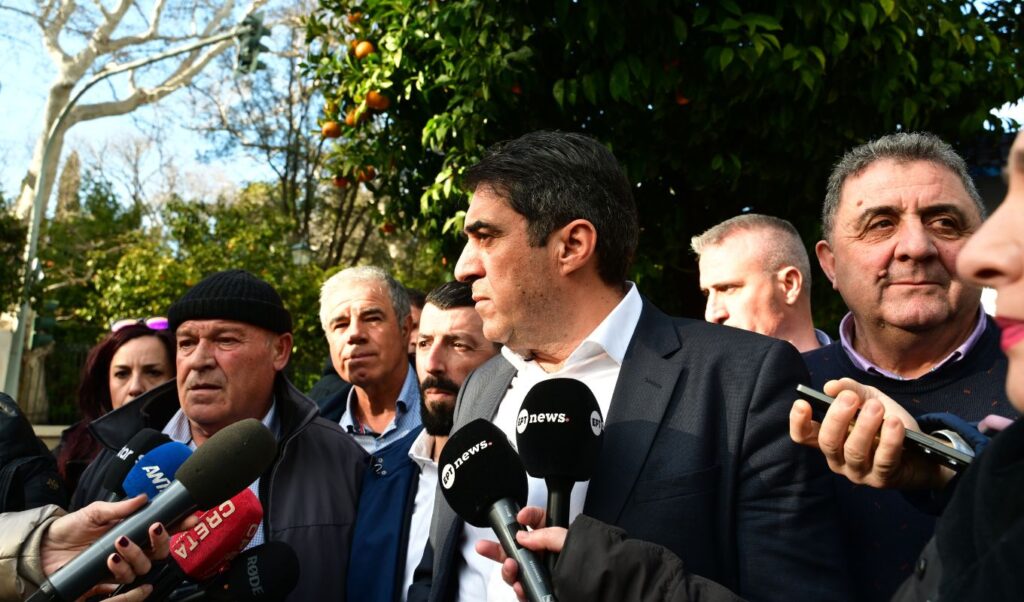
The intense anxiety of the country’s livestock farming community was conveyed to Prime Minister Kyriakos Mitsotakis by a delegation that met with him today at the Maximos Mansion. Among them was the President of the National Union of Agricultural Cooperatives (ETHEAS), Pavlos Satolias. Mr. Satolias emphasized the danger from the spread of foot-and-mouth disease and the need for immediate measures to protect the sector.
The request for an alternative eradication plan
Referring to the disease’s progression, the ETHEAS President noted that “we, the representatives of agricultural cooperatives and associations from across the country and federations, conveyed here the anxiety of the country’s livestock farming community, which has to do with the spread of the plant pathology and the non-containment of this disease”. Regarding the state’s planning, Mr. Satolias emphasized that “if nothing is done with the eradication, with the way the state says, there must immediately be a plan B”. He added with concern that “after Easter we believe we will have very bad situations regarding the spread”.
Livestock capital reconstruction and commitments
The focus of the discussion was also on supporting farmers who have lost their animals, with Mr. Satolias calling for swift and flexible procedures. He characteristically emphasized that “all this cannot go on indefinitely, because the reconstruction of livestock capital is difficult”. At the same time, he referred to the responses he received from the Prime Minister, noting that “the prime minister, under pressure from colleagues, said two or three things that have to do with genetic improvement which is very important and we must support it as a country for livestock farming”.
According to the ETHEAS President, there was reference to finding resources for feed enhancement, as well as an additional “de minimis” concerning funding for livestock farmers who are in a state of animal confinement. In closing, Mr. Satolias warned about the broader implications, emphasizing that “if we don’t finish with this, livestock farming is at risk. And not only livestock farming but the entire economy, the entire economic cycle that deals around livestock farming”.
Livestock farmers: Critical situation with foot-and-mouth disease – Called for acceleration of solutions at Maximos
In a climate of concern and with anxiety about the sector’s course, the meeting of livestock representatives with the Prime Minister and the government team at Maximos Mansion was completed. The livestock farmers’ representatives emphasized the need to accelerate decisions, as the foot-and-mouth disease situation remains particularly critical for production sustainability.
Concerns and “red lines” regarding vaccination
Dimitris Moschos, president of the Greek Livestock Association, appeared reserved about the meeting’s outcome, noting that there was no substantial differentiation from previous meetings. “The impression I get is that we are at roughly the same data as the previous time. We didn’t hear anything substantially new regarding disease management,” he characteristically stated. Referring to the vaccination issue, he noted that it remains a topic on which the Ministry appears negative, while expressing concern for the coming weeks, as rising temperatures may favor disease spread. “The question is what will happen in the coming period, when weather conditions change and the risk of outbreak increases,” he emphasized.
The concerns of Crete’s producers were conveyed by Lefteris Triantafyllakis, president of the Livestock Association of Heraklion Prefecture, highlighting the particularities and increased difficulties the island faces. “We raised the general problems of livestock farming, but also Crete’s specific issues, such as increased costs, milk prices and transportation,” he stated. Regarding the risk of foot-and-mouth disease spread, he pointed out that such a development would have particularly serious consequences due to the island’s geographical conditions. As he noted, from the government side there was a commitment that every possible effort will be made to prevent such an eventuality.
Issues of responsibility and biosecurity
For his part, Christos Tsernis, president of the Livestock Association of Kato Neapolis, expressed his annoyance at the fact that, as he said, the responsibility for disease spread is often attributed to the producers themselves. “Livestock farmers see their herds being slaughtered and at the same time hear that they are responsible for the situation,” he stated, emphasizing that substantial strengthening of biosecurity measures at all levels is required. In closing, the livestock farmers emphasized that “the state, local government, regions and cooperatives must move together to halt the disease spread,” adding that commitments that have been given must be translated into action in the coming period, as the foot-and-mouth disease issue remains decisive for the future of Greek livestock farming.