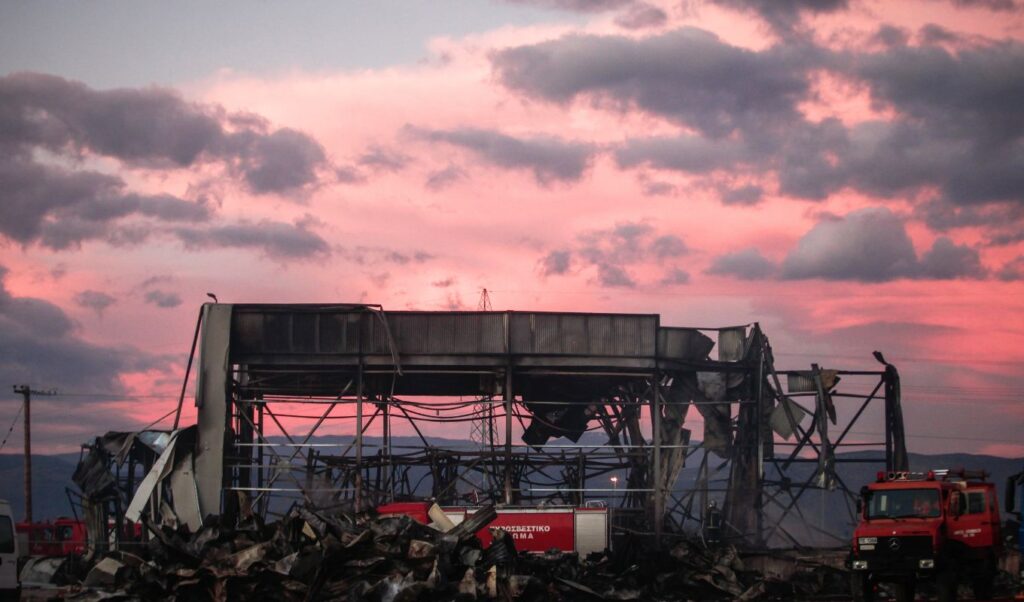
Investigations continue at full pace four days after the deadly tragedy at the “Violanta” factory that claimed the lives of five female workers. Initial findings suggest the tragic accident in Trikala was caused by a propane gas leak that had been ongoing for months. However, what could have prevented the explosion and its aftermath would have been propane detectors, which are essential for every industrial facility. Specifically, as an expert explained on a Mega TV program: “The detector would be connected through a fire detection panel, and in case of a leak, it would signal and trigger the alarm siren while simultaneously closing a valve to cut off the gas supply. There’s also a button that can manually cut off the gas flow.”
Violanta: High costs and questions about whether safety measures were implemented
Notably, one of the key issues in the expert investigation is whether propane detectors existed or were positioned in the correct locations. According to specialists, the detection system, which consists of components like the fire detection panel, the beacon-siren, and the solenoid valve, can cost anywhere from 1,500 to 6,000 euros, depending on requirements.
“Detectors must be installed approximately every 3-5 meters. This clearly depends on the detector we use, which we’ve selected, and is predetermined by the designer who has studied and created a plan submitted to the Fire Service.”
The question remains whether what the expert describes was implemented at “Violanta,” and more importantly, in thousands of other businesses with similar risks, and whether all these companies make safety compromises to avoid costs.
“There was no detector or fire protection measures in the basement”
Meanwhile, Michalis Christodoulidis, a certified expert, noted that according to the Fire Service, there was cracking in the propane transport pipe from the tank, in the buried section, leading to the interior of the building.
“Why was there cracking? I see two reasons. Either there was mechanical stress on the pipe from some heavy vehicle, for example, since I heard there were some asphalt paving works being done, or from the beginning when the metal pipe was buried, anti-corrosion protection measures weren’t taken. Regulations require that when you bury a metal section, it must be coated with epoxy and asphalt paints, then the pipe must be wrapped with plastic insulating tape so the metal section doesn’t come into contact with soil, because soil contains moisture and salts. These corrode the metal. If we accept the Fire Service’s announcement that there was pipe cracking, the gas escapes and follows the downward path of the pipe until it enters the building interior, going to the lowest level of the building, which is the basement. There was no propane leak detector there, no fire protection measures, nothing. So the propane gradually accumulated there and created a spark,” he said speaking to Live News.