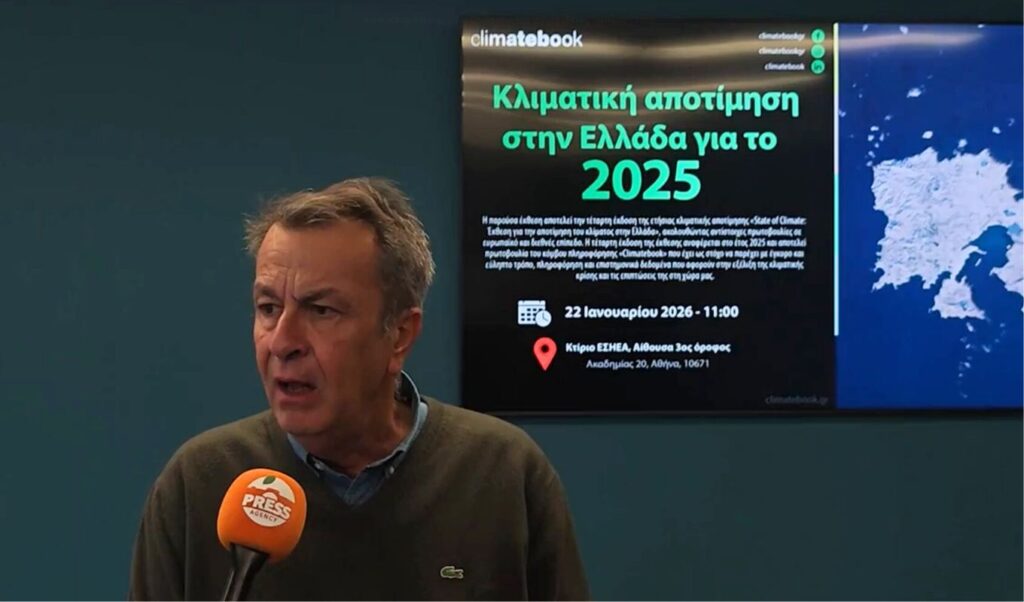
The Climatebook scientific team presented its annual report on Greece’s climate status in 2025 at a special event held at the ESHEA offices. The data released confirms that the climate crisis is no longer a future possibility, but a reality already affecting the country.
According to the report’s data, 2025 ranks as the second hottest year in Greece since 1991, with the annual average temperature reaching 15.3 degrees Celsius. Particularly concerning is the fact that six of the seven hottest years of recent decades have occurred within the last seven years.
Speaking to Orange Press Agency, Kostas Lagouvardos, Research Director at the National Observatory of Athens, was clear: “Climate change is not a future scenario, it’s something we see here. We see it from temperature increases, with reduced snowfall, with increased frequency of extreme weather events.”
Warning bells for Lake Mornos
Although rainfall across the country remained at normal levels, there were areas with significant deficits, such as Eastern Peloponnese, Attica, Thrace and Crete.
The situation at Lake Mornos artificial reservoir is particularly concerning. “Mornos has worried us greatly. We see it has been continuously dropping for the past two years, mainly due to lack of snow but also rainfall. We reached the lowest level in many years by late 2025,” noted Mr. Lagouvardos.
However, there is a small ray of hope: “The positive news is that in the last month, due to snow and rain, this decline has stopped and we’ve started to see a small rise in the lake’s extent. However, it remains 40% below normal levels as we speak.”
Seas that “boil” and changes in fishing catches
Overheating doesn’t leave Greek seas unaffected, as 2025 was the 4th warmest year, with surface temperatures reaching locally up to 29°C in August. The impacts are visible in fishing too. Showing the relevant chart, Mr. Lagouvardos explained that from 2018 to 2023 “this declining trend continues, endemic species are falling while alien species are increasing.”
The record of zero casualties
On the positive side of the year, for the first time since 2000, we had no human casualties from extreme weather events. However, Mr. Lagouvardos advised restraint, commenting that “this is probably coincidental.”
A total of 19 weather episodes were recorded (20% decrease compared to average), while snowfall in Northern Greece and Pindus was limited by 25-30%, a fact connected to the drying of fir forests.