The five Greek satellites that were launched in late November and are now orbiting Earth as part of the “National Microsatellite Program” have already begun producing results. This project, developed under the umbrella of the Ministry of Digital Governance, was implemented to generate solutions that will lead public administration, security, and sustainable development of the country into a new era, shaped through the systematic utilization of satellite data from the Greek space program.
Two operational microsatellites are already in space, along with three experimental-research microsatellites for technological demonstration, aimed at testing new space technologies developed in Greece to strengthen the domestic industry. Now, through the systematic utilization of satellite data, the country is entering a new era that promises significant benefits for its citizens.
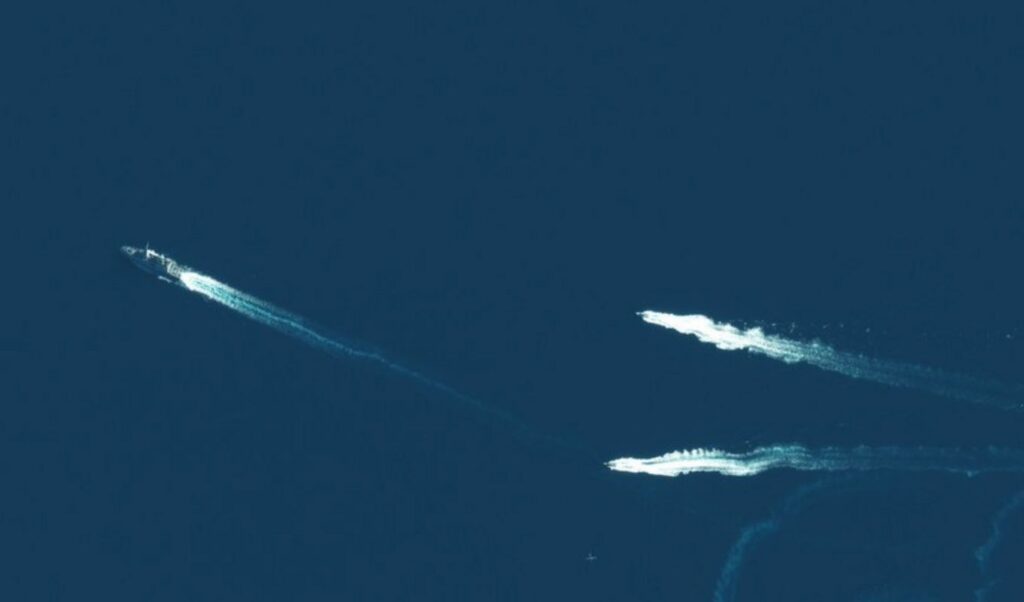
Greek microsatellites captured frigate “Kimon” from space
The Athens-Macedonian News Agency presents the first photographs from the microsatellites: The first was taken on December 13, 2025, showing the ports of Piraeus and Perama, while the second, a high-resolution optical satellite image, has symbolic significance as it shows the Belharra frigate “KIMON” (January 15, 2026) and its arrival in our country from France to be incorporated into the force of the Hellenic Navy. “The prospect of Greece’s presence in space once seemed either a joke or a utopia. Fortunately, we have left those times behind us. In just over a month and a half since their launch, we have in our hands the first images from the satellites of the ‘National Microsatellite Program’. This is a milestone that confirms that as a country we are moving from planning to action and acquiring a substantial presence in space, with direct benefit for the state and the citizen. Beyond the enormous symbolic value of capturing images of Greek territory from Greek satellites in space, it also has enormous practical value,” said Digital Governance Minister Dimitris Papastergiou to ANA-MPA.


As he continued, “we will continuously receive critical data, which we will use to strengthen Public Administration, improve decision-making and formulate more effective policies in key sectors. Indicatively, in the agricultural sector they contribute to ensuring transparency in subsidies, while offering valuable information to producers. In environmental protection, they enable continuous monitoring of forests, waters and protected areas.
In civil protection they contribute to early prevention, rapid response and informed crisis assessment. In defense they facilitate surveillance of areas of interest. At the same time, they create new prospects for research, innovation and entrepreneurship. With resources from the Recovery Fund we are investing in cutting-edge technologies and exploiting the opportunities that space gives us with the aim of development, security and a sustainable future for all.”
Greece is now in a new era in the field of digital and space infrastructure with the implementation of a unified, central digital platform that will collect and utilize data from all Greek and international satellites. This infrastructure will enable the transformation of information coming from space into directly applicable policy tools, bringing significant changes to citizens’ daily lives. The central infrastructure will operate as the common operational core of the state, managing the collection, scheduling of acquisitions, storage and processing of satellite data.
The creation of this platform allows all ministries and public services to have access to reliable and updated data, without the need for specialized technical knowledge. The central government hub will be installed in Athens and will collaborate with the Hellenic Space Center, providing an access point to satellite services. In practice, the country acquires the ability to systematically map the entire territory, as well as immediate response to critical events. Optical, thermal and radar satellite data are combined so that there is visibility day and night, even with clouds. The existence of satellite constellations allows multiple captures within the same day throughout Greek territory, providing continuous and updated imagery of the country. Data reaches the system in minimal time and is automatically converted into “ready for analysis” products, drastically reducing decision-making time.
The contribution to the agricultural sector is particularly critical. Through applications, the agricultural sector acquires a reliable, objective tool for monitoring and documenting agricultural subsidies. Satellite data enables accurate mapping of agricultural plots, verification of the type and extent of crops, as well as detection of changes or deviations in relation to producers’ declarations. In this way, controls become faster, fairer and with less bureaucracy, while errors are significantly reduced. At the same time, farmers benefit from information about the health of their crops, irrigation needs and the effects of extreme weather events, reducing costs and increasing productivity. In the natural environment sector, the capabilities are equally decisive. Continuous monitoring of protected areas, mapping and assessment of forests, recording of land use changes and evaluation of water conditions, provide the responsible organizations with a strong scientific background for informed policies.
Natura areas are systematically monitored with optical, thermal and radar data, enabling early detection of pressures such as illegal interventions, changes in vegetation, drought or habitat degradation. At the same time, areas with high environmental pressure, such as coastal zones, tourist areas and forest ecosystems, are monitored continuously, so that the competent authorities can intervene before the impacts become irreversible. Climate change ceases to be an abstract concept and is transformed into measurable data.
The role in civil protection and climate change assessment is also decisive. Early detection of forest fires, monitoring their evolution, detection of flooding phenomena and damage assessment are carried out automatically, with data reaching directly the Fire Department and competent authorities, allowing faster evacuations, better property protection and documented damage assessment. Thermal data enables early detection of fire sources, optical data maps affected areas and radar captures floods, even when there are clouds or darkness.
In the maritime domain, Greece acquires a complete picture throughout the Eastern Mediterranean. Through satellite data, it becomes possible to detect boats, vessels and objects of interest, enhancing border surveillance, migration flow management, navigation safety and protection of critical infrastructure. Specifically, radar satellite data detects ships regardless of weather or time, while optical and thermal data contribute to monitoring pollution, marine heat waves and protected marine areas.
At the same time, defense and national security are substantially strengthened. Multi-sensor monitoring of areas of interest, protection of critical installations and the ability for rapid situation assessment create a new level of strategic autonomy, with data remaining under national control and high cybersecurity standards. Furthermore, the same infrastructure operates as a powerful lever for innovation and economic development. Research centers, universities and businesses gain access to high value-added datasets, creating the conditions for developing new applications, advanced digital services and solutions that utilize artificial intelligence and machine learning. These applications, through institutional procedures to be announced in the coming period, will be able to be commercially exploited at international and global levels. After all, satellite systems are not geographically limited only over Greece, but cover the entire planet, creating significant opportunities for extroversion, development and international competitiveness for Greek industry and the country’s space and digital technology ecosystem.
In this way, Greece is building its digital “nervous system” from Space: a unified, intelligent and secure infrastructure that connects cutting-edge technology with the real needs of society, strengthening resilience, state effectiveness and the country’s digital transformation.