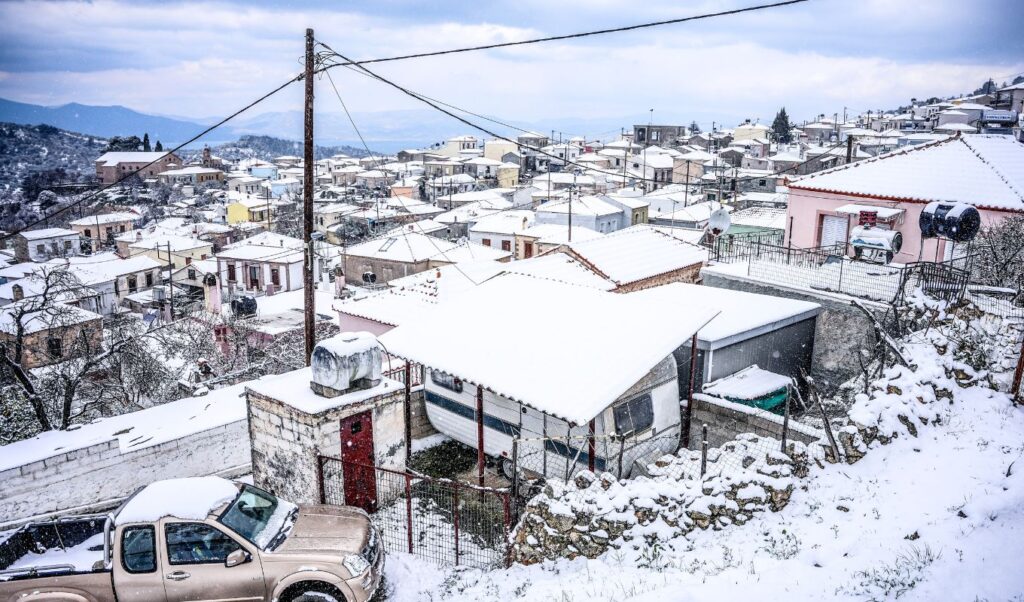
The Risk Assessment Committee was convened on Sunday (11/01) by the Secretary General of Civil Protection, Nikos Papaefstathiou, in anticipation of the gradual deterioration of the weather expected from this afternoon, with an intense cold wave, strong northerly winds of 7-8 Beaufort scale and local snowfall. According to the committee’s scientists, snow is expected in mountainous and semi-mountainous areas as well as in lowland regions of mainly northern Greece. At the same time, the General Secretariat of Civil Protection is addressing recommendations to citizens, calling on them to be particularly careful and take self-protection measures against risks arising from severe weather phenomena.
Weather: Where snowfall will occur
Snowfall will occur:
a. In the mountainous and semi-mountainous areas of mainland Greece and Evia.
b. From the night in lowland areas of the Eastern Macedonia-Thrace region, in the regional units of Serres and Halkidiki, the eastern parts of the Thessaloniki regional unit as well as islands of the northern Aegean (Limnos, Lesbos, Chios, Sporades).
c. From early Monday morning in lowland areas of Evia (mainly in its eastern parts) and the mountainous and semi-mountainous areas of the Cyclades and Crete.
Snowfall will stop before Monday noon (12-01-26) in the north and from afternoon hours in other areas except the mountainous and semi-mountainous areas of Crete where it will continue until Tuesday morning (13-01-26).
Weather deterioration: Civil Protection recommendations to citizens
The General Secretariat of Civil Protection is addressing recommendations to citizens, calling on them to be particularly careful and take self-protection measures against risks arising from severe weather phenomena.
The General Secretariat of Civil Protection (civilprotection.gov.gr) of the Ministry of Climate Crisis and Civil Protection has informed the competent state services involved, as well as the regions and municipalities of the country, to be on heightened civil protection readiness in order to immediately address the impacts from severe weather phenomena.
Specifically, in areas where intense rainfall, thunderstorms or stormy winds are forecast, the GSCP recommends that citizens:
Secure objects which, if carried away by severe weather phenomena, may cause damage or injury.
Ensure that roof drains and gutters of homes are not blocked and function normally.
Avoid crossing streams and riverbeds, on foot or by vehicle, during storms and rainfall, and for several hours after they end. Particular attention is needed at road network points where the road crosses streams and there is no bridge.
Avoid outdoor work and activities in marine and coastal areas during severe weather phenomena (risk from lightning strikes).
Take immediate shelter during hailstorms. Seek refuge in a building or car and do not leave the safe space until certain the storm has passed. Hailstorms can be very dangerous for animals as well.
Avoid passing under large trees, under hanging signs and generally from areas where light objects (e.g., flower pots, broken glass, etc.) may detach and fall to the ground (e.g., under balconies).
Faithfully follow instructions from local authorities, such as Traffic Police, etc.
In areas where snowfall and frost are forecast:
If traveling by car:
Stay informed about the weather and road network conditions
Have anti-slip chains in your vehicle and a full fuel tank
Travel, if necessary, preferably during the day, choosing main roads
Inform relatives about the route you plan to follow
Modify your travel schedule to avoid peak weather conditions
Faithfully follow instructions from local authorities, such as Traffic Police, etc.
If traveling on foot:
Dress in multiple layers of light clothing instead of one heavy garment and wear appropriate shoes to avoid injuries due to slippery conditions
Avoid unnecessary travel during peak conditions (heavy snowfall, frost conditions)
For information and announcements regarding the prevailing situation and road network accessibility due to flood waters or snowfall and frost, citizens can visit the Hellenic Police website www.astynomia.gr.
For more information and self-protection instructions from severe weather phenomena, citizens can visit the General Secretariat of Civil Protection website at civilprotection.gov.gr.