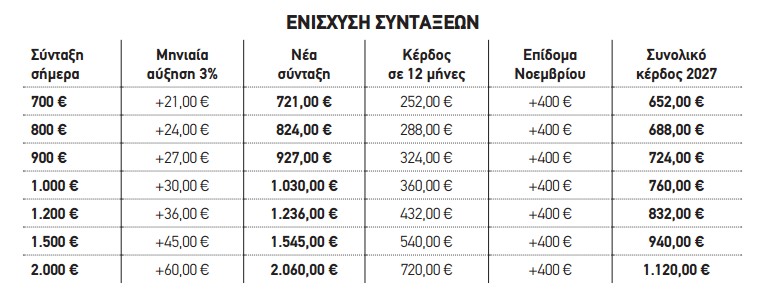
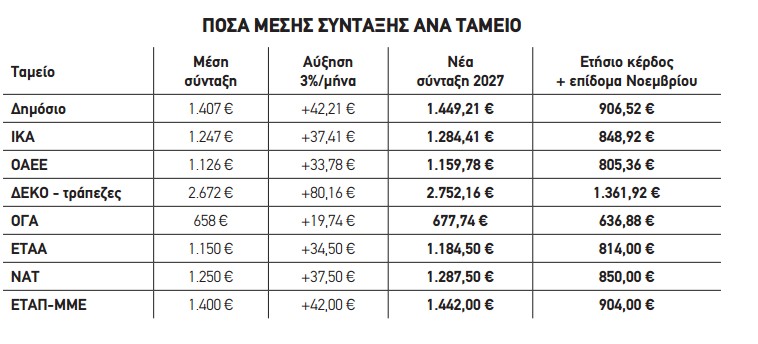
The energy crisis and the resulting surge in inflation are creating room for higher pension increases, overturning initial projections of a 2.8% raise. The new estimate for pension increases now hovers around 3%, with the final figure to be determined by price developments through the end of 2026. Based on the new data, total increases — including the permanent November bonus — will bring the lowest pensions to €652, average pensions to €810, and the highest pensions to €1,120.
Read also: Pensioners: Double boost with €400 allowance and raises in 2027 — who benefits
Pensions: Inflation running higher than initially projected
Inflation is playing a decisive role in reshaping forecasts, showing far greater momentum than originally anticipated. Its significant acceleration to 5% in September — followed by a surge to 5.6% in October — has shifted the landscape considerably. While initial projections placed average annual inflation at 3.6%, the latest estimates now put it between 3.8% and 4%. If this trend is confirmed, pension adjustments will need to be revised upward accordingly, as inflation is one of the two key factors used to calculate the annual adjustment rate. The pension increase rate is derived from a combination of annual GDP growth and inflation, with the law specifying that the average of the two figures is taken into account.
For 2026, Greece’s economic growth is projected at 2%, according to the preliminary budget draft. However, the revised inflation estimates are changing the adjustment arithmetic. If inflation settles at 3.8%, the combined figure with 2% GDP growth would reach 5.8%, translating into a 2.9% pension increase. If inflation reaches 4%, the total would hit 6%, pushing pension increases to 3%.
The difference between 2.8% and 3% may seem modest as a percentage, but it translates into meaningful additional income for millions of pensioners. The actual benefit varies depending on the pension amount — the higher the pension, the greater the monthly increase in euros. Based on a 3% raise, a pension of €600 would see a monthly boost of €18, while a pension of €1,575 would increase by €47.25 per month. For pensions of €3,710, the monthly increase would reach €111.30.
The key question now is whether the revised figures will be reflected upfront in the state budget, or whether the difference will need to be paid retroactively to pensioners. It is customary for a corrective adjustment to be paid every March in the event of an inflation deviation. That same month will also see a decision on the rate of contribution increases for self-employed workers and farmers.
No income criteria required
In the final week of November, the annual financial bonus of €400 will be paid to 2.2 million pensioners, persons with disabilities, and recipients of the uninsured elderly benefit. This year’s payment comes with a significant change: the income and asset criteria that previously applied to pensioners are being abolished. This broadens the pool of eligible recipients, as the bonus will no longer depend on income level or the value of real estate holdings.
For pensioners, however, the age criterion remains in place. Specifically, those eligible are individuals who have reached the age of 65 if they receive an old-age pension, or 60 if they receive exclusively a survivor’s pension.
The key condition is that the relevant age thresholds must have been reached by December of the previous year. This means that for the November 2026 payment, old-age pensioners must have turned 65, and survivor’s pension recipients must have turned 60, by December 2025. Those who turn 65 or 60 during 2026 will become eligible for the bonus in November 2027.
The €400 payment will be made without any age restrictions for the remaining eligible groups — namely, persons with disabilities and uninsured elderly individuals receiving the corresponding benefit from OPEKA. As a result, millions of beneficiaries will receive two separate financial support measures in the final two months of 2026: the annual €400 payment in November, and new pension increases from January 2027 (paid in December 2026), the final size of which will depend on inflation figures and decisions by the economic policy team.
Published in “Kyriakátiki Apogeumatini”.