The ceasefire in the Middle East served as a powerful signal of de-escalation for international energy markets, triggering an impressive wave of oil price declines and a modest correction in natural gas. However, behind this initial “relief” reaction emerges a more complex scenario, where uncertainty over energy transit through the Strait of Hormuz keeps geopolitical risk at high levels.
Read: US-Iran ceasefire hangs by a thread: The murky landscape of negotiations and Pakistan’s key role
According to analyses by Axios and Bloomberg, markets reacted immediately to the reduced risk of generalized conflict, yet they have not been convinced that the crisis has definitively ended. As Axios notes, “investors are giving peace a chance, but remain cautious,” reflecting the widespread sense of temporary de-escalation.
The initial picture on Wednesday morning was indeed impressive. Brent crude recorded drops that in some sessions approached 15%, falling below the psychological barrier of $100 per barrel. This represents one of the largest daily corrections in recent decades outside periods of systemic crisis, confirming that prices had incorporated a very high “risk premium.” This de-escalation, however, did not stem from improvements in market fundamentals, but from the retreat of fears about immediate supply disruption.
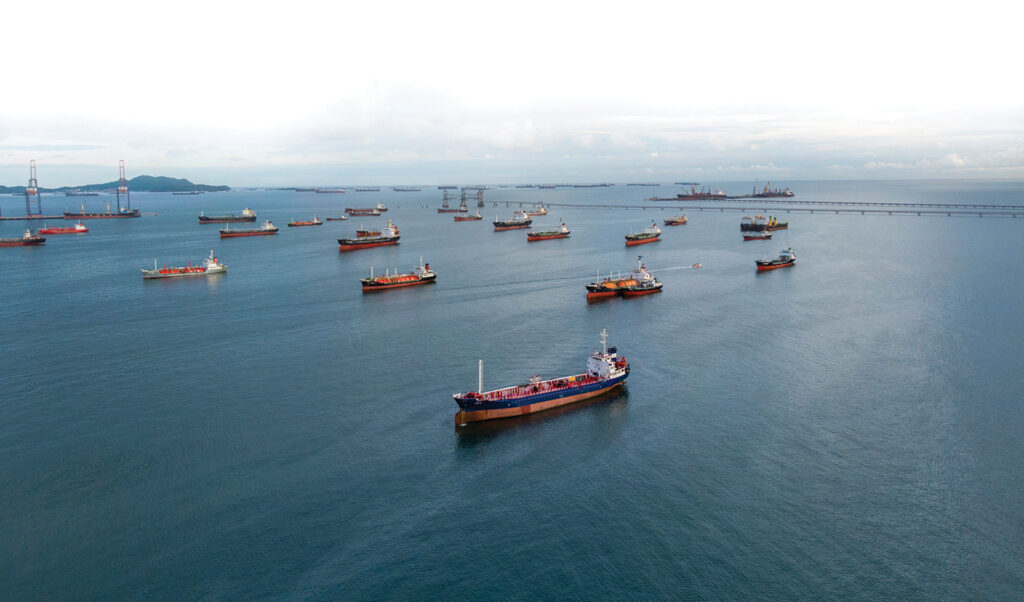
As Bloomberg analysts point out, the market is “removing risk premium, not supply deficit,” emphasizing that production in the Middle East continues to be significantly below pre-crisis levels, with losses that, according to some estimates, reach up to 9 million barrels daily. This means the market essentially remains in a “supply shock” state, with the ceasefire functioning more as a temporary “brake” on price increases rather than an indication of return to normalcy. At the center of uncertainty lies the Strait of Hormuz, the planet’s most important energy artery, through which approximately 20% of global oil supply and a large portion of liquefied natural gas shipments pass. During the crisis, shipping was severely disrupted, with hundreds of tankers changing course or remaining on standby.
Middle East: “Markets have entered a new era”
Despite the ceasefire, full restoration of traffic is not considered immediate. Shipping companies and insurance organizations appear particularly cautious, while it’s estimated that up to two months may be required for flow normalization. As Axios notes, “full restart of oil transport is not guaranteed,” emphasizing that the market continues to price in the risk of new disruptions. “Markets have entered a new era, where geopolitical tension is not an exception, but a basic pricing factor,” Bob McNally, president of the Rapidan Energy Group, told Bloomberg. In this environment, particular interest lies in scenarios being examined internationally regarding Iran’s potential role in controlling shipping in Hormuz. Analysts cited by both Axios and Tradewinds note that Tehran could leverage its geographical position not only as a pressure tool, but also as a means of economic influence.
On the table – at least at the scenario level – is the imposition of indirect “tolls” or increased transit fees, either through stricter controls or through mechanisms related to shipping security. Such a development would not necessarily constitute official taxation, but could translate into significant increases in transportation costs, through delays, inspections, or increased risk premiums. Characteristic is the market situation assessment cited by Business Insider analysts, according to whom Hormuz tends to function “like a toll road,” as passage occurs under increased control and with significant cost to shipping companies. As market players point out, even limited application of such practices would have immediate impact on prices, as it would increase logistics costs in an already burdened market. In an extreme scenario, the creation of a “semi-controlled” transit regime by Iran could function as a new, informal mechanism for regulating global supply. “Iran doesn’t need to close Hormuz to affect prices – it’s enough to control the flow,” emphasized Helima Croft, head of commodity strategy at RBC Capital Markets, to Bloomberg.
Natural gas price rigidity
Regarding natural gas, the picture remains even more complex. Unlike oil, where markets reacted immediately, natural gas prices show greater rigidity. Dependence on specific LNG routes – especially from Qatar – and limited ability for immediate cargo redirection make the market more vulnerable to disruptions. During the crisis, European prices recorded sharp increases, with some sessions touching levels almost double compared to early year levels.
De-escalation after the ceasefire is slower, reflecting the market’s structural weaknesses and limited supply-side flexibility. As Bloomberg analysts point out, “the natural gas market reacts more slowly, because the supply chain is less flexible compared to oil.”
Projections for the next phase remain cautious. Short-term, oil prices are expected to move in a range between $85 and $100 per barrel, with intense fluctuations depending on geopolitical developments. Medium-term, full restoration of maritime routes could lead to further de-escalation, however the possibility of new tensions remains real.
Published in Parapolitika