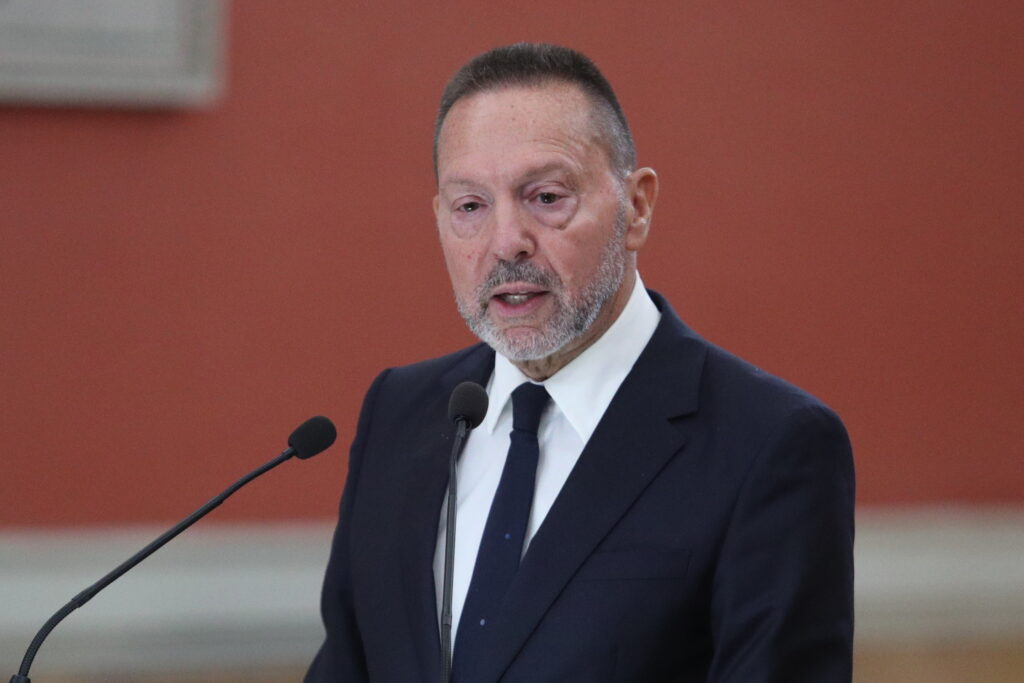
The Governor of the Bank of Greece, Giannis Stournaras, conducting a comprehensive assessment of the Greek economy’s trajectory, analyzed the challenges of 2026 and future prospects amid international uncertainty. He characterized 2025 as one of the best years for the Greek economy, with growth closing at 2.1%, significantly higher than the European average, and fiscal indicators showing exceptional performance with debt reduction and strong primary surpluses.
Speaking on SKAI radio station, Mr. Stournaras characterized 2025 as one of the best years for the Greek economy, with growth closing at 2.1% —significantly higher than the European average— and fiscal indicators showing exceptional performance with debt reduction and strong primary surpluses.
However, he noted that inflation remained at levels higher than Europe (2.9% versus 2.1%), a phenomenon he attributed to the “excess demand” created by tourism (45 million visitors to a population of 10 million).
Stournaras: Forecasts for growth deceleration
For 2026, the Governor expressed reservations due to military escalation in the Middle East. He predicted a slight growth deceleration to 1.9%, provided the crisis subsides soon, emphasizing that risks remain downward-facing.
Investment remains the economy’s main driver, with a projected increase of 8.8%. Mr. Stournaras highlighted the synergy between the private sector, banks, and the Recovery Fund, while allaying fears about a sharp economic gap (cliff effect) after the Fund’s expiration, as EU programs will continue to provide similar support. He notably pointed out that investments have increased impressively from 11% of GDP in 2019 to 18% today.
Responding to criticism about Greeks’ low purchasing power, the Governor acknowledged that convergence with Europe is a slow process due to the “deep imprint” of the previous crisis. However, he emphasized that per capita GDP in purchasing power terms has risen from 64% in 2019 to 68-69%.
The solution, according to Mr. Stournaras, lies not in cutting demand but in strengthening supply and productivity. He clarified that productivity doesn’t mean more working hours, but improving state services, accelerating justice delivery, reducing bureaucracy, investing in capital equipment and education.
“Need to exhaust the four-year term”
He made special mention of the primary sector, citing the Netherlands as an example, which is 4-5 times more productive than Greece in agriculture due to technology (greenhouses), calling on Greek producers to emulate successful models and cooperatives.
Regarding the “black economy,” the Governor mentioned that digital transactions and POS systems have significantly limited the shadow economy, which nevertheless remains at 20-21% of GDP (versus 15-16% in the EU). He emphasized that the definitive elimination of tax evasion, especially in fuel, requires full implementation of input-output systems.
In conclusion, Mr. Stournaras reiterated his position on the need to exhaust the four-year term. He characterized political stability as the country’s most important intangible asset, emphasizing that early elections reduce a government’s useful time and create destabilization at a time when external crises require immediate decision-making.
“Especially now that the situation in the Middle East has spiraled out of control, we need a government to make decisions, to address mainly external crises, and perhaps the difficult times are still ahead of us in the case of the Middle East,” he concluded, sending a message for economic fortification through institutional normalcy.