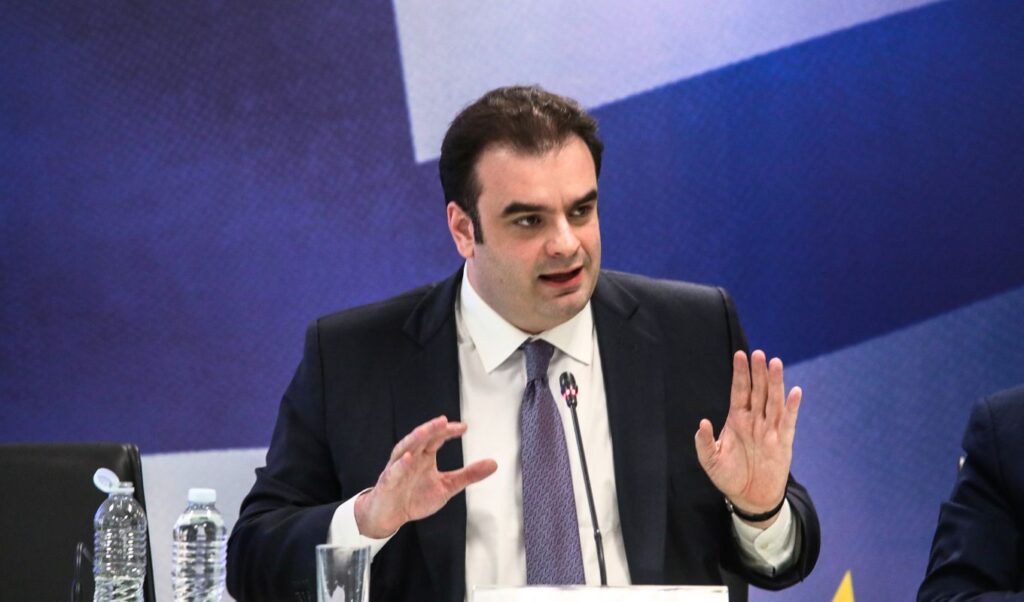
“We have already announced targeted measures to mitigate the immediate impact, relying on the European toolkit developed during the 2022 energy crisis, emphasizing support for the most vulnerable households and ensuring market stability. Since April 2026, Greece is implementing a €300 million support plan to address rising energy costs. Key measures include a €0.16 per liter subsidy on diesel (total reduction of €0.20 including VAT), a digital fuel card for consumers, and a 15% subsidy on fertilizer costs for farmers. At the same time, we remain on standby. Any additional measures, if needed, will be targeted to ensure substantial support for households and businesses,” emphasized Finance Minister and Eurogroup President Kyriakos Pierrakakis in an interview with “Le Point” magazine and journalist Philippine Robert, who believes that Athens can absorb the shock of the war in the Middle East and explains his country’s transformation.
Kyriakos Pierrakakis: Full interview on the energy crisis and Greek recovery
**Le Point: Is Greece in a position to handle the oil crisis?**
Kyriakos Pierrakakis: Greece is well-positioned to absorb the shock. Our economy has clearly become more resilient in recent years, thanks to sustainable growth, the restoration of public finances, and continued structural reforms. As highlighted by the latest IMF Article IV report, the strengthening of Greece’s fiscal position and the increased resilience of its financial sector constitute strong bulwarks against external shocks, particularly volatility in energy prices. We have already announced targeted measures to mitigate the immediate impact, relying on the European toolkit developed during the 2022 energy crisis, emphasizing support for the most vulnerable households and ensuring market stability.
Since April 2026, Greece is implementing a €300 million support plan to address rising energy costs. Key measures include a €0.16 per liter subsidy on diesel (total reduction of €0.20 including VAT), a digital fuel card for consumers, and a 15% subsidy on fertilizer costs for farmers. At the same time, we remain on standby. Any additional measures, if needed, will be targeted to ensure substantial support for households and businesses.
**Le Point: The Greek economy indeed seems to be on a better path today. Is this a renaissance?**
Kyriakos Pierrakakis: Yes, the data confirms it. Greece now shows a primary surplus and we have the fastest declining debt (as a percentage of GDP) in Europe. In 2026, according to forecasts, the growth rate is estimated to reach 2.4%, one of the highest rates in the European Union. Meanwhile, the debt that once approached 210% as a percentage of GDP is calculated to fall below 120% by the end of the decade.
This performance is linked to the country’s profound transformation. We implemented reforms and benefited from political stability, European support, and the continued action of the Mitsotakis government since 2019. Unemployment is at its lowest level since 2008. This proves that Greek society managed to recover from a crisis that, for us, resembled the Great Depression of the United States: we lost 25 GDP units, thousands of people emigrated, lives were destroyed, but Greece endured.
**Le Point: You speak of a country on a good trajectory. However, many Greeks feel that their lives are more difficult than before. What do you tell them?**
Kyriakos Pierrakakis: I hear them. The challenges exist, both in daily life and in politics. Housing is a problem throughout Europe, and in Greece as well. We experienced strong inflationary pressures after the Covid pandemic that significantly burdened households. Some people need more targeted support and we must strengthen the economy to protect society. This is the purpose of our reforms: to strengthen growth and help citizens in a sustainable way. The latest tax package announced by the Prime Minister aims to increase incomes, particularly through a reform based on family and age of entry into the labor market. Greeks will see this directly in their bank account.
**Le Point: France is in a difficult situation regarding public finances. As a country that suffered years of austerity, what do you take from this experience?**
Kyriakos Pierrakakis: France adopted a budget that respects European rules and is part of a deficit reduction path. This is positive. Greece, for its part, experienced the harshest crisis of all countries that entered IMF surveillance programs: three memoranda, huge income losses, record unemployment levels. The lesson is clear: not to repeat the mistakes of the past. Sustainable public finances and strong reforms are needed so that the burden is not transferred to future generations. France has a strong, multidimensional and innovative economy. It has all the advantages to return to strong growth and healthy public finances.
**Le Point: What are the reform priorities to further strengthen the Greek economy?**
Kyriakos Pierrakakis: Much is at stake first at the European level: investments, digitization, reducing barriers between member states, simplifying procedures. We must create real “European champions,” capable of competing globally. At the national level, we must broaden our growth potential, respond to housing challenges, strengthen our tax system. We have already abolished 83 taxes and contributions in six and a half years, but we must do even more.
Competitiveness and productivity remain major objectives, especially facing the demographic challenge. Digital reform was one of the most significant changes: we have digitized more than 2,000 public services. This is a very popular reform that frees up time, eliminates friction and enhances transparency. We must now digitize Justice, health and education. In higher education, for example, we had never managed (in the past) to attract foreign students, nor to retain our young people (to study in Greece). The reform of this sector will have not only educational but also economic benefits.
**Le Point: You were recently elected to a European position. Is this a “revenge” for Greece after the crisis?**
Kyriakos Pierrakakis: I don’t like that word. In Greek we have the word “hubris” and we know what it means. I prefer to talk about responsibility. Our mission is clear: to deliver results. Europe must now transform its strategies, such as those described in the Draghi report, into tangible results. What matters is not words, but our actions.
**Le Point: Is the crisis definitively over?**
Kyriakos Pierrakakis: We are on the right path. The future is in our hands. Policymakers must remain vigilant against risks. But yes, we have every reason to be optimistic, both as politicians and as citizens.