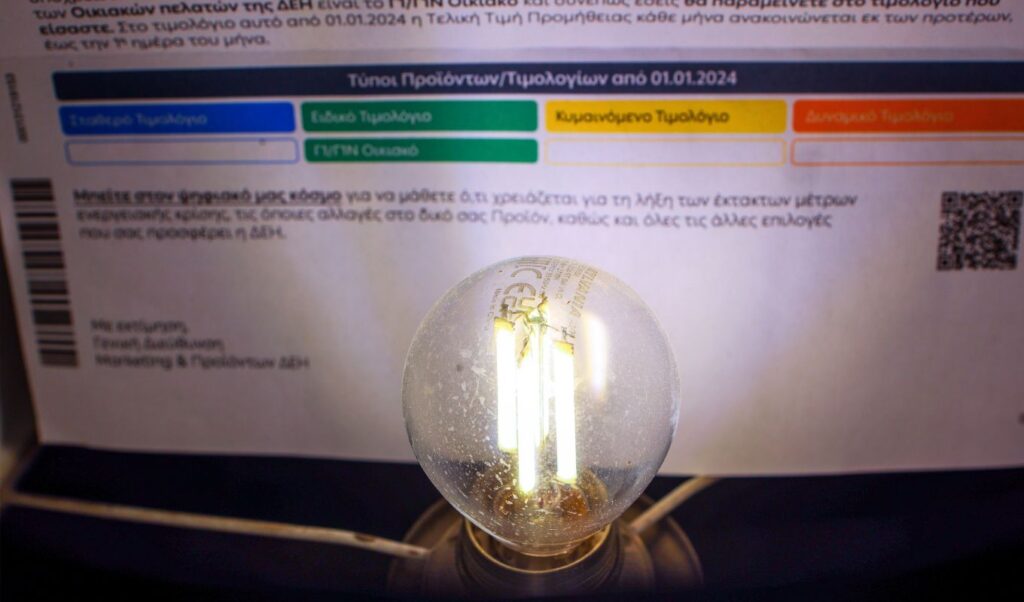
The government’s economic team is working on scenarios for emergency subsidies for electricity bills, using resources from the Emissions Fund, in an effort to shield households and businesses from the wave of price increases sweeping the energy market. According to sources, the measure will be implemented from May, while final decisions are expected to be made immediately after Easter, after assessing the course of the crisis in the Middle East and the surge in oil and natural gas prices, which is causing strong disruptions in the real economy.
The plan under development provides for targeted interventions in electricity bills for a specific period, with specific income criteria and conditions, aimed at absorbing part of the increases already recorded in wholesale prices. Sources from the Ministry of National Economy point out that the government has fiscal tools for interventions, however they emphasize the need to move prudently and not overdo it with reserves, to a degree that could burden the Budget and primary surplus targets. As they stress, the country must remain a point of reference regarding compliance with the Stability Pact rules.
Electricity: Intense concern over international energy market trends
However, while new support measures are being planned, there is intense concern about the course of the international energy market, as the situation remains extremely fluid and uncertainty about the duration of conflicts is high, with messages from US President Donald Trump remaining ambiguous. Meanwhile, extensive damage to critical oil infrastructure has caused deep disruption in supply, with international production recording a sharp decline, while analysts’ estimates for global oil adequacy are now taking dramatic dimensions.
According to estimates, up to 40% of facilities in the broader Gulf region have been affected, resulting in reduced daily production. More critical is the fact that, even if hostilities stop immediately, restoring refining and production units will not be a matter of a few weeks. On the contrary, it is estimated that at least one year will be required to return to normal operating levels, a fact that prolongs uncertainty and intensifies fears of prolonged energy shortage.
Three scenarios
The economic team has raised the alarm level and, according to sources, behind closed doors they are already working on extreme crisis management scenarios, fearing a major disruption in fuel supply that could drag down all economic activity. The General Accounting Office has started simulation exercises with three different scenarios – the “bad,” the “worse,” and the “worst” – which depict graduated levels of crisis intensity and attempt to map not only the fiscal impacts, but also the overall effect on the country’s production, development dynamics, and inflation trajectory, in an environment of prolonged pressures on the energy market.
The basic scenario foresees significant burdens for public finances, mainly due to the need for additional “defense lines” to limit burdens on households and businesses. In the most adverse scenarios, however, the picture deteriorates significantly, as energy price increases transform into a generalized inflationary shock, limiting consumption and slowing the growth rate. The Bank of Greece and the State Budget Office in Parliament have already revised downward their estimates for the Greek economy’s growth rate in 2026, placing the bar below 2%, from 2.4% which was the government’s initial forecast, as reflected in the Budget’s explanatory report.
In any case, the consequences of a prolonged energy crisis are estimated to be horizontal and deep. The increase in oil prices, now moving above $100 per barrel, is directly passed on to production and transportation costs and final product prices. Industry, commerce, and agricultural production are the first sectors to be hit. The increase in energy costs drags along fertilizer prices (note: for this reason, the economic team proceeded with retroactive application from March 15, 2026 of a 15% subsidy on invoice value for fertilizer purchases), as well as transportation and supply chain costs, creating a domino effect of price increases. International organizations are already warning of steep increases in food prices and further strengthening of inflationary pressures in Europe. The cost of transportation is particularly concerning. Airlines face increased fuel prices, leading to more expensive tickets, especially ahead of the tourist season.
For Greece, where tourism is a basic pillar of the economy, such a development may affect demand and total revenues. Similarly, increases are recorded in maritime transport, with fuel costs burdening the transport of both goods and passengers. The same applies to road transport, further strengthening the wave of price increases throughout the supply chain. This scenario brings back memories from the oil crisis of the 1970s, when production restrictions led to skyrocketing prices and deep recession in many economies.
Today, conditions show certain worrying similarities, with the difference that the globalized economy is even more vulnerable to such shocks.
Published in Parapolitika