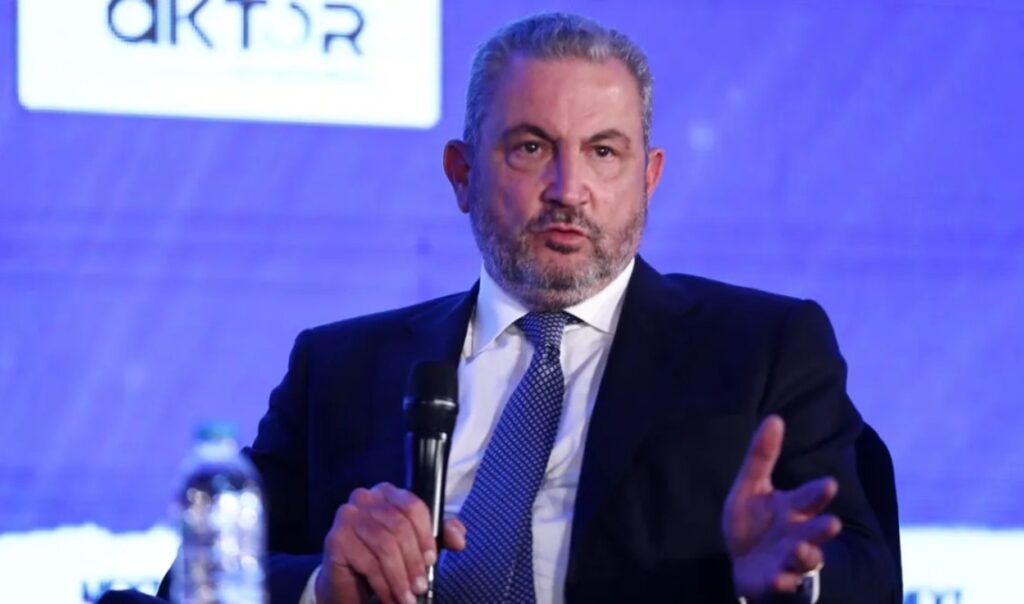
The key gap in European energy policy lies in the delay in making critical decisions during a period when geopolitical developments require speed, coordination, and strategic consistency, highlighted Alexandros Exarchou, head of AKTOR Group and CEO of Atlantic SEE LNG Trade. Speaking at an Economist panel in Romania titled “South-east Europe’s Next Leap Forward“, he emphasized that energy is a decisive factor for the EU economy, yet its management continues to be characterized by delays, contradictions, and lack of long-term planning. He made particular reference to the Vertical Corridor, emphasizing that it is not simply an infrastructure project, but a critical tool for diversifying energy flows in the broader region. As he noted, the ability to transport LNG through Greece to Southeastern and Eastern Europe is a fundamental prerequisite for independence from Russian gas and for creating a more resilient energy system.
“I have the advantage of not being a politician,” he noted when opening his remarks, clarifying that the market must ask the real questions when politics often hesitates. The first question, as he said, concerns Europe’s strategy itself: “Do we really mean we don’t want Russian gas?”. If the answer is positive, then according to him, the critical question shifts to whether sufficient alternative quantities have been secured, mainly from the United States.
Exarchou: Need for second FSRU, as well as improvement and expansion of natural gas pipelines
In this context, he highlighted the weaknesses of the European decision-making mechanism, noting that the EU has historically proven that it reacts with delay to crises. “We saw it with the war in Ukraine, we see it now with developments in the Middle East,” he said, emphasizing that energy disruptions are not theoretical, but have direct impact on prices, inflation and ultimately citizens’ daily lives.
He placed particular emphasis on the issue of energy cost, which he characterized as pivotal for the sustainability of the European economy. As he noted, prices change very rapidly, even within a few months, making the need for stabilizing mechanisms urgent. In this logic, he highlighted the role of long-term LNG contracts as a basic tool for market balance and ensuring predictable prices.
At the same time, he pointed out that the European Union is called to move coordinately at the level of 27 member states, both in medium-term and long-term horizons, in order to address the challenges of energy security. As he emphasized, until today Europe has proven effective in “describing the problem,” but not in making the necessary decisions.
Mr. Exarchou referred to the need to strengthen energy infrastructure, noting that creating additional LNG import capabilities is a critical prerequisite for supply security. “The need for a second FSRU, as well as for improving and expanding natural gas pipelines, is not a choice but a necessity in an environment of increased uncertainty,” he said.
At the same time, he referred to international developments, noting that global energy flows are strongly affected by geopolitical factors, such as developments in Qatar, China’s stance, and the continued presence of Russian gas in the markets. The fact that the market remains multilevel and interconnected makes the need for strategic preparation even more urgent.
In closing, Mr. Exarchou sent a clear message for the coming period, warning that the effects of today’s choices will be strongly reflected in the coming months, with next winter constituting a critical test for the endurance of the European energy system. “We face a strong alarm bell and we are unprepared,” he noted, emphasizing that Europe must redefine its strategy if it wants to ensure its energy autonomy and economic stability.
The basic conclusion of his intervention is clear: energy security cannot be based on fragmented moves and delayed reactions. It requires decisions, investments and above all a coherent strategy that will respond to the speed of developments.
Papastravrou: Energy is security, it is stability
The Minister of Environment and Energy, Stavros Papastravrou, clearly stated the basic stakes: energy is not simply an economic or technical factor, but the core of stability, resilience and the very functioning of societies. “Energy is security, it is stability, it is life,” he characteristically emphasized, underlining that without reliable and affordable energy neither households nor economies can function.
Referring to the European experience of recent years, he noted that the crisis revealed the limits of a model that relied excessively on low cost at the expense of security. “Energy cannot be considered cheap if it is not secure,” he pointed out, adding that choices that in the past seemed efficient ultimately proved fragile and, in some cases, vulnerable to geopolitical weaponization.
In this context, he highlighted as a basic priority the diversification of sources as well as routes and energy technologies. As he emphasized, Europe has already taken steps toward independence from Russian gas, with imports reduced significantly in recent years, without however having completely disappeared. “This must reach zero,” he emphasized, noting that dependence on sources that have proven they weaponize energy cannot be part of a sustainable strategy.
He placed particular emphasis on the role of Southeast Europe, noting that a large part of Russian gas flows continues to be directed toward the region. In this context, he characterized projects like the Vertical Corridor as “of pivotal importance,” not only for transporting natural gas, but for the overall reorganization of the region’s energy map.
As he explained, Greece has adopted a “pragmatic” energy strategy, investing in diversifying the energy mix. From a period where electricity generation was based more than 65% on lignite, today its share has been limited to below 10%, while renewable energy sources now cover more than 50%-55% of electricity generation.
At the same time, he highlighted the country’s strategic choice to proceed with developing the hydrocarbons sector, noting that for the first time after almost five decades, exploratory drilling is proceeding in the Ionian, while by the end of the year seismic surveys are expected to begin south of Crete as well. Major international energy groups such as Chevron and ExxonMobil participate in the projects, which “strengthens the credibility and prospects of the undertaking.”
He also characterized the Vertical Corridor as of decisive importance, which he described as something much broader than a set of pipelines. “It’s not simply about transporting molecules, but about arteries of development, stability and prosperity,” he said, adopting a more geopolitical approach to the project. As he noted, through Greece as an entry point, American LNG can be directed toward Bulgaria, Romania, Moldova and Ukraine, strengthening energy security throughout the region.
At the same time, he opened the discussion for extending the corridor toward the Western Balkans, emphasizing that countries like North Macedonia and Serbia should be included in the planning, so that a broader regional energy system with increased connectivity and resilience can be created.
In closing, the minister repeated that energy policy cannot be disconnected from broader geopolitical and economic strategy. Ensuring reliable, affordable and diversified energy is, as he emphasized, a prerequisite for development, competitiveness and social cohesion. “Energy is life. And secure energy is power,” he concluded, summarizing the basic message of his intervention.
Bogdan-Gruia Ivan: We don’t have the luxury to wait
Romania’s Energy Minister Bogdan-Gruia Ivan clearly stated the dilemma facing Europe: decisions now or prolonged dependence and instability. As he emphasized, the region’s problem is neither lack of resources nor bureaucracy, but the absence of clear political decision.
He highlighted Romania’s role as a key energy player, noting that it is the largest natural gas producer in the European Union, though this is not enough to cover the region’s increased needs. “We need alternative supply chains,” he emphasized, clarifying that complete disconnection from Russian energy flows is a one-way path for Europe’s energy security.
With particularly sharp language, he noted that the discussion about independence from Russia remains at the level of statements, while in practice decisions are delayed. “At the collective level everyone agrees, but in practice changes don’t proceed,” he characteristically said, noting that the region is at a critical crossroads where immediate action is required.
At the center of his intervention was the need to formulate a long-term strategy for the next 20 to 25 years, through coordination of the region’s countries. As he emphasized, energy independence is not a matter of choice between the US and European Union, but a matter of strengthening self-sufficiency through cooperation and diversification of supply sources.
The Romanian minister also highlighted a critical contradiction of European energy policy: despite billions invested in renewable energy sources, they continue to cover less than 20% of consumption, while globally over 80% of energy continues to come from fossil fuels. In this context, he argued that Europe must utilize available fuels during the transition period, while simultaneously emphasizing nuclear energy as a basic pillar of energy security.
He made particular reference to Romania’s nuclear projects, noting the importance of upgrading unit 1 and constructing new units, which can strengthen not only the country’s energy self-sufficiency but also neighboring markets’ supply security.
At the same time, he directly connected energy policy with industrial and technological development, emphasizing that the future belongs to countries that have two basic pillars: affordable base energy and access to technology. As he noted, energy is a prerequisite for developing industry, robotics and artificial intelligence, making it a critical competitiveness factor.
In the same context, he referred to the capabilities of the broader Black Sea region, emphasizing that countries like Greece, Bulgaria, Hungary, Moldova, Serbia and Ukraine can function as a unified market, strengthening their negotiating power and creating new investment opportunities. The development of natural gas deposits in the Black Sea held a central position in his remarks, with the Neptun Deep project at the forefront, which he characterized as a “tremendous success.”
As he said, Romania aims not only to utilize this specific project but also to expand activity with new projects, in order to cover the needs of the entire region. Referring to the Vertical Corridor, he clarified that Romania actively supports the project’s business model and is working to remove obstacles and accelerate procedures. However, he warned that the region does not have the “luxury of waiting.” “It’s not a matter of whether it’s right, we know it’s necessary. The only thing left is to act immediately,” he characteristically said.
Georgieva: Southeast Europe is on the front line of energy security
Subsequently, Teodora Georgieva-Mileva, Deputy Minister of Energy of Bulgaria, took the floor, emphasizing that the European energy market is in deep transformation, with LNG now occupying a significant share of EU supply, while dependence on Russian natural gas has declined to much lower levels. As she noted, this is not simply about diversifying sources, but about a new architecture of energy security in Europe.
She emphasized that energy policy is no longer determined mainly by cost and efficiency, but by resilience against geopolitical crises, protection of social stability and protection of industry under pressing conditions. This, as she said, requires a different mindset, with political and strategic dimension, as well as ability to make decisions under crisis conditions. Referring to the European Union, she noted that gradual independence from Russian gas is no longer a political declaration but legal and operational reality, which requires careful implementation and coordination. She pointed out that energy security is not ensured by short-term markets, but by long-term partnerships and contracts, which offer stability and predictability.
She placed particular emphasis on the role of Southeast Europe, emphasizing that the region is no longer the “edge” of the network but the front line of European energy security. In this context, she characterized Bulgaria as a critical hub between LNG entries from the South and Central and Eastern European markets, noting the importance of the Vertical Corridor and interconnections.
At the same time, she said that her country is promoting new market tools and cooperation for capacity booking and attracting LNG, mainly from the United States, through coordinated initiatives with European institutions and international partners. As she emphasized, Bulgaria no longer functions simply as a transit country, but as an active shaper and coordinator of energy strategy in the region. In closing, she noted that success belongs to those who control access, build trust and shape rules, aiming to transform infrastructure into an integrated system of energy stability for Europe.