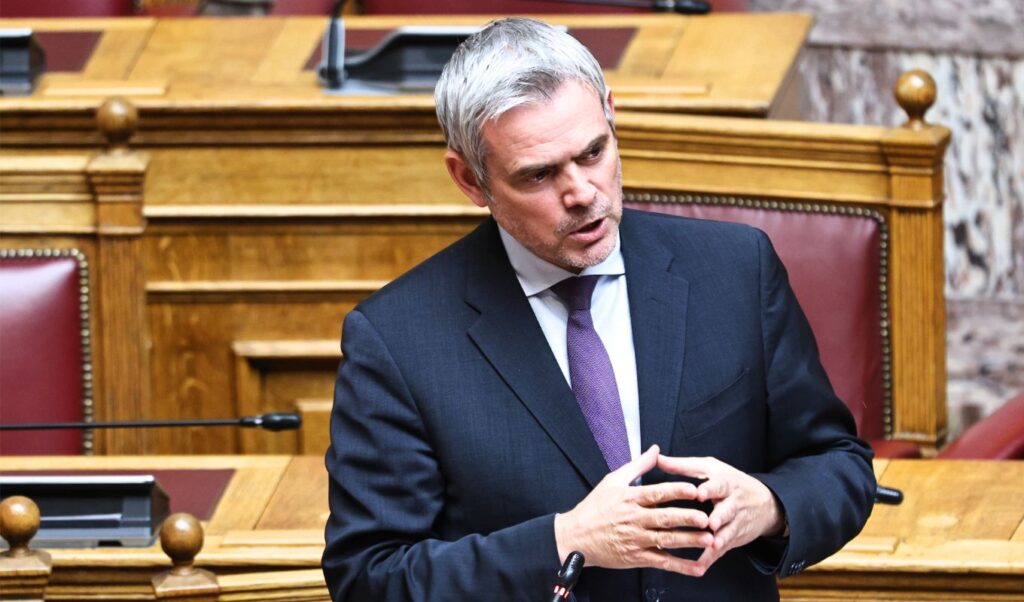
“Priority to increase workers’ incomes within the framework of our country’s economic capabilities,” emphasized Deputy Minister of Labor and Social Insurance Konstantinos Karagounis on Parapolitika 90.1 radio show “Opposite Microphones” with Vassilis Skouris and Julie Tsigka, following announcements about the minimum wage increase taking effect from April 1st.
Karagounis on minimum wage increase and small and medium enterprises
Specifically, he stated: “Income increases must be implemented within our economy’s capabilities while considering small and medium enterprises. In recent years, we have reduced wage costs by approximately 5.4 percentage points, with another half percentage point reduction still pending, bringing us to 5.9%.”
“This is the right balance, which is why insurance contributions will be reduced by another half unit – this represents €400 million for the state budget. When non-wage costs decrease, these businesses can better handle the minimum wage increase, which brings us to approximately 12th place globally. We’ve surpassed Croatia and Portugal. When adjusted for 14 monthly salaries, as calculated by the European Commission, our minimum wage reaches approximately €1,073,” Minister Karagounis explained.
He added: “This affects many people – approximately 700,000 in the private sector, public employees, and benefits calculated based on minimum wage. Maternity allowance, parental leave, unemployment benefits – another significant extension for public employees with a nominal increase of €40 that will cascade across all public employee pay scales.”
“We’ve reduced unemployment below 10%. Unemployment today stands at 7.7%,” he noted.
He continued: “The goal is to continuously increase income. This increase was at the upper limit of recommendations from both the consultation committee, which includes all social partners and ADEDY, and the scientific committee of 5 independent economic experts. Their ceiling was 4.50%, but we increased wages by 4.55%. This also includes daily wage increases, rising to €41.09 from €39.30. We have a significant increase for triennial bonuses, meaning minimum wage for skilled workers will be much higher than the €1,192 calculated until today.”
When asked about Greeks experiencing one of Europe’s highest inflation rates while ranking last in purchasing power according to Eurostat data alongside Bulgaria, he said: “The question is what we do to address a difficult and pressing situation. If we remained with pre-2019 conditions, what would be the logic? The logic is to increase incomes, reduce costs where possible, and control high prices. Indeed, compared to some European countries, we have much work to do, but compared to our own past, there’s no comparison.”
“Our goal is to reduce taxes because our economy is producing, and the Greek economy has double the growth rate of the European average. But it’s not an easy equation because we’ve been through the memoranda,” he stated.
For those under 25
Finally, when asked about young people and wage differences for those under 25, where there’s a larger increase, he mentioned: “There is a larger increase. For those under 25, net monthly earnings were €797, now the net monthly increase is €54, meaning €249 additional compared to December 2019. This is because they don’t pay income tax due to new tax rates.”