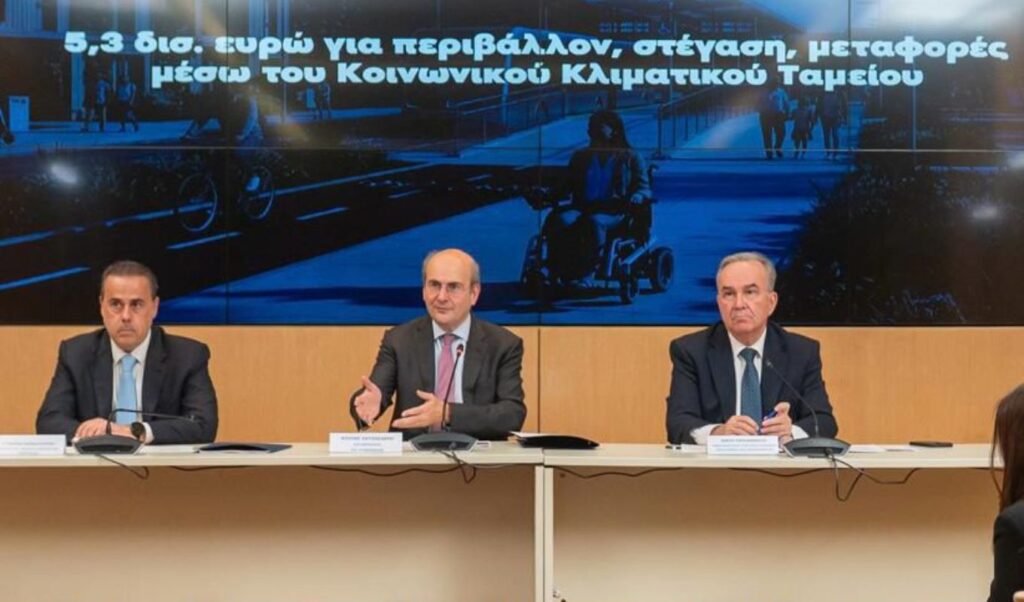
A series of interventions to support households and businesses within the framework of the Social Climate Fund were presented by Deputy Prime Minister Kostis Chatzidakis, Environment and Energy Minister Stavros Papastavrou and Deputy Minister of National Economy and Finance Nikos Papathanasis. The national plan, developed by the deputy prime minister’s office in recent months, includes 25 actions and aims to benefit approximately 1.5 million households and 70,000 small businesses.
The €5.3 billion actions from the Emissions Fund will be completed gradually by 2032. The goal of the Greek proposal submitted to the Commission, which promotes reforms with a social dimension, is for the first actions to launch in 2026. As Kostis Chatzidakis emphasized, Greece ranks 2nd in the EU in European funds per capita and is the 6th country to submit such a plan, developed with participation from 13 ministries and various organizations.
The plan’s key initiatives include:
-“Energy Saving” programs for energy upgrades of 62,000 homes and 10,000 small businesses
-Installation of 280,000 heat pumps
-Construction of 2,350 homes for vulnerable households
-Increase of up to €100/year in heating allowance
-Procurement of new electric buses
-Electric vehicle leasing
-Subsidies for purchasing or leasing electric commercial vehicles
View detailed information on all measures and interventions included in the Social Climate Fund (HERE)
Stavros Papastavrou: Support for vulnerable households with 80% subsidies
Stavros Papastavrou explained that the actions are designed to provide support to vulnerable households, with subsidies of around 80%. For example, a household choosing interventions worth €24,800 including VAT will receive a total subsidy of €19,800 and pay only €5,000.
Among other things, a unified platform for beneficiaries and a one-stop shop for comprehensive information is being created.
According to Kostis Chatzidakis, in addition to the above:
-4 inactive military camps are being licensed, two in Attica and one each in Thessaloniki and Patras for construction of 2,350 apartments for vulnerable citizens, a €435 million intervention.
-Additionally, 15 student dormitories are being modernized with €226 million
-Social leasing is being promoted, a €174 million action
-100% subsidy for individual transportation means for people with disabilities, a €51 million investment
There are also measures aimed at benefiting society as a whole, as Mr. Chatzidakis noted, referring to:
-Strengthening the urban bus fleet in Athens and Thessaloniki, with €129 million
-Upgrading 10 trains on Metro line 1, a €60 million project plus station upgrades with €7 million
-Procurement of 12 new trains for Athens Metro lines 2 and 3, a €240 million project
-Development of on-demand transport services in Attica and Thessaloniki, a €10.2 million project and
-Development of similar on-demand transport services in the provinces, a €44 million project
-Athens Move, Municipal Transport, with €11.2 million
-€219 million investment to cover student transportation needs, serving people with disabilities
-Infrastructure upgrades at 33 railway stations, a €50 million project
-Installation of publicly accessible electric vehicle charging points, a €135 million project
-Digital mapping and guidance at all Athens and Thessaloniki Metro stations, €5.5 million
-Promotion of cycling and pedestrian paths €93 million
Finally, several other significant programs are noted:
-Energy saving for businesses €394 million
-Acquisition of commercial electric vehicles through leasing or purchase by very small enterprises, €298 million and
-Subsidies for replacing conventional taxis with electric ones, a €68 million project.
This represents a total of 25 interventions worth €5.3 billion.
Nikos Papathanasis referred to the new programming period 2028-2034, the era after the Recovery Fund which concludes this year.