Terrible consequences on the economy and pressures on the market have been brought by the escalation of conflict in the Middle East, following the US and Israeli attacks against Iran last weekend and the disruption of shipping through the Strait of Hormuz.
Iran: Crisis deepens with massive stock market losses, Athens exchange “plunges”
Markets are recording sharp declines globally, while oil prices are rising simultaneously, gold is skyrocketing to record levels, and there’s an increased shift by investors to safe havens, at the same time that the Athens Stock Exchange is falling, dropping below 2,200 points.
The crisis is deepening and adds to an already fragile investment environment, burdened by concerns about artificial intelligence valuations and credit market pressures. Investors are preparing for a period of high volatility, with inflation and energy security returning to the forefront.
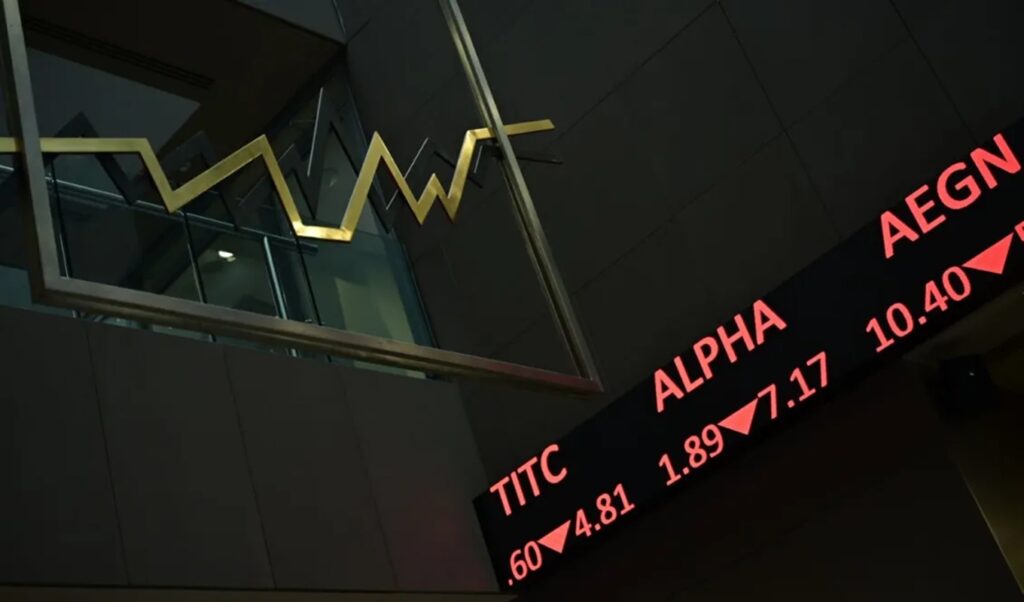
Clear and simultaneously disappointing is the picture at the Athens Stock Exchange, with the general index sliding to 2,197 points, recording losses of 3.5%. Banking stocks bear the brunt of liquidations, with Alpha Bank declining 3%, National Bank losing 3.92%, while Eurobank and Piraeus record even more intense pressures, with losses of 6.51% and 6.55% respectively. As it clearly appears now, due to uncertainty, investors are withdrawing for self-protection.
The pressures extend across all blue chips, with Metlen marking a 3.69% drop, GEK TERNA 4.38%, PPC 4.13%, Motor Oil 4%, HELPE 2%, while Aegean records one of the day’s biggest losses at -6.12%.
Major losses in European stock markets, Asian markets under pressure
At the same time, Asian stocks declined 1.6%, while futures contracts for US stocks recorded falls above 1.3%. Meanwhile, European futures posted losses of 2.3%, anticipating pressures on European stock exchanges.
In Asia, the MSCI Asia Pacific index fell 1.7%, Hong Kong’s Hang Seng index dropped 2.1%, while the Shanghai Composite strengthened 0.5%. In Japan, the Nikkei 225 recorded a 1.35% fall to 58,053 points. In China, the Shanghai Composite rose 0.47%, while Shenzhen declined 0.20%. In Australia, the ASX 200 posted a marginal gain of 0.03%, while Singapore’s Straits Times lost 1.8%. Finally, India’s Nifty 50 recorded a strong 2% decline.
Opening with 1.8% losses, the pan-European Stoxx Europe 600 index, the German DAX records a 2.28% fall, the French CAC 40 declines 1.82%. In Britain, the FTSE 100 index marks a 0.94% drop. On the periphery, Italy’s FTSE MIB records 2.41% losses, while Spain’s IBEX 35 declines 3.10%. On Wall Street, Nasdaq 100 futures lead losses with a 2% drop, followed by the S&P 500 (-1.6%) and Dow Jones (-1.5%).
Oil and gold skyrocket
Oil surpassed $78 per barrel, strengthening approximately 8%, with investors closely monitoring the situation in the Strait of Hormuz, which remains essentially closed – a critical maritime route for oil flow to the rest of the world. Earlier, crude had recorded gains of up to 13%.
Spot gold increased 2%, as investors preferred safer assets, trading around $5,380 per ounce, while the Bloomberg Dollar Spot index strengthened 0.5%. Conversely, government bonds declined across the spectrum.
Global markets disrupted
Stock exchanges are called to face the escalation of military tensions in Iran and the broader region, with this development threatening to disrupt global transport and travel, with significant impact on oil and inflation. As stated by Dilin Wu, strategic analyst at Pepperstone: “I don’t rule out the possibility of further escalation, but I believe the market is more likely to reverse the previous overreaction and adopt a wait-and-see stance. Although Iran has shown some resistance, its capability is clearly limited and negotiations may be the most viable solution.”
Markets remained unstable amid conflicting reports regarding discussions between Iran and the US. The Wall Street Journal reported that Iran made a new attempt to restart nuclear talks with the US, however, Iran’s national security chief, Ali Larijani, stated that the country would not negotiate.
Donald Trump stated that the bombing campaign against Iran would continue until strategic objectives are achieved, while calling on the country’s leaders to surrender. His statement comes despite the report suggesting that at least one senior official in Tehran sought to restart nuclear talks with the US. As reported by The Atlantic magazine, Trump agreed to talk with Iran’s new leadership.
A period of global market gains from December to February was followed by Monday’s stock decline. Asian markets outperformed US and European ones, where concerns about AI spending and the potential consequences of the technology have caused turbulence. Strategists at Barclays Plc warned against rushing to buy on any dip. Ajay Rajadhyaksha, the firm’s global head of research, noted that geopolitical tensions may last longer than usual, affecting the likelihood of US losses, attacks against Iranian leadership, and shipping disruption in the Strait of Hormuz. As he noted: “The risk-reward relationship doesn’t look attractive,” adding that a potential buying opportunity would only arise if the S&P 500 declines more than 10%.
What’s happening with currency and cryptocurrencies
Markets are already vulnerable due to the disruption caused by artificial intelligence in stocks, within the framework of the so-called “AI scare trade,” with geopolitical risks adding as a problem, while issues in private credit – a key financing source for technology companies – are affecting sentiment.
The Topix banking index in Asia fell up to 6.3%, the largest since April, due to concerns about credit market problems. Investors are also monitoring inflation, as even before Monday’s oil price surge, data showed higher-than-estimated producer prices in the US.
A prolonged oil price increase would negatively affect government bonds. Specifically, the flight to safer investments would reduce yields, but rising energy prices would fuel inflation and increase them. Bloomberg noted that if the Strait of Hormuz closed, oil prices could reach $108 per barrel, given that approximately one-fifth of global flows pass through this particular maritime route.
The possibility of prolonged Middle East turbulence and rising oil prices give fund managers reasons to reduce risk, selling stocks and turning to safer investments. As stated by Dec Mullarkey, managing director at SLC Management: “Everything is happening at a sensitive time. US markets are already vulnerable to technological turbulence and emerging credit pressure, so rising commodity prices could trigger massive selling as investors limit risk.”
Regarding the currency market, the US dollar strengthened 0.7%, functioning as a haven against major currencies. The euro declined 0.8% to $1.1714, the British pound fell 0.9% to $1.3356, while the Japanese yen and offshore yuan slipped 0.7% and 0.3% respectively.
Finally, commodity gains are explosive, with Brent strengthening 9.4% to $79.69 per barrel and spot gold rallying 2.5%, touching $5,411.07 per ounce. Conversely, bond yields moved higher, with the US 10-year at 3.96% and the British equivalent jumping 10 basis points to 4.33%. Finally, cryptocurrencies showed relative resilience, with bitcoin posting a marginal 0.3% gain to $65,850.35.