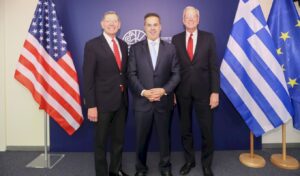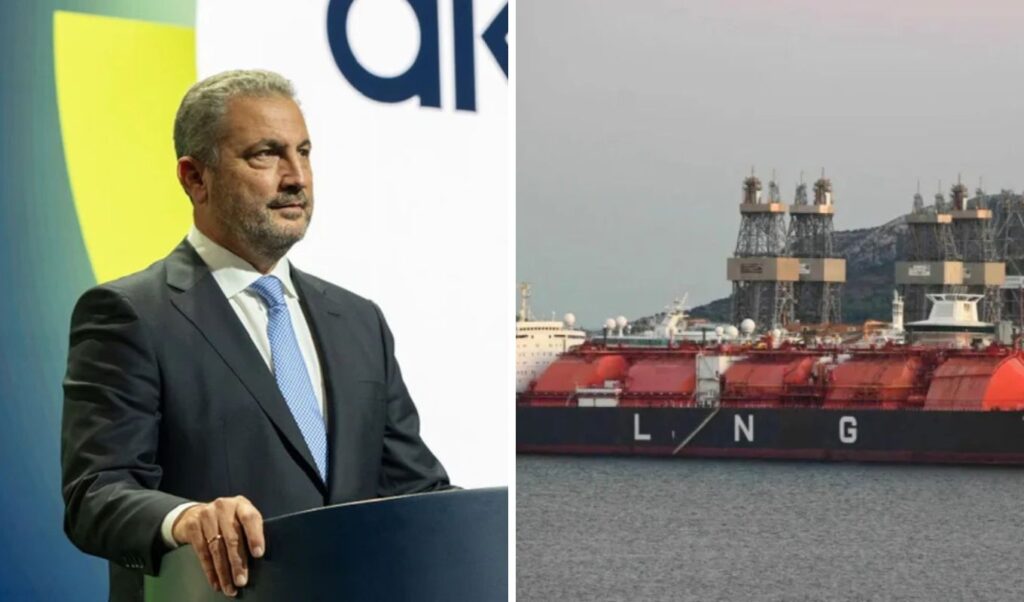
Last week’s news from Washington appears positive at first glance for the Vertical Corridor – with the series of long-term agreements signed by Atlantic SEE LNG Trade with states and government entities from Ukraine, Bulgaria, Albania and Bosnia-Herzegovina for the supply of American LNG. These are agreements lasting almost 25 years that certainly strengthen the economic interests of the companies participating in the consortium (namely the AKTOR group and DEPA Commercial), as well as the geopolitical character of the project.
Fine print
However, since – as is well known – the devil is often in the details, sources speak of some “fine print” that raises concerns, particularly regarding Albania’s demand for the construction of a Floating Storage and Regasification Unit (FSRU) for LNG on its territory, which reportedly has been set as a condition in the LNG supply agreement between Atlantic SEE LNG Trade and the neighboring country.
This is because – as sources with excellent knowledge of the developments note – given that gas consumption in Albania is minimal and in no case justifies an FSRU with a capacity of 4.5-5 billion cubic meters of gas (bcm) per year, the question arises: what exactly does Albania want this terminal for? And furthermore, with which natural gas pipeline will it connect it and for what purpose?
Currently, the only natural gas pipeline passing through Albania is the Trans Adriatic Pipeline TAP that carries Azerbaijani gas, which is suspected of potentially mixing with Russian gas during its route from the Caspian Basin to Europe via Turkey – and the Southern Gas Corridor. Connected to this pipeline is another natural gas pipeline project that directly competes with the Vertical Corridor, the Ionian Adriatic Pipeline – IAP with transport capacity up to 5 billion cubic meters/year, designed to start from Fier (where there is a TAP exit point) and head north through Montenegro and Bosnia-Herzegovina to Croatia.
Therefore, one could reasonably speculate that this FSRU could be financed by the Americans as part of an alternative to the Greek Vertical Corridor towards the North. The entire equation must also take into account that Albania is not bound by European Union restrictions, which certainly makes things easier with the administration on the other side of the Atlantic.
Ankara’s mega-deals
At the same time, the Turks are claiming a leading role in the “game” of covering the energy needs of Central and Southeast Europe, armed with the five LNG terminals they already possess and the long-term LNG supply agreements they have signed, such as that of state company Botas with Bulgarian Bulgargaz since 2023 and those with Shell, ExxonMobil and Total Energies that followed.
The conclusion is one: nothing is and should not be taken for granted with the current government in Washington, and constant effort and vigilance are required to protect and strengthen whatever energy assets exist, which are anything but guaranteed. And while some here hesitate to sign long-term agreements thinking about the higher cost (compared to the supposedly “alternative” options that have expiration dates, like Russian gas), without considering the premium that energy supply security entails, Greece risks falling behind in the energy dominance game in Central and Southeast Europe and losing its advantage to the Albanians, the Turks, or both together. Certainly not the desired scenario…
Published in Apogeumatini