The Vertical Corridor faces a new, critical test on Tuesday, March 3rd in Brussels, with focus on the next phase of a project that is now attempting to move from signatures and political commitments to implementation. After the “wave” of agreements and strong support messages that came from across the Atlantic, stakeholders return to the table to gradually complete all links in the chain.
The timing is considered pivotal. The political signal has been given, alliances have been forged, and the first agreements with Atlantic SEE LNG Trade taking the lead have already paved the way. What remains is to align the technical, economic and commercial data, so that the Vertical Corridor stops being an ambitious plan and begins operating as a real energy artery for Southeastern and Central Europe.
Vertical Corridor: The geopolitical message from the Washington summit
The picture that emerged in Washington had a clear political and geostrategic imprint. Thirteen countries, including Greece and the US, signed a joint declaration at the Transatlantic Gas Summit for diversifying Europe’s supply sources and gradually reducing dependence on Russian gas, with explicit references to the need to remove bottlenecks weighing on the Vertical Corridor. Participants committed to developing new LNG infrastructure, as well as utilizing Ukraine’s underground storage facilities, aiming to enhance regional supply security and gradually integrate Kiev into European markets as a natural gas trading hub.
The need to “unlock” capital, both public and private, with participation from export credit agencies and multilateral banks was also put on the table, so that infrastructure investments can move forward. At the same time, countries agreed on closer coordination for more stable and sustainable pricing schemes, aiming to limit volatility and give the market greater predictability. However, for Athens, these processes are part of the strategy to establish the country as an energy gateway for Southeastern Europe, as became clear from the statements by Energy Minister Stavros Papastavrou, who highlighted the Vertical Corridor not simply as an infrastructure project, but as a structural element of a broader geostrategic architecture for the region. Taking the baton from the intensive processes in Washington, attention now turns to the Brussels table.
At the center of discussions is the Commission’s intention to examine a new, improved capacity booking product of longer duration than current ones. This is a development that, if confirmed, would signal a clear change in stance compared to the current regime of limited duration (even monthly) products, strictly targeted at the Ukrainian market and approved as exceptions to existing regulations.
The political signal has been given, alliances have been forged and the first agreements, with Atlantic SEE LNG Trade taking the lead, have already paved the way
The predictability challenge for the European natural gas market
The challenge for the European Commission is to shape those terms that will offer the market greater predictability and investment visibility, so that recent framework agreements can gain commercial depth and transform into actual flows. At the same table, the open issues that keep the project in transition phase are expected to be addressed: the need for infrastructure financing, removal of regulatory bottlenecks and balancing of transit charges that continue to burden the route. In other words, Brussels is called upon to synchronize technical and economic data with the geopolitical will recorded in recent days. The proposal submitted by the American side is also of interest – to include countries’ investments for upgrading Vertical Corridor infrastructure in the $750 billion amount provided by the EU-US trade agreement for energy product imports from the US by summer 2028.
Despite the clear political push of recent months, the decisive challenge for “filling” the Vertical Corridor remains demand and, mainly, buyers’ willingness to undertake long-term commitments. In an environment where uncertainty prevails, signing multi-year contracts is not a given. This does not negate the strategic importance of the project, but highlights its complex character: technical adaptations, regulatory interventions and economic risks coexist and influence final decisions by countries and companies. The picture forming in key countries along the route highlights the project’s complexity. Romania and Bulgaria institutionally support the Vertical Corridor and proceed with infrastructure upgrades, while at the same time strengthening domestic gas sources and alternative supply options reduce pressure for immediate, long-term commitments. Hungary’s stance fits into the same mosaic, having co-signed the source diversification declaration while maintaining reservations regarding the cost and capacity of the new route.
What the major Washington deals signal and the strong Greek “flavor”
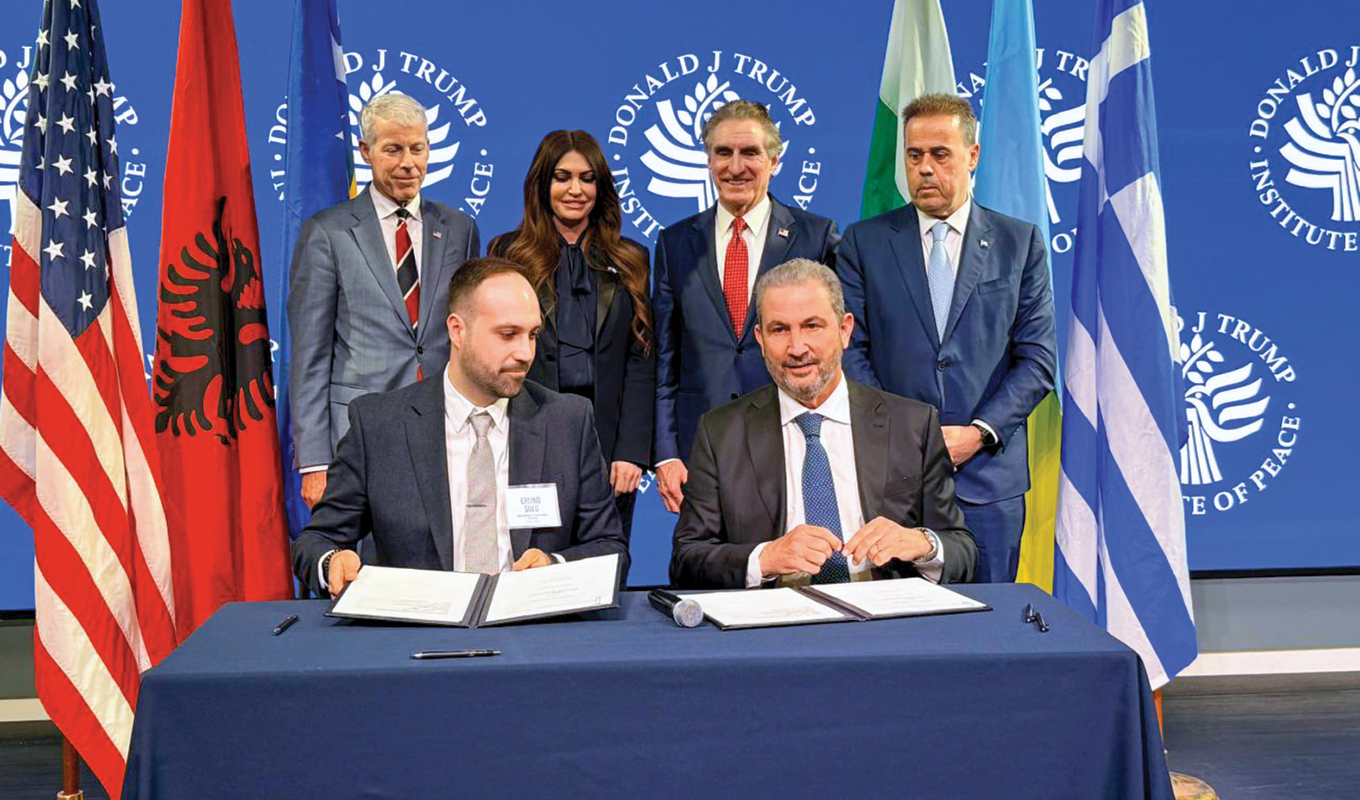
The broader geographical footprint that the American side seeks to cover is not limited to the narrow route of the Vertical Corridor, but embraces Southeastern and Central Europe as a whole. This was reflected in the very subject of the Washington summit, which exceeded the limits of a specific infrastructure project and touched on the overall reorganization of energy flows in the region. The presence of 22 countries, from Albania to Poland, highlighted exactly this ambition: shaping a broader cooperation framework that transcends a single corridor and targets overall diversification of European supply. The broader geopolitical framework of the summit was clear. However, the real “color” of the meeting was provided by the Greek-interest Memoranda of Understanding signed in Washington. Indeed, a milestone for the Vertical Corridor is the four new long-term agreements signed – on behalf of Atlantic SEE LNG Trade – by the company’s and AKTOR Group’s CEO, Alexandros Exarchou, with Ukraine’s state gas supply company Naftogaz, Ukraine’s public natural gas company Bulgargaz, Aluminij Industries and M.T. Abraham group from Bosnia-Herzegovina, and Albania’s Ministry of Infrastructure and Energy.
The agreements follow those Atlantic SEE signed in November in Athens, to strengthen the country’s strategy in promoting the Vertical Corridor and its geostrategic role in the region, which the US has recognized, establishing the country as a gateway for transporting American LNG to Central and Eastern Europe. These are exactly the type of deals that give strong credibility and commercial viability to the Vertical Corridor over time. At the same time, it is significant that these agreements “expand the range” of Atlantic SEE LNG Trade’s counterparts and simultaneously “open the door” of the Vertical Corridor to the Western Balkans (through the agreement concerning Bosnia), in a region where Russian gas dominates until today, something that is sought to be overturned also through the Vertical Corridor. At the same time, beyond upgrading existing infrastructure of the old Trans-Balkan Pipeline, which constitutes the “backbone” of the Vertical Corridor, new infrastructure in Southeastern Europe now comes to the forefront more dynamically, deemed necessary to receive increased quantities of American LNG planned to be directed to the region. In this context, Atlantic SEE LNG Trade is reportedly examining participation in a series of projects considered pivotal for full development of the Vertical Corridor: from new floating storage and regasification units (FSRU) and capacity enhancements in existing pipelines to possible new interconnections and natural gas-fired power generation units. Additionally, in Washington, Metlen signed an agreement with Shell, currently the largest buyer of American LNG.
The five-year agreement with immediate activation from 2027 provides for supplying 0.5 to 1 billion cubic meters of LNG annually (10 cargoes) that will arrive in Greece and, through the Vertical Corridor, will be channeled to other markets beyond those of Southeastern Europe. The two companies also agreed on broader cooperation for joint marketing of natural gas along the Vertical Corridor. Metlen is currently Greece’s largest LNG importer with significant export share to Balkan countries, while by autumn 2027 it must completely replace gas quantities supplied from Gazprom through long-term contract.
Stavros Papastavrou to Parapolitika: “It was confirmed that energy constitutes the foundation of the strategic relationship between Greece and the US”
Environment and Energy Minister Stavros Papastavrou spoke to Parapolitika about the important contacts made in Washington and the vote of confidence our country received once again from the US government.
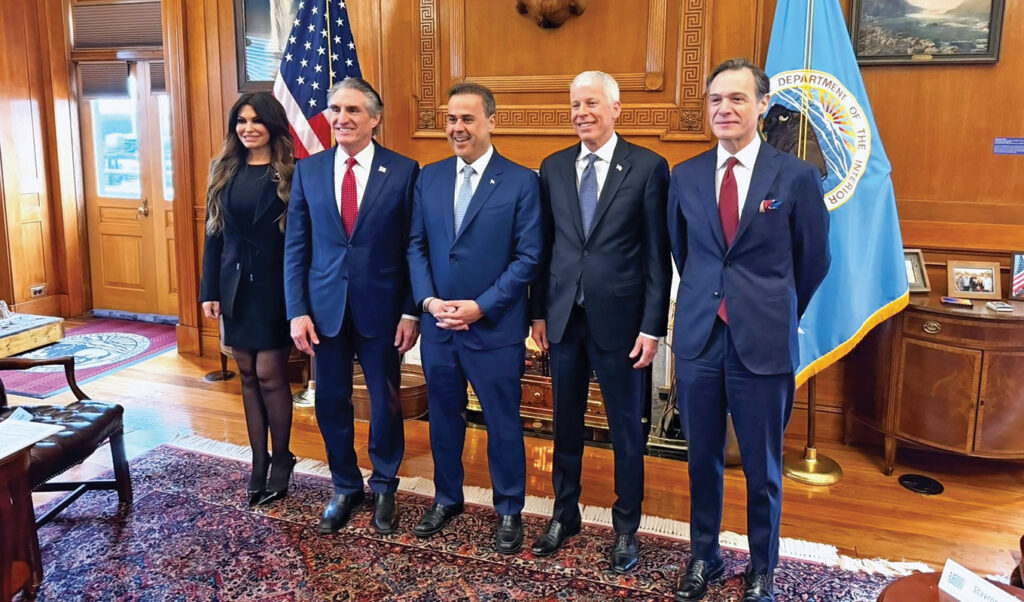
“Our recent mission to the US demonstrated that Greece is not limited to words and declarations. It moves to action. It implements strategy. At the Ministerial Summit organized in Washington by the Trump Institute, the White House and the US National Energy Dominance Council (NEDC) for Transatlantic Natural Gas Security, the strategic importance of the Vertical Corridor was recognized, a Greek initiative that can ensure energy security for up to 100 million citizens and create an axis of stability in a region that remained fragmented for decades. In our meeting with Interior Secretary and chair of the US Energy Dominance Council Doug Burgum, and Energy Secretary and council vice-chair Chris Wright, in the presence of Greece’s ambassador to the US Antonis Alexandridis, and US ambassador to Greece Kimberly Guilfoyle, it was confirmed that energy constitutes the foundation of the Greece-US strategic relationship. This strategic relationship is not built with slogans, but with agreements, investments and projects with measurable results. In an era of geopolitical uncertainty, others are content with analyses. Greece moves to decisions and implementation. We build strong partnerships, diversify sources, armor Europe’s energy security and strengthen our national power. Energy is a matter of national sovereignty. And Greece exercises it in practice, with planning and determination,” Minister Papastavrou concluded.
Published in Parapolitika