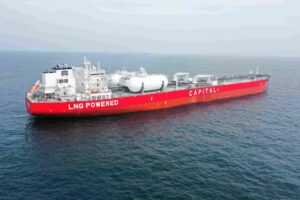
As Europe absorbed nearly three-quarters of US LNG exports in December 2025, transatlantic energy flows are strengthening dramatically, confirming the pivotal role of the United States in the Old Continent’s energy supply. The increased demand from European markets, combined with Turkey’s significant participation, is not only reshaping the natural gas trade balance but also directly impacting the LNG carriers freight market, causing freight rates to rise in the Atlantic while simultaneously pressuring the Asian market.
Europe absorbed 75.8% of US LNG exports in December 2025
According to US Department of Energy data, Europe maintained its leading position in US liquefied natural gas imports in December 2025, absorbing 431.5 billion cubic feet (Bcf), equivalent to approximately 12.2 billion cubic meters, representing 75.8% of total US LNG exports for the month.
Overall, in December 2025, the United States exported 569.3 Bcf of LNG to 28 countries worldwide, approximately 16.1 billion cubic meters, marking an 8.4% increase compared to November and a 38.6% rise compared to December 2024.
Other markets operated at significantly lower levels. Asia imported 68.2 Bcf, approximately 1.9 billion cubic meters (12%), Africa 48.5 Bcf or about 1.4 billion cubic meters (8.5%), while Latin America and the Caribbean absorbed 21.1 Bcf, equivalent to approximately 0.6 billion cubic meters (3.7%).
It’s worth noting that 93.7% of shipments were directed to non-Free Trade Agreement countries (nFTA), while only 6.3% went to countries with which the US maintains Free Trade Agreements (FTA), highlighting the decisive role of US LNG in markets outside the traditional trade framework.
Key destinations: Turkey first, followed by UK and Germany
At the country level, the five main destinations concentrated 52.6% of US shipments.
Turkey ranked first with 95.7 Bcf (approximately 2.7 billion cubic meters, 16.8%), followed by the United Kingdom with 67.4 Bcf (1.9 billion cubic meters, 11.8%), Egypt with 47.1 Bcf (1.3 billion cubic meters, 8.3%), Germany with 45.8 Bcf (1.3 billion cubic meters, 8.0%) and the Netherlands with 43.5 Bcf (1.2 billion cubic meters, 7.6%).
In terms of total natural gas trade, the US recorded exports of 889.3 Bcf (approximately 25.2 billion cubic meters) and imports of 325.1 Bcf (9.2 billion cubic meters), resulting in net exports of 564.2 Bcf, or approximately 16.0 billion cubic meters.
Official US Department of Energy data shows that the United Kingdom emerged as the top European destination with 67.4 billion cubic feet (Bcf), approximately 1.91 billion cubic meters of natural gas. Germany followed with 45.8 Bcf (1.30 billion cubic meters) and the Netherlands with 43.5 Bcf (1.23 billion cubic meters).
Italy (39.2 Bcf – 1.11 billion cubic meters), France (38.4 Bcf – 1.09 billion cubic meters) and Spain (32.3 Bcf – 0.91 billion cubic meters) also recorded particularly high deliveries, confirming Southern Europe’s continued shift toward US LNG shipments.
In Central and Eastern Europe, Poland imported 21.7 Bcf (0.61 billion cubic meters), while Belgium received 17.7 Bcf (0.50 billion cubic meters). In the Eastern Mediterranean, Greece recorded imports of 12.0 Bcf (0.34 billion cubic meters), leveraging the potential of LNG terminal stations.
Meanwhile, Croatia imported 10.7 Bcf (0.30 billion cubic meters), while smaller but strategically important quantities were directed to Lithuania (3.7 Bcf – 0.10 billion cubic meters) and Portugal (3.5 Bcf – 0.10 billion cubic meters).
Overall, European imports of US LNG in December 2025 reached levels that confirm the stable transatlantic energy relationship, with Europe remaining the dominant destination for US shipments during a period of global energy flow restructuring.
Rising freight rates in the Atlantic
At the same time, the divergence between Atlantic and Asian LNG carrier freight markets is intensifying, with the European market absorbing increased volumes of US cargo and supporting freight rates west of Suez, while prices decline in the East.
Europe – together with Turkey – concentrates the largest share of LNG exports from the US, confirming the importance of US natural gas for the continent’s energy sufficiency. The increased activity in the Atlantic translates into significant enhancement of daily earnings for modern LNG transport vessels.
According to latest data from Norwegian firm Fearnleys, MEGI/XDF technology vessels with capacity of 170,000-180,000 cubic meters, equipped with dual-fuel engines, are being chartered in the spot market east of Suez at around $27,000 daily, marking a decrease of $2,000 compared to the previous assessment.
Conversely, in the area west of Suez, freight rates recorded a surge, reaching $35,000 per day, up $13,000, as flows to European terminals strengthen.
In the time charter market, one-year contracts remain at $39,000 daily, indicating that charterers continue to secure capacity on a medium-term basis, anticipating gradual normalization of balances within 2026.
US becomes top global LNG supplier
With daily liquefaction capacity reaching approximately 18 billion cubic feet of natural gas per day (bcfd), the United States maintains its position as the world’s leading LNG supplier, according to LSEG (London Stock Exchange Group) and EIA (Energy Information Administration) data.
As the EIA notes, the increase in US LNG exports is due to a combination of factors: abundant domestic supply and high natural gas inventories, flexible export contracts and competitive gas feedstock costs. The enhanced international demand – particularly from Europe following the Russian invasion of Ukraine – and the favorable investment environment that accelerates infrastructure expansions also play decisive roles. According to the EIA, US exporters have announced plans to increase total liquefaction capacity to 28.7 bcfd by 2029, from 11.4 bcfd in early 2024, signaling more than a doubling of production capacity within a few years.