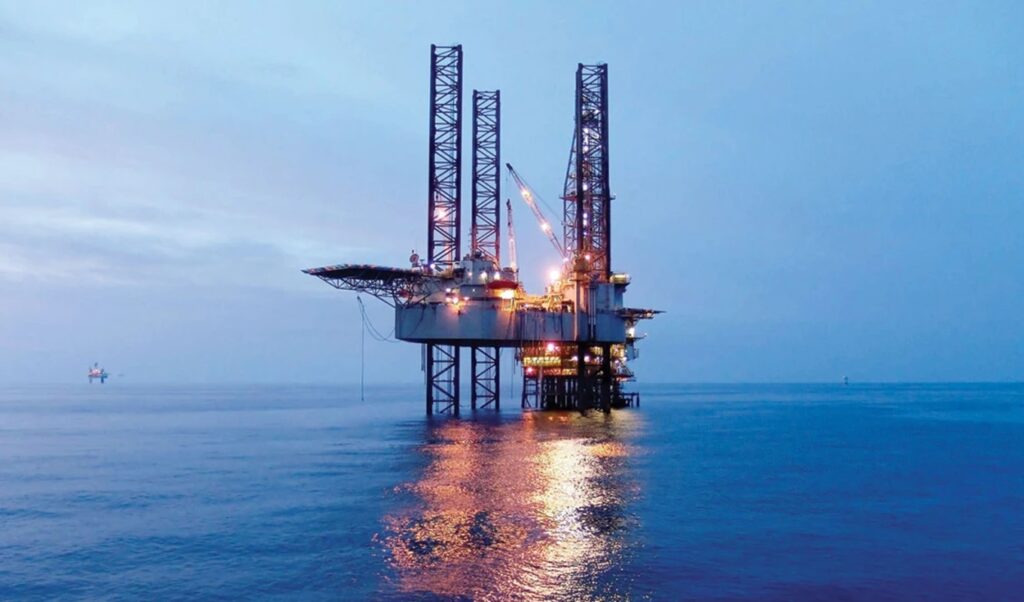
The planning by the Hellenic Hydrocarbon and Energy Resources Management Company (HEREMA) includes ten exploratory drilling operations for hydrocarbons in the six-year period 2027 – 2032 and production start from the same year (2032).
An essential prerequisite is that the seismic surveys that will precede will “show” interesting targets that will justify the high investments required for drilling execution, which collectively (for the ten areas) move at the level of 1 billion euros.
Ten hydrocarbon drilling operations by 2032: Peloponnese, Crete and Ionian Sea in focus
According to data presented last week at the event for signing concession contracts for the 4 areas south of Crete and south of the Peloponnese to the Chevron / Helleniq Consortium, the most mature area for exploration and production is “plot 2” in the Ionian Sea. In this area, it is recalled, ExxonMobil entered last year together with Helleniq Energy and Energean. An exploratory drilling is scheduled in the area in early 2027 and another in early 2029 targeting (according to existing data) a deposit of 200 billion cubic meters of gas.
Eight other drillings follow:
- In the Ionian area (lessee: HELLENiQ) in the first quarter of 2028.
- In “plot 10” (Kyparissiakos Gulf, HELLENiQ) in the second quarter of 2028.
- In the Southwest Crete area (ExxonMobil/HELLENiQ) in the third quarter of 2028.
- In the West Crete area (ExxonMobil/HELLENiQ) in the third quarter of 2030.
- In the 4 plots granted last week to the Chevron/Helleniq Consortium: A2 (south of Peloponnese) 3rd quarter 2031, South Peloponnese 1st quarter 2032, South Crete 1 third quarter 2032 and South Crete 2 first quarter 2033.
This means that if the preceding seismic surveys prove successful, there could be years with 2-3 drillings and production (if deposits are located) is expected to start in 2032 in the Ionian areas, in 2033 west and southwest of Crete and in 2034-2035 in the 4 areas south of the Peloponnese and Crete.
The Lease Contracts for the 4 areas south of Crete and the Peloponnese were signed by Environment and Energy Minister Mr. Stavros Papastavrou and HEREMA CEO Mr. Aristofanis Stefatos, while on behalf of Chevron and HELLENiQ ENERGY, Mr. Gavin Lewis, Vice President Global New Ventures, and HELLENiQ ENERGY CEO Mr. Andreas Siamisiis signed respectively. Seismic surveys in these areas are expected to begin at the end of the year. In the business scheme, Chevron has a 70% participation rate while also undertaking operator duties, while HELLENiQ ENERGY participates with a 30% share.
With the concession of these 4 “plots,” the extent of the country’s marine areas under exploration doubled, from 47,905 square kilometers to 94,094 sq.km, a fact that correspondingly significantly increases the chances of locating commercially exploitable deposits.
The prospect of hydrocarbon production from our country is connected in the long term with the development of the vertical corridor for natural gas transport through Greece to Southeast European countries, up to Ukraine. The difficulties in developing the corridor, due to the high cost entailed by its use, will be at the center of contacts that Environment and Energy Minister Stavros Papastavrou will have next Tuesday in Washington in a meeting that will include the Energy Ministers of the Vertical Corridor countries (Bulgaria, Romania, Moldova, Ukraine), US Energy Secretary Mr. Chris Wright, as well as a European Commission representative. The vertical corridor constitutes a significant alternative supply route for the region with liquefied natural gas from the US and other sources, strengthening competition and supply security. Its importance is expected to be further enhanced when the EU decision to ban natural gas imports from Russia by the end of 2027 is implemented.
Papastavrou: “Practical exercise of sovereign rights”
In statements to APE-MPE regarding developments in hydrocarbon exploration and the “vertical corridor,” Environment and Energy Minister Mr. Stavros Papastavrou notes the following:
«The energy agreements with the world’s leading energy groups ExxonMobil and Chevron constitute acts of responsibility that strengthen the country’s energy security, upgrade its geopolitical role in the Eastern Mediterranean and create prospects for our children and future generations. The implementation of research in areas of Greek jurisdiction constitutes a practical exercise of sovereign rights, with institutionality and respect for international law and law of the sea, as the Prime Minister has also pointed out. The Government of Kyriakos Mitsotakis moved from words and declarations to actions and energy agreements.
Beyond the very great geostrategic significance of these agreements, there is also the economic and social dimension, as, provided the deposits prove commercially exploitable, a significant part of revenues -approximately 40%- will return to citizens through social policy, support for the vulnerable and strengthening economic development. With the Chevron-HelleniqEnergy contracts signed Monday heading for ratification in Parliament within March and research starting in the second half of 2026, a new chapter opens for the country.
Greece today does not simply monitor international developments; it co-shapes them with plan, vision and national confidence. Recent references by US President Mr. Donald Trump confirm in practice that Greek-American relations are at the highest level of recent decades, with clear cooperation axes in defense, economy, energy and technology.
Simultaneously, the Vertical Corridor constitutes a project of strategic importance for all of Europe, strengthening energy diversification and supply security. Greece is becoming a reliable natural gas gateway, utilizing its infrastructure and geographical position.
During the coming week I will be in the United States for crucial discussions regarding the implementation, expansion and strengthening of energy agreements and the Vertical Corridor. Our goal is to strengthen cooperation of all involved parties and accelerate a project that concerns not only Greece, but Europe’s overall energy security. Greece moves forward with stability, reliability and strategic orientation».
Source: APE-MPE