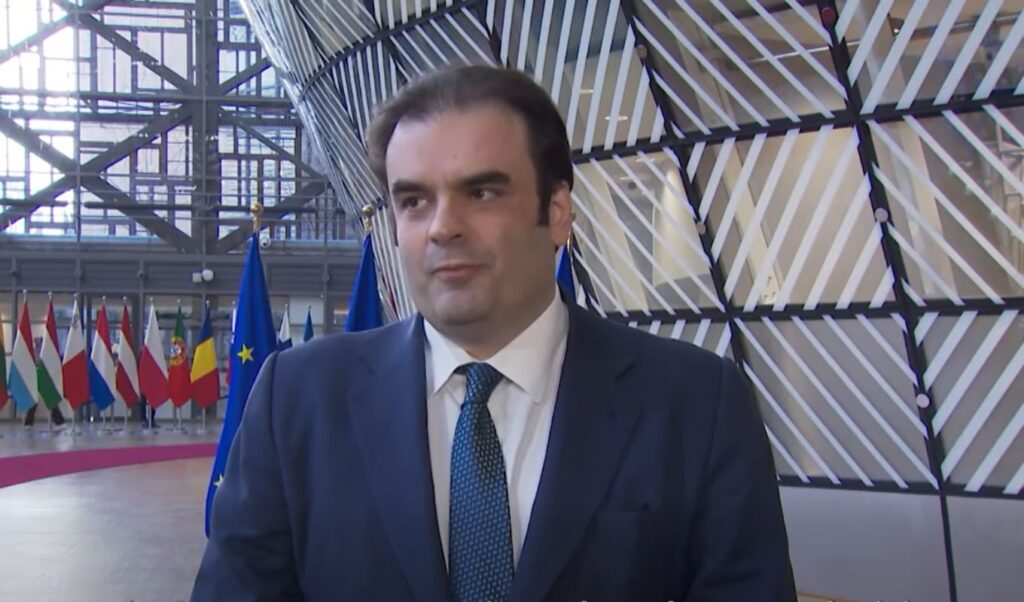
The Eurogroup held a scheduled meeting on Monday afternoon, February 16 in Brussels, with Kyriakos Pierrakakis announcing the discussion topics in his statements. According to the president of the body for Eurozone finance ministers, the main topic of discussion is the ways the European Union can enhance its competitiveness. In this case, however, as the Minister of National Economy and Finance stated, the issues to be analyzed extend beyond the European community, since the Eurogroup president’s invited guest at the meeting was François-Philippe Champagne, Canada’s Finance Minister, who has assumed the G7 presidency. Kyriakos Pierrakakis and François-Philippe Champagne had an official meeting earlier on Monday, February 16.
Kyriakos Pierrakakis: Trade and internal imbalances
“Today’s (note: 16/2) Eurogroup meeting takes place at a decisive moment for the European economy, just days after the meeting of European Union heads of state and government to discuss Europe’s competitiveness. Enhancing EU competitiveness has always been a key priority on the Eurogroup agenda and we intend to continue contributing to this discussion, strengthening economic growth and shared prosperity. Today’s agenda includes two particularly important issues.
The first concerns the international role of the euro. There’s no need to emphasize the role that the common currency plays in the European economy, ensuring its stability and unity. However, in light of recent geopolitical developments and in today’s geopolitical environment, there are risks that the international financial and monetary system could be used as a political tool. It is therefore vital to safeguard the international role of the euro, as this directly relates to the European Union’s monetary sovereignty.
The second issue we will examine concerns global macroeconomic imbalances between regional blocs. This is a matter of global scope, which we will discuss together with our colleagues from countries outside the eurozone. This issue touches on trade imbalances, but also internal imbalances, such as those related to government budgets, private savings and investments, as well as how they connect globally. It has also acquired a geopolitical dimension.
It is therefore particularly important to discuss it at the level of EU finance ministers, in order to develop a common understanding of the problem. Given that this is an issue of global nature, I also took the initiative to invite my good friend, Canada’s Finance Minister, François-Philippe Champagne, particularly in view of Canada’s recent G7 presidency, so that he can share with us his views and thoughts on the matter”.