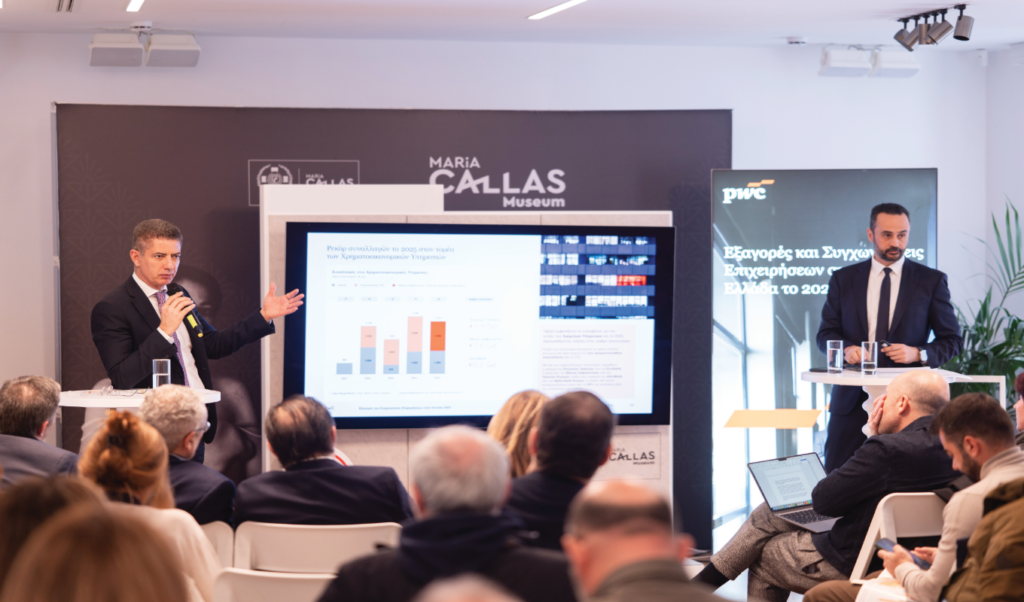
The Iranian crisis has not yet affected the merger and acquisition (M&A) “fever” happening in Greece. Last year, according to a recent study by PwC Greece, a historic record of M&A deals worth €23.8 billion was recorded, while for 2026, deals exceeding €7 billion have already been announced or completed. As acknowledged by PwC Greece Partners, Thanasis Panopoulos, Deals & Strategy Leader, and Giorgos Makrypidis, Head of Deals, last year there were some significant transactions that are difficult to repeat this year. PwC Greece executives note in parallel that the Iranian crisis has not affected the pipeline of deals, but this cannot be ruled out if this crisis becomes prolonged.
What happened in 2025 in terms of M&A in Greece and what do we expect this year?
T. Panopoulos: 2025 saw a historic record in both number and total value of transactions, as well as a decade record in average transaction value. The levels recorded were unprecedented for the Greek market. Also, last year included megadeals, which are very difficult to see every year.
G. Makrypidis: Last year we reached levels exceeding 10% of GDP, which are difficult to encounter again. However, to date, for 2026 we have not observed the slightest decline.
Due to the Iranian crisis?
G. Makrypidis: No. Compared to last year, the activity we observe during the first months of the year is increased. The total size of M&A deals may be smaller this year, mainly because it is quite difficult to have another large deal like the OPAP-Allwyn merger. Currently, we observe more sectors opening up compared to last year and we have more investors of different quality. Regarding the crisis in Iran, so far no decline in activity has been recorded.
T. Panopoulos: We already have some large transactions, such as Eurobank’s deal with Eurolife, a transaction worth €800 million. There are, in other words, large transactions ready for this year.
How can the latest Iranian crisis affect M&A?
G. Makrypidis: Uncertainty is a difficult condition and always affects strategic decisions. Especially when preparing to invest significant capital. Unfortunately, in uncertain environments, M&A as strategic decisions may lead to postponement and waiting. Given that similar crises have occurred in the past without exceeding one month in duration and the market had recovered very quickly, investors are now “trained”. They wait, but they don’t stop discussions. We who participate in many of these discussions have not seen anyone ask us to slow down. This could potentially change if the Iranian crisis lasts for a long time.
T. Panopoulos: We need to wait to see what the effects of the Iranian crisis will be. In other words, it remains to be seen whether this will develop into a global crisis, as happened with Ukraine with direct consequences being increased energy costs and inflation, but markets and economies absorbed these effects and the Ukrainian issue tends to be a regional crisis now. We need to assess the dimension of the Iranian crisis, see where it will extend and how long it will last. If we reach levels of energy crisis and serious inflationary pressures, then it is natural that business valuations will be affected.
In which sectors do we expect greater activity this year?
T. Panopoulos: The financial sector is expected to attract specialized and structural investments during 2026, such as the Eurolife deal and others. Also, the energy sector will remain at the center of investor interest, especially in renewable energy wind farms and less in solar photovoltaics. Additionally, significant activity is observed in technology and food & beverage sectors.
G. Makrypidis: To support what Thanasis mentioned, there are already announced M&A deals worth €7 to 8 billion. Therefore, the momentum of the first quarter is very strong.
In the past we mainly saw acquisitions by investment companies. Has the approach to valuations changed?
G. Makrypidis: I don’t think there are significant differences. For example, valuation multiples in Greece remain roughly the same as those in the rest of Europe. They were never noticeably lower. They were simply multiplied by much lower figures as we had a country that had lost 30% of its GDP. The basic change, however, concerns the size of Greek businesses. Right now our companies are in a growth phase with larger financial results. For this to happen, capital has flowed in and investments have been made – either from investment funds or from strategic investors – and value, increased profitability and tax results have been correspondingly generated. This allows divestment thoughts with good returns and thus we see increased activity in the M&A sector from investors of many categories now, domestic and international.
T. Panopoulos: The bet here is that as Greece develops business-wise and its companies increase their valuations and profits, we will compete with mature European markets. Our sizes are now such that an international investor focusing on Greece and choosing a business does so in an environment where Greek businesses compete with other businesses in Italy, France, Spain, Portugal, etc. And an investment that is finally made in Greece constitutes a sign of confidence in the country and this is very important.