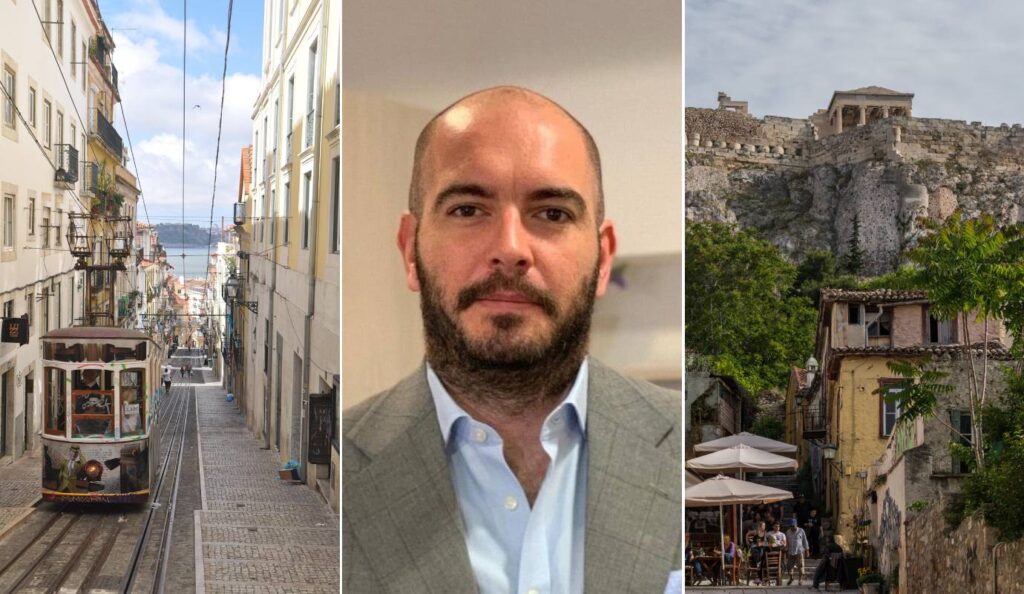
“Don’t do it like Lisbon.” This is the message from the 55th general assembly of the Athens-Attica and Argosaronic Hotels Association (EXA) held on December 5, as Athens balances on a dangerously stretched rope of investment explosion in the hotel sector. Europe’s oldest capital after Athens, Lisbon, with 3 million inhabitants, shows a somewhat similar trajectory to ours, except for one crucial element: its rapid development eventually returned to “devour” it.
It all started with the global financial crisis: The domino effect reaches Portugal, foreign capital inflow is encouraged through tax policy, golden visas and policies that at the time seemed to be paying off. Old buildings in Lisbon are renovated, the city is transformed, its reputation soars and tourism is strengthened like never before. Along with it comes short-term rentals. And rental prices. And everything returns like a boomerang with the gentrification phenomenon. Lisbon residents can no longer afford the cost of living in their own city. The result is that 30% of the capital’s population has already relocated. This is followed by loss of local character, social inequality and numerous sustainability issues.
EXA: Lisbon’s mistake that should teach Athens to avoid falling victim to hotel investment explosion
The boomerang, the farther you throw it, the more unexpectedly it returns. Especially if you overestimate the strength of your throw. This is how concerns are raised about the frenzied development of hotel investments in Athens that could turn back with force, to its detriment. Hyatt, Wyndham and Marriott are among the main international players that the Attica market is attracting, which continues to draw increasing investment interest, entering almost the same “track” as Paris, Barcelona, London and Berlin.
According to new statistical data from EXA regarding the ranking of top European cities for hotel investments, Athens climbs even higher in 2025, occupying 8th place, up from 11th position in 2024. Specifically, as Stefan Merkenhof – Managing Consultant / GBR Consulting mentioned during EXA’s 55th assembly, Athens, maintaining steady growth in arrivals, managed to record higher occupancy rates than Rome, Madrid and Lisbon, confirming the city’s rapid pace of change. This is particularly evident through the over-concentration of boutique and lifestyle hotels, short-term rentals, and the rise of the serviced apartments/aparthotels sector.
Equally noteworthy is the fact that in the 5-star category, 82% of rooms belong to chains. However, this is where EXA’s management calls for immediate attention to thoroughly investigate the new environment in tourist accommodations of all kinds, as it affects the destination’s profile, overall demand and hotel prices, business sustainability, and naturally the overall quality offered and tourism industry expectations.
Eugenios Vasilikos: “We are entrepreneurs for the long term, not the short term”
“The numbers inspire optimism, but its further tourism development requires a scientific approach and strategic plan,” noted Eugenios Vasilikos, EXA president, warning that Athens risks facing the consequences of uncontrolled overdevelopment. “New hotels are needed, but with proper planning,” he emphasized, referring to the chronic issue of spatial planning, overtaxation and the inconceivable amount spent on accommodation renovations alone, reaching 1 billion euros. “We are entrepreneurs for the long term, not the short term,” he stressed, and together with St. Merkenhof, referred to Lisbon’s major mistake that can serve as a lesson for Athens.