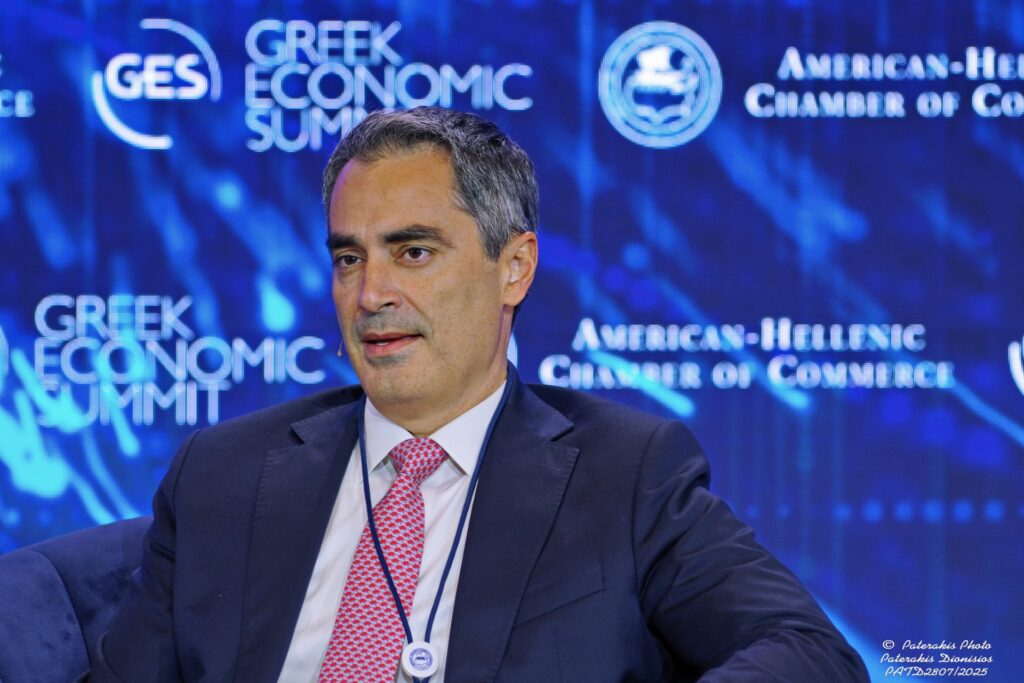
«For infrastructure to be resilient and safe, it must remain operational in case of force majeure events; otherwise, the impacts of a crisis on society and the economy multiply exponentially,» stated Manos Moustakas, General Director of Business Development and Executive Member of the Board of Directors of GEK TERNA Group, speaking yesterday at the 36th Annual Greek Economic Summit of the Hellenic-American Chamber of Commerce.
«Effective initial planning, proper construction immediately after, and systematic maintenance throughout the project’s lifespan are catalysts for its resilience to natural disasters. Today, due to major investments in recent years, the country has one of the safest national road networks in Europe. This result was achieved through excellent cooperation between the public and private sectors,» he added.
A critical factor for rapid and effective response to emergency conditions is public-private sector cooperation. Storm “Daniel” revealed that smaller-scale infrastructure suffered disproportionately greater damage compared to those constructed, maintained, and operated by private entities. «However, even in this case, the contribution of private companies in cooperation with the public sector was crucial: I remember that GEK TERNA Group alone deployed more than 200 machines at that time for immediate disaster response and temporary damage restoration in the first days after the storm,» he emphasized.
Traffic congestion
Referring to the traffic congestion issue, he noted that there are two schools of thought. «The European approach, which prioritizes the creation and strengthening of mass transportation systems, and the American approach, which focuses on developing highways, boulevards, and major road networks. Critics of the second school argue that the more you facilitate private car use, the more demand increases, resulting in greater congestion and pollution,» he stressed. Athens requires a hybrid approach, given that half of Greece’s population lives in 3% of the country’s area, while infrastructure remains without comprehensive upgrades for decades. It requires encouraging mass transportation use and promoting sustainable mobility, alongside creating necessary road infrastructure.
He reminded, however, that in Greece an average of fifteen years is required from project conception to completion and full operation. A few years ago, legislative changes allowed private entities to «substitute» the public sector in primary project maturation and infrastructure preparation. Thus, through so-called Standard Proposals, significant interventions directly connected to traffic have been submitted: bypassing the basin through the Elefsina-Oinoe road connection and underground construction of the Ymittos ring road from Karea to Vouliagmenis Avenue. These proposals were submitted three years ago, but no progress has been made since then, partly due to project complexity.
«In any case, public-private sector cooperation can continue to cover new needs. Solutions exist. We just need to focus on accelerating them. The challenge is not planning, but better programming how we will implement them to make them realistic and applicable,» Mr. Moustakas concluded.