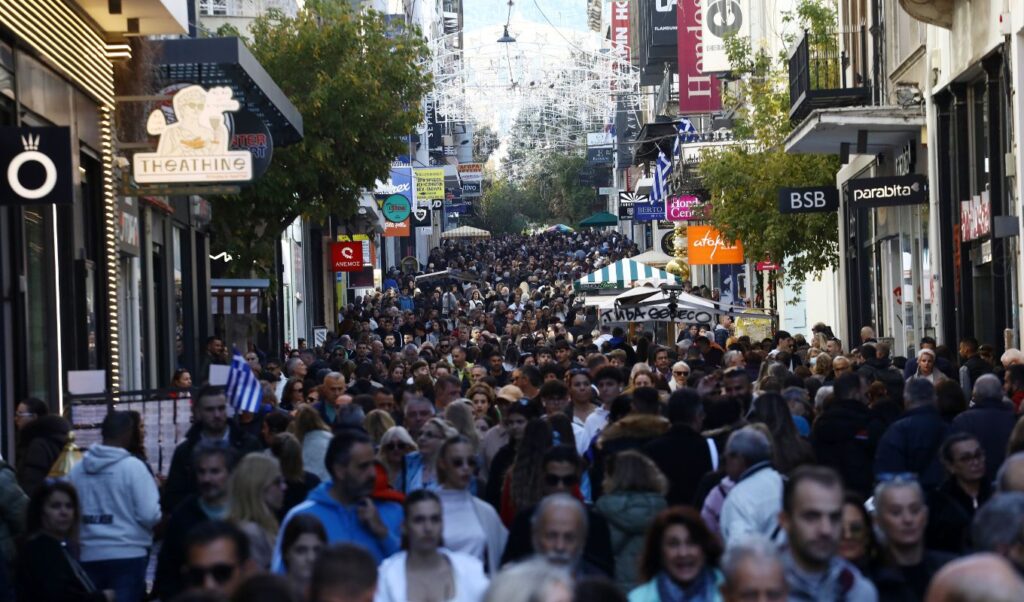
This year once again confirmed the trend of premium brands managing promotional activities in increasingly sophisticated ways and approaching Black Friday as an opportunity for careful communication of their value rather than horizontal and generalized discounts.
Specifically, Ozios Broker presents a comprehensive overview of five leading international luxury companies that recorded the best performance during challenging 2025, as well as how their strategic choices were reflected in annual sales and the evolution of their stock value. Black Friday, in this case, isn’t just about discounts.
Global luxury market showed slight deceleration
The global luxury market has shown slight deceleration, however individual categories are moving at different paces. This is why a brand’s ability to properly leverage Black Friday is crucial, not only for retailers but also for investors seeking to understand which brands can protect their margins and which are forced to retreat.
Rise of mobile shopping plays decisive role
The strong rise of mobile shopping also plays a decisive role. Thanks to this, retailers can personalize offers and target specific consumer audiences. The result is that the premium segment is modernizing at rates that would have seemed unexpected just a few years ago.
The final landscape is a clearly divided market: Wealthier consumers make purchases without needing large discounts, while a broader audience seeks premium products at more accessible prices. Thus, Black Friday evolves into a test of each brand’s ability to address both groups simultaneously.
LVMH: Asia showed first recovery signs
LVMH rarely offers discounts on its iconic brands, such as Louis Vuitton and Dior, during Black Friday. Instead, it prefers limited online packages or exclusive products for travel and seasonal collections, to avoid officially undermining the full-price image. Deeper discounts are shifted to less premium brands and the cosmetics and selective retail sector, where discounts pose less “threat” to their prestige.
The group entered this year’s period under pressure due to slowing demand in Asia, particularly China, which traditionally constitutes one of its main growth drivers.
However, latest data brings the first signs of recovery. In the third quarter, revenues reached approximately €18.3 billion, marking a return to organic annual growth of 1% and the first positive quarter this year.
For the first nine months of 2025, the group recorded approximately €58.1 billion in revenues. Compared to last year, this still corresponds to a sales decrease of about 4%. Nevertheless, clear improvement is observed in Asia, while the United States and Europe show stable figures, mainly supported by partial recovery of local demand.
The core fashion and leather goods unit, including iconic names like Louis Vuitton and Dior, remains lower compared to last year, but in the third quarter the decline was limited to about 2%, after a particularly weak first half. LVMH shares, trading on Euronext Paris, moved around €620 per share in late November, after intense volatility throughout the year, reflecting more a transition phase between previous decline and expected gradual recovery.
Hermès: Continues showing steady growth
This giant avoids any price adjustments beyond its established long-term policy during Black Friday. For Hermès, this shopping frenzy functions more as reinforcement of the myth of inaccessible luxury rather than an actual sales event.
Nevertheless, it continues showing steady growth, while its iconic products become a “safe haven” for customers seeking not only quality but also value over time. Sales increases and high profit margins show that tradition, emphasis on handmade products, and limited supply create an effective model that maintains its position even in challenging periods.
In the third quarter, the company recorded revenues of approximately €3.9 billion, while cumulatively for the first nine months of the year they reached €11.9 billion, recording an increase of about 9% year-on-year at constant exchange rates. The value of its bags in the secondary market continues to rise, adding another level of uniqueness.
From an investment perspective, this is a brand worth monitoring long-term, but the entry price is high and much of the growth potential has already been incorporated into the valuation. Hermès shares, listed on Euronext Paris under symbol RMS, underwent correction after a February high above €2,900 and in late November traded around €2,100 per share, significantly below this year’s high, but still well above the sector’s long-term average.
Richemont: Recorded the year’s biggest recovery
Like its competitors, Richemont tries to avoid generalized discounts during Black Friday. Instead, it offers additional value to customers through interactive events and exclusive presentations. This is crucial for approaching its core clientele, which doesn’t seek financial benefits but brand prestige.
Richemont records the biggest recovery this year among major luxury groups. For the first 6 months (until September 30) it recorded revenues of €10.6 billion, increased by 5% at current exchange rates (and 10% at constant rates), while Cartier, Van Cleef & Arpels and others increased their sales by 9% reaching approximately €7.75 billion, with increases up to 14% at constant rates.
Demand from the highest customer category therefore remains exceptionally strong, although specialized watchmakers record about 6% decline in sales, which doesn’t constitute a fundamental threat, as jewelry now generates the largest portion of the group’s profits.
Richemont shares, trading mainly on SIX Swiss Exchange, rank among the best performers in the luxury sector in 2025, with their price having increased by about one-third since the beginning of the year.
Kering: The year’s biggest uncertainty
Kering continues facing challenges, mainly due to Gucci’s performance, which negatively affects its results. Black Friday therefore creates a complex situation. Large discounts would harm the brand’s position, however increasing inventories suggest some form of support is needed. The group tries to strengthen its retail network and reduce wholesale trade, but this process takes time.
In the first half of the year, Kering’s revenues reached €7.6 billion, recording a 16% decrease compared to last year. Gucci fell 26%, Saint Laurent decreased by about one-tenth, while Bottega Veneta showed mild growth.
In the third quarter of 2025, Kering’s revenues reached approximately €3.4 billion, recording a decrease of about 10% based on reported figures and 5% on comparable basis. Gucci generated approximately €1.3 billion in this period, remaining nearly one-fifth in negative territory. However, the decline rate slowed significantly compared to the first half.
Meanwhile, the group strengthens its store network, limits wholesale trade, and prepares a reboot of Gucci’s products and creativity, making the investment riskier but potentially profitable for investors, if it manages to restore demand and margins without further weakening the brand’s position.
Kering shares, trading mainly on Euronext Paris under symbol KER, recover from their lows after the decline of previous months in 2025 and by late November are about one-third higher compared to the beginning of the year, suggesting partial return of investor confidence.
Estée Lauder: A resilient strategy based on cosmetics
As the Christmas shopping period approaches, the company traditionally relies on gift sets and product packages, which increase perceived value without dramatic pressure on profit margins, while gradually seeking to benefit from recovering demand for more affordable luxury cosmetics, particularly in Asia.
In terms of perceived market risk, Estée Lauder appears as a company in transition phase, combining gradual weakening of sales decline with first signs of renewed growth and profitability improvement.
While the fashion and leather goods sector has shown weakness, cosmetics had a very volatile year, and Estée Lauder responds with significant reorganization.
For fiscal year 2025 (ended June 30, 2025), the group recorded net sales of approximately $14.3 billion, marking an 8% decline compared to last year, while simultaneously improving net profit margin to 74%, thanks to cost savings and stricter pricing discipline.
In the first quarter of fiscal year 2026 (period from July 1 to September 30, 2025), sales already returned to growth, increased by 4% year-on-year, reaching approximately $3.48 billion, with 3% organic growth, where the main driver was the fragrance sector, which recorded an increase of about 13–14%.
Estée Lauder shares, trading on the New York Stock Exchange under symbol EL, have gradually recovered from levels just above $70 after a sharp decline in 2025 and by late November trade around $90–95 per share, recording a clear but still partial recovery compared to previous highs.
Black Friday: What rules it brought to the luxury sector
Developments in 2025 show that extreme exclusivity becomes increasingly less effective strategy when consumers emphasize value. Brands that can communicate their prestige without excessively exclusive positioning achieve better results. Black Friday thus transforms into a testing platform for the ability to balance accessibility and exclusivity.