Libya is evolving into one of Turkey’s most important proxies. Greece has grown complacent about the good relationship it had built in previous years with Benghazi, which is controlled by Marshal Khalifa Haftar, and now watches with concern as our former ally responds to Ankara’s “flirtation.” Parapolitika reveals the reasons why September will be the month that will severely test Greece-Libya relations, against the backdrop of already planned Turkish-Libyan projects.
The Turks now want a unified Libya, with one Army
The Turks now want a unified Libya, with one Army. It appears they believe there can be an overcoming of the divided Libya model, where one side, in the west, Tripoli, would be “theirs” and the other side, in the east, Benghazi, would be “our” privileged relationship for Egypt or Greece. This is because they are betting that, by approaching Benghazi, the Tobruk Parliament will ratify the Turkish-Libyan memorandum. According to information, ratification could happen even in the first days of September. Of course, this doesn’t mean it will cease to be an illegal and baseless agreement, signed by the transitional government of a country in years of civil strife. Greece will continue to characterize it as illegitimate. The fact that the eastern side’s leadership hadn’t ratified it until now gave our country an additional argument to deconstruct it in all international forums. From now on, the phrase “but even Libya’s own Parliament hasn’t ratified it” won’t be able to be said. Very specific regarding Ankara’s new approaches were Foreign Minister Fidan’s comments in his Thursday interview, particularly the phrase “not to open the door to crises that can create geostrategic costs as well as costs for the Greeks.”
Tripoli is considered Ankara’s “long arm” in the region
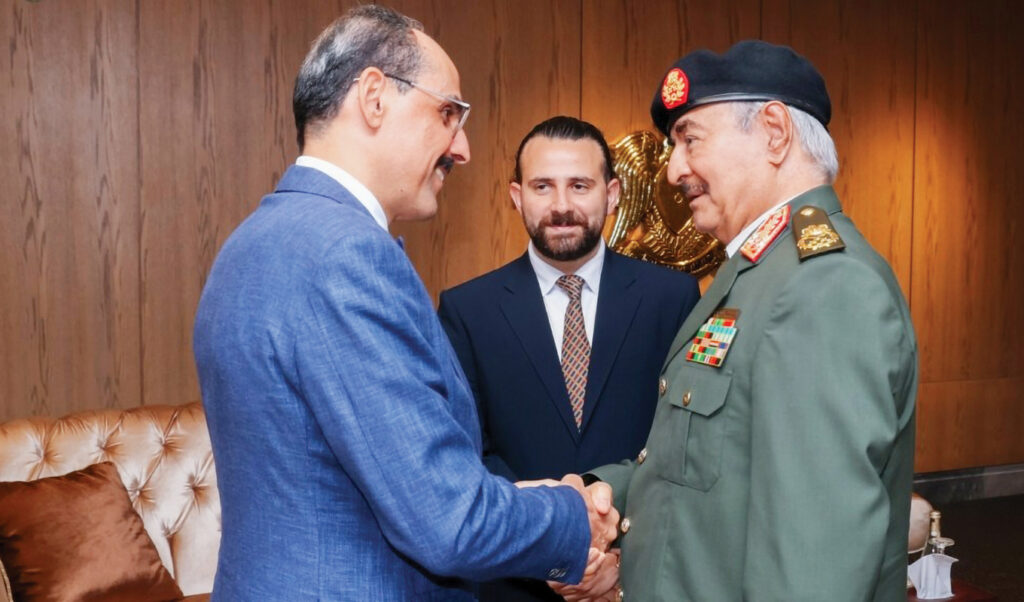
Turkey’s ultimate goal is to convert Libya into its protectorate. Already, Tripoli under the pro-Turkish Abdulhamid al-Dbeibeh is considered Ankara’s “long arm” in the region. Now, Tayyip Erdogan has shown he is focusing on Benghazi. He “deployed” his most experienced and brilliant head of Secret Services (MIT), Ibrahim Kalin, who traveled to Eastern Libya and met with Haftar. It was the first meeting of a high-ranking Turkish official with Haftar.
The tête-à-tête took place hours after the Turkish corvette “Kınalıada” docked at Benghazi port, within the framework of strengthening military cooperation between Turkey and Libya, as well as a joint naval exercise. It’s estimated that Kalin pressured Haftar so that the Libyan Parliament would “fast-track” the issue of ratifying the Turkish-Libyan agreement, while he also met with the son and deputy commander of the marshal’s forces, Saddam Khalifa Haftar. In their conversation, both sides discussed joint actions they could undertake for Libya’s unity and the creation of a unified Army. Also present were Turkey’s ambassador to Libya, Güven Begec, and the consul in Benghazi, Serkan Kiramanlioglu. After the crucial meeting, Haftar’s son and General Saddam visited the Turkish warship at Benghazi port. Besides Saddam, Kalin also met with Haftar’s other son, Belgasim Khalifa Haftar, general director of Libya’s Development and Reconstruction Fund.
Georgios Gerapetritis also had contacts with father and sons Haftar a month earlier. Referring to his July meetings and the Ankara-Benghazi “flirtation,” the Foreign Minister stated on Open: “Today we are in a position to dialogue with Western Libya, so that we can proceed with a delimitation between Greece and Libya. That is, to do what International Law provides. Greece and Libya have directly opposite coasts, which Turkey doesn’t have. As for the Eastern Libya issue, we never cut the channels, the channels continued to exist. You saw, I think, the way I was received in both Eastern and Western Libya during my recent visits. There will also be visits by Libyan officials in the future, the ties weren’t severed.” Greece, indeed, will attempt this fall to begin talks for EEZ delimitation with Libya, in order to save what can be saved. However, it’s difficult to put a brake on the normalization of Ankara-Benghazi relations. The crucial thing is not to lose our most stable and valuable ally in the region. Namely… Egypt.
Bloomberg: Energy cooperation between the two countries is “cooking”
Bloomberg reports that Kalin’s visit to Libya indicates that energy cooperation between the two countries is “cooking,” meaning hydrocarbon exploration that would reach as far south as Crete, “stepping on” the Turkish-Libyan memorandum. “If the agreement is ratified (by the Libyan Parliament), it could give the green light for oil and natural gas exploration by Turkish ships in an area between Crete and Turkey, something that risks triggering a dispute with Greece and Cyprus, which accuse Turkey of seeking sovereignty in disputed waters,” Bloomberg concludes.
Published in Parapolitika